Labs: 3 Traceability Checks for Peptide COA Interpretation

A peptide Certificate of Analysis is only as useful as three checks confirm: the lot number and analysis date match the vial in hand, mass spectrometry identity data shows the observed mass close to theoretical, and an HPLC chromatogram with its peak table shows the purity claimed. For anything injectable, endotoxin and sterility results need to appear too, within stated limits, before the lot gets used.
TL;DR:
- Single quadrupole MS commonly allows a 1 to 2 Da spread, while high resolution instruments require tighter accuracy; compare observed mass with the stated tolerance.
- HPLC purity measures peak area, not usable peptide mass; request water and counter ion results when accurate milligram amounts matter for dosing or assays.
- For injectable use, require endotoxin and sterility results with stated limits, and quarantine the lot if either test is missing or cannot be confirmed.
- Verify suspicious reports with the issuing lab, then request raw chromatograms and full mass spectra to check the summary results.
- A sterility pass applies only to sampled units, while the COA records the lot’s condition on its analysis date, not after storage or handling.
Table of Contents
- What a peptide COA is and what it can’t prove
- How to read identity (MS) and purity (HPLC) data
- Net peptide content, water, and counter-ions
- Interpreting endotoxin and sterility results
- Red flags and how to verify a suspect COA
- A practical checklist before using a peptide lot
- What independent lab verification has taught us
- An adjunct resource for vendor-level verification
- FAQ
- Sources
What a peptide COA is and what it can’t prove
A COA is a batch-specific lab report. It ties a defined set of tests, identity, purity, sometimes safety screening, to one lot number and one analysis date. It is not a blanket statement about a peptide’s quality across every batch a vendor has ever shipped, and it is not a guarantee that the vial you are holding matches the document unless the lot numbers agree.
It helps to separate three things that get blurred in casual reading: the test result (what the instrument measured), the specification or acceptance criterion (the range the result needs to fall within to pass), and the sample (the physical material that was actually tested). A COA that reports a result without stating the acceptance criterion gives you a number with no context for whether it is good, borderline, or out of range, as FDA guidance on ICH implementation frames it for batch-specific release testing.
A COA is also a snapshot. It reflects the material’s condition at the moment of testing, not after months of storage, temperature excursions, or repeated freeze-thaw cycles. Treat it as evidence for that lot at that date, not as a permanent quality warranty.

How to read identity (MS) and purity (HPLC) data
Identity and purity are two separate questions, and a COA needs to answer both before you trust the lot.
For identity, mass spectrometry compares the observed mass against the theoretical mass calculated from the peptide’s sequence. Look for the charge state reported (commonly M+H for singly charged ions) and whether the instrument used was single-quadrupole or high-resolution MS (HRMS). Tolerances differ sharply by instrument class: single-quadrupole systems commonly accept a spread of roughly 1 to 2 Da, while HRMS instruments report much tighter mass accuracy. A deconvoluted mass that lands within that stated tolerance of the theoretical value is a pass; anything wider deserves a question to the lab.
For purity, the HPLC chromatogram and its accompanying peak table need to agree. Check that the retention time of the main peak is reasonable for the method described, that peak-area percentage in the table matches what the trace visually shows, and that the baseline is clean rather than noisy or drifting. Peak tailing or shoulder peaks can indicate related substances or degradation products that a single purity percentage will not reveal on its own.
Pro Tip: HPLC purity measures area percent under one detection wavelength; it says nothing about identity on its own, which is why orthogonal MS data matters even when the chromatogram looks clean.
Multiple orthogonal methods, HPLC for purity, MS for identity, sometimes peptide mapping, are the standard approach because no single test closes every gap, a point ICH Q6B guidance makes explicit for biotechnological and biological products.
Watch for these suspicious presentations:
- Identical or repeating rounded purity values (99.2%, 99.2%, 99.2%) across unrelated batches.
- A chromatogram image whose peak shapes or retention times don’t match the numbers printed in the adjacent peak table.
- Purity reported with no MS data at all, leaving identity unconfirmed.
Net peptide content, water, and counter-ions
Purity percentage from HPLC tells you how clean the peptide is relative to other substances in the sample. It does not tell you how much of that vial’s mass is actually peptide. That number is net peptide content, sometimes called assay, and it’s calculated differently: mass-balance methods subtract water content and counter-ion mass from the total, while some labs use quantitative NMR or amino acid analysis for an independent cross-check, an approach USP’s guidance on peptide reference standards treats as methodologically distinct from chromatographic purity.
Residual water and counter-ions like TFA or acetate, left over from synthesis and purification, add mass without adding peptide. A vial that is 99% pure by HPLC can still deliver meaningfully less usable peptide per milligram once water and counter-ion weight are subtracted, which matters directly for dosing accuracy and concentration calculations in any assay (our earlier breakdown walks through exactly this gap).
If your work depends on precise usable mass, request the water percentage and the counter-ion identity and percentage on the COA, not just the HPLC purity line.

Interpreting endotoxin and sterility results
For injectable or cell-based work, endotoxin and sterility entries on a COA carry as much weight as identity and purity. Endotoxin is typically reported via the LAL (limulus amebocyte lysate) assay in endotoxin units per milligram or per milliliter, with research thresholds set by the intended use. The LAL method is sensitive to interference from the sample matrix itself, so a result is only meaningful if the lab has demonstrated the assay is suitable for that specific material, a caveat tied to FDA cGMP expectations for endotoxin testing validation.
Sterility results are reported as pass or fail, but a pass applies only to the units actually sampled and tested, not to every vial in the lot, and it says nothing about contamination introduced after the vial is opened. Our sterility testing checklist covers the sampling limitations in more depth.
If a COA is missing endotoxin or sterility data entirely and the intended use is injectable, don’t assume it was simply omitted from the document. Contact the lab directly, confirm whether the test was run, and quarantine the lot until you have a clear answer.
Red flags and how to verify a suspect COA
Certain patterns show up repeatedly in fabricated or templated COAs, and spotting them early saves time:
- Missing lot number or analysis date, or a date that predates when the vendor claims to have received the batch.
- Identical rounded purity values across multiple, supposedly independent batches.
- A chromatogram image that visually conflicts with the numbers in its own peak table.
- No mass spectrometry data anywhere in the document.
- An issuing laboratory with no independent, verifiable presence outside the vendor’s own paperwork.
Pro Tip: Call or e-mail the issuing lab directly and quote the report number; a legitimate lab can confirm a result against its own records in minutes, while a fabricated one usually can’t be verified at all.
When something looks off, ask for the raw chromatogram file (.cdf or .raw) and the full MS spectra, not just the summary numbers, and request method details: column type, gradient, and detector wavelength. Confirm the run date and sample ID align with what’s on the vial. If the lab cannot produce raw data on request, or the answers contradict the COA, quarantine the lot and escalate to QA or procurement before it enters any protocol (our guide to requesting raw COA data walks through the exact questions to ask).
A practical checklist before using a peptide lot
Run through this sequence on receipt, before the lot goes anywhere near a protocol:
- Match the vial’s lot number and the COA’s report number and date.
- Confirm MS identity and cross-check the HPLC chromatogram against its peak table for consistency.
- Verify net peptide content, or request mass-balance data if your assay needs accurate peptide milligrams rather than purity percentage.
- Check endotoxin and sterility results for any injectable use, and quarantine the lot if either is missing.
- Archive the COA alongside your sample records, noting chain of custody from receipt onward.
This sequence takes a few minutes and catches the majority of documentation problems before they become experimental ones (our two-check verification walkthrough expands each step for lab use).
What independent lab verification has taught us
Running independent HPLC and MS testing across vendors exposes patterns that a single COA review never will, as explained in detail on Peppy&Me’s research-use-only peptide classification. The gaps repeat: method details left out entirely, chromatograms that look copy-pasted across unrelated lots, and endotoxin data that simply never appears for products clearly intended for injectable research use.
None of that replaces your own lot check. But cross-referencing a vendor’s published, independently verified results against what shows up on your own vial’s COA is one of the fastest ways to catch a mismatch before it costs you a batch of data.
— Ross
An adjunct resource for vendor-level verification
When you’re comparing vendors rather than checking a single lot you already hold, we publish independent, third-party HPLC and MS results across more than 200 verified peptide vendors, with daily price updates and purity rankings drawn from blind sample purchases, not vendor-submitted paperwork. Every result we publish goes up, including failures.
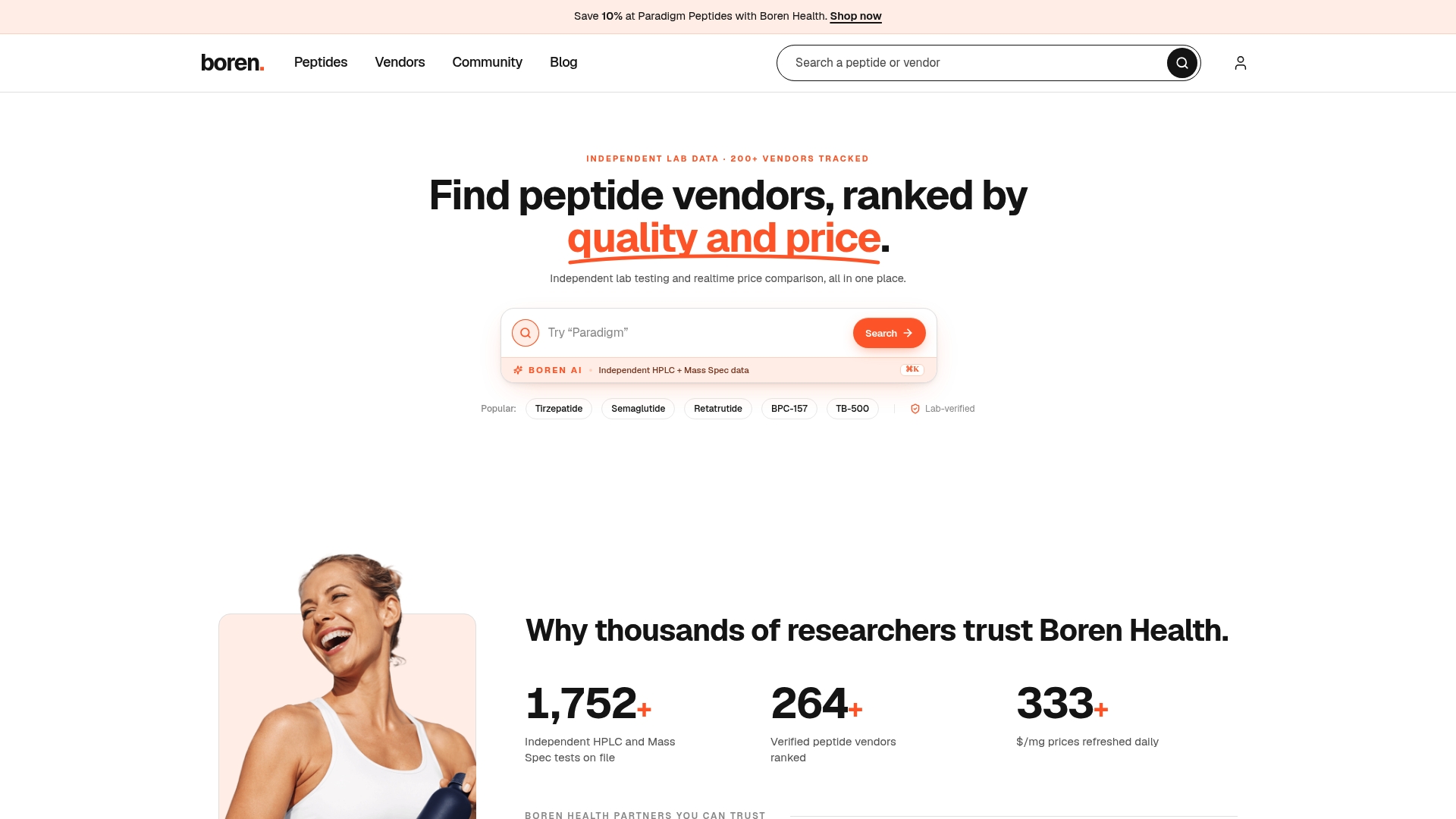
This data is a starting point for vendor comparison, not a substitute for the lot-level checks above: you still verify your own vial’s COA against its lot number, MS identity, and chromatogram every time. For a current comparison by category, see our peptide vendor rankings by goal, or check vendor verification services if you’re sourcing on behalf of a lab or procurement team.
FAQ
How to read a COA for peptides?
Start by matching the lot number and analysis date on the COA to the vial, then check the mass spectrometry section for observed mass against theoretical mass, and review the HPLC chromatogram alongside its peak table for purity. For injectable use, confirm endotoxin and sterility results are present and within stated limits before use.
What does COA mean in peptides?
COA stands for Certificate of Analysis, a batch-specific lab report that lists the identity, purity, and sometimes safety test results for one defined lot of material. It is tied to a single lot number and analysis date, not to the product generally, as outlined in FDA guidance on ICH-implemented standards.
How do I interpret C-peptide levels?
C-peptide blood levels are a clinical diagnostic measurement related to insulin production in a patient, which is a different concept from a peptide product’s Certificate of Analysis. If your question concerns a clinical C-peptide test result, that interpretation sits with a physician or clinical lab, not with COA documentation for research peptides.
How to tell if a COA is real?
A genuine COA shows a chromatogram that visually matches its own peak table, includes mass spectrometry data with a stated tolerance, and names an issuing lab that can be independently verified and will confirm the report number on request. Missing MS data, repeating rounded purity values across batches, or a lab with no verifiable presence are signs the document may be templated or fabricated.
What tolerance limits apply to peptide purity and identity?
Acceptance criteria are specific to the product and method used, so there is no single universal threshold that applies across all peptides, a principle ICH Q6A guidance sets out for specification-setting generally. Mass spectrometry tolerance also depends on instrument type, with single-quadrupole systems typically allowing a wider mass spread than high-resolution instruments.
Sources
- ICH Q6B guideline (Specifications for Biotechnological/Biological Products)
- USP — Reference standards to support quality of synthetic peptide therapeutics