COA Checklist to Verify Peptide Sterility Testing for Researchers
In this context, “peptide sterility testing” means independent HPLC and mass spectrometry verification of purity and identity, not a microbial contamination assay. The single highest-leverage step: demand a batch-specific third-party HPLC chromatogram plus an MS result that matches the lot number on your vial. A credible Certificate of Analysis shows three things at a glance: HPLC percent purity with the actual chromatogram, observed versus theoretical mass tied to a named instrument, and a lab name with a verifiable test ID.
TL;DR:
- Ensure each peptide batch includes a third-party HPLC chromatogram matching the lot number to verify purity beyond the percentage figure.
- Confirm that observed mass spectrometry data aligns within ±1 Dalton of the theoretical mass, especially for complex sequences or substitutions.
- Understand that a high HPLC purity percentage does not indicate the actual usable peptide content, which can be reduced by salts and moisture, often by 10-15%.
- Review detailed COA information, including testing lab identity, lot number match, method transparency, and accreditation scope to validate result credibility.
- Recognize that sterility testing methods, such as membrane filtration or direct inoculation, assess different quality aspects and require proper sample handling to avoid false positives or negatives.
Table of Contents
- Interpreting HPLC Results on a Peptide COA
- What Observed vs Theoretical Mass Tells You About Identity
- Net Peptide Content: The Number Vendors Don’t Want to Talk About
- A Step-by-Step COA Verification Flow
- Verifying Laboratory Accreditation Before You Trust a Result
- Sterility Testing Methods Peptide Manufacturers Rely On
- Regulatory Standards That Govern Peptide Quality Testing
- Handling Samples Correctly Before Any Contamination Test
- Why Peptides Present Unique Sterility Testing Challenges
- Reading Contamination Test Results Without Overreacting
- Keeping Peptides Sterile from Synthesis Through Packaging
- Why Aggregated Lab Data Changes How You Evaluate Vendors
- Compare COAs or Submit a Sample on Borenhealth
- Sources
Interpreting HPLC Results on a Peptide COA
Reverse-phase HPLC purity is an area-under-the-curve calculation. The lab injects your peptide, runs it through a column, and measures how much of the UV-absorbing material elutes as your target peak versus everything else, including truncated sequences, oxidized variants, and synthesis byproducts. That percentage depends heavily on integration settings, run length, and detection wavelength, which is why the same sample can report differently between two labs using different methods.
A trustworthy chromatogram shows a single sharp main peak with a retention time that lines up against a reference standard. Watch for late-eluting shoulders or undisclosed secondary peaks that got quietly excluded from the integration.
Pro Tip: A purity number without the chromatogram image is a claim, not evidence. Ask for the image every time.
Research-grade material commonly reports HPLC area percent at 98% or higher, but a round number like exactly 99% or 98% across every batch a vendor sells should raise your eyebrows. Real synthesis runs have variance. Identical numbers across dozens of lots usually mean someone copied a template rather than ran a fresh analysis.
Before trusting a reported purity figure, check for:
- The column type and dimensions used for the run
- The gradient profile and total run time
- The detection wavelength (typically 214 nm for peptide bonds)
- Whether the lab discloses its integration parameters, not just the final percentage
HPLC area percent is a proportion of detected material, and it does not by itself confirm that the peak is your intended peptide at all. That confirmation is mass spectrometry’s job.
What Observed vs Theoretical Mass Tells You About Identity
HPLC tells you how clean a sample is. Mass spectrometry tells you whether the clean thing is actually the peptide you ordered. A peak can be sharp and 99% pure and still be the wrong molecule if a synthesis error swapped one amino acid for another with similar hydrophobicity.
Labs report MS data using a few common platforms, and each gives you a slightly different picture. ESI-LC-MS typically shows a deconvoluted mass alongside the chromatogram in the same run. MALDI-TOF gives a fast, single mass reading, useful for a quick identity check but less precise on complex mixtures. QTOF and other high-resolution instruments report mass with parts-per-million accuracy, tight enough to catch a single-atom discrepancy.
For most research peptides under roughly 3 kDa, observed mass should land within about ±1 Dalton of theoretical mass. A gap beyond 2 Da is a real signal, not rounding error. It usually points to a missed deprotection step, an incomplete coupling, or a substituted residue somewhere in the chain.
When you’re evaluating a COA, look for:
- The specific instrument model or tier, not just “MS confirmed”
- Both the observed and theoretical mass values side by side
- A stated tolerance or agreement window, ideally in Da or ppm
- MS/MS fragment mapping when the sequence itself needs verification, not just the total mass
A combined RP-HPLC plus LC-MS/MS workflow is the standard for orthogonal identity and purity confirmation, and high-resolution instruments become essential when a single amino acid substitution needs to be ruled out.
Net Peptide Content: The Number Vendors Don’t Want to Talk About
A 99% HPLC purity result tells you almost nothing about how much actual peptide is in the vial. That number describes the ratio of your target peak to everything else detected by UV absorbance. It says nothing about counterions, bound water, or inorganic salts riding along with the peptide mass.
Net peptide content is the percentage of the total powder weight that is actually peptide, once you strip out trifluoroacetate (TFA) counterions, residual moisture, and leftover synthesis salts. A peptide synthesized with TFA as a counterion can lose 10 to 15% of its labeled weight due to that salt alone. Add in moisture absorbed during shipping and storage, and a vial labeled “5 mg” might contain closer to 4 mg of actual peptide.
Labs measure this a few ways: amino acid analysis (AAA) hydrolyzes the peptide and quantifies individual residues, quantitative NMR (qNMR) measures peptide concentration against a reference standard, and mass-balance approaches back-calculate content from combined purity, moisture, and counterion data.
When dose accuracy actually matters for your work, check for:
- Stated mg recovered, not just mg ordered or labeled
- Karl Fischer moisture content or an equivalent residual water measurement
- Disclosed salt form (TFA, acetate, or free base)
- AAA or qNMR data if you’re doing anything dose-sensitive
Pro Tip: Two vendors can both report 99% HPLC purity on the same peptide and still differ by 15% in actual usable mass. Always ask which number you’re looking at.
A Step-by-Step COA Verification Flow
Run through a COA in the same order every time, because skipping straight to the purity percentage is exactly how bad documents get approved.
- Confirm lab identity and test ID. A named laboratory with a searchable, verifiable test ID beats an anonymous PDF every time.
- Match the lot number. The lot on the COA must match the lot printed on your physical vial. No match means the document isn’t proof of anything you’re holding.
- Check the HPLC chromatogram and method. Look for the actual image, plus column, gradient, and wavelength details.
- Review MS observed mass and instrument tier. Confirm the tolerance window and which instrument generated the reading.
- Verify mg recovered and salt form. This tells you what you’re actually paying for versus what’s on the label.
- Note the testing date and analyst. Recent testing on the specific lot matters more than a generic “typical results” sheet.
- Verify accreditation. Confirm any claimed ISO/IEC 17025 scope independently rather than taking a vendor’s word for it.
Watch for these red flags: unattributed COAs with no lab name, suspiciously rounded purity numbers repeated across every batch, missing lot matches, no MS data at all, absent method details, or no mg recovered figure. A useful reading order mirrors actual failure frequency: lot number first, then mg recovered, then the mass field, then salt form, then purity percentage last, since purity is the number vendors polish hardest and verify least.
If two or more critical fields are missing, escalate. Request an independent blind re-test or refuse the vendor outright rather than assuming good faith.
Verifying Laboratory Accreditation Before You Trust a Result
ISO/IEC 17025 is the internationally recognized standard for testing laboratory competence, and it’s the credential most credible peptide-testing labs will cite. The problem is that accreditation isn’t a blanket stamp. A lab can be accredited for one method or matrix and completely unaccredited for the specific peptide assay on your COA.
Scope matters more than the badge. A lab accredited for pharmaceutical tablet dissolution testing isn’t automatically qualified, in accreditation terms, to run peptide identity confirmation by LC-MS/MS. Always ask which specific tests fall under the lab’s accredited scope, not just whether the lab holds accreditation at all.
Verification is public and free. The ILAC MRA directory links to national accreditation bodies where you can search a lab’s name and see its actual accredited scope, not the marketing summary on its own website. This step takes maybe five minutes and eliminates an entire category of vendor overstatement.
Don’t rely on a certificate graphic or a logo pasted into a COA footer. Anyone can copy an accreditation badge into a PDF. The register is the only source that confirms current status. If a lab’s scope doesn’t cover the assay it claims to have run on your peptide, treat the result as unverified regardless of how polished the paperwork looks.
Sterility Testing Methods Peptide Manufacturers Rely On
Peptides intended for injectable or research use in sterile conditions typically go through one of two standard approaches: membrane filtration or direct inoculation. Membrane filtration passes the sample through a filter fine enough to trap microorganisms, then incubates the filter in growth media to check for colony formation. Direct inoculation adds the sample straight into a culture medium and watches for turbidity or growth over an incubation period, usually 14 days.
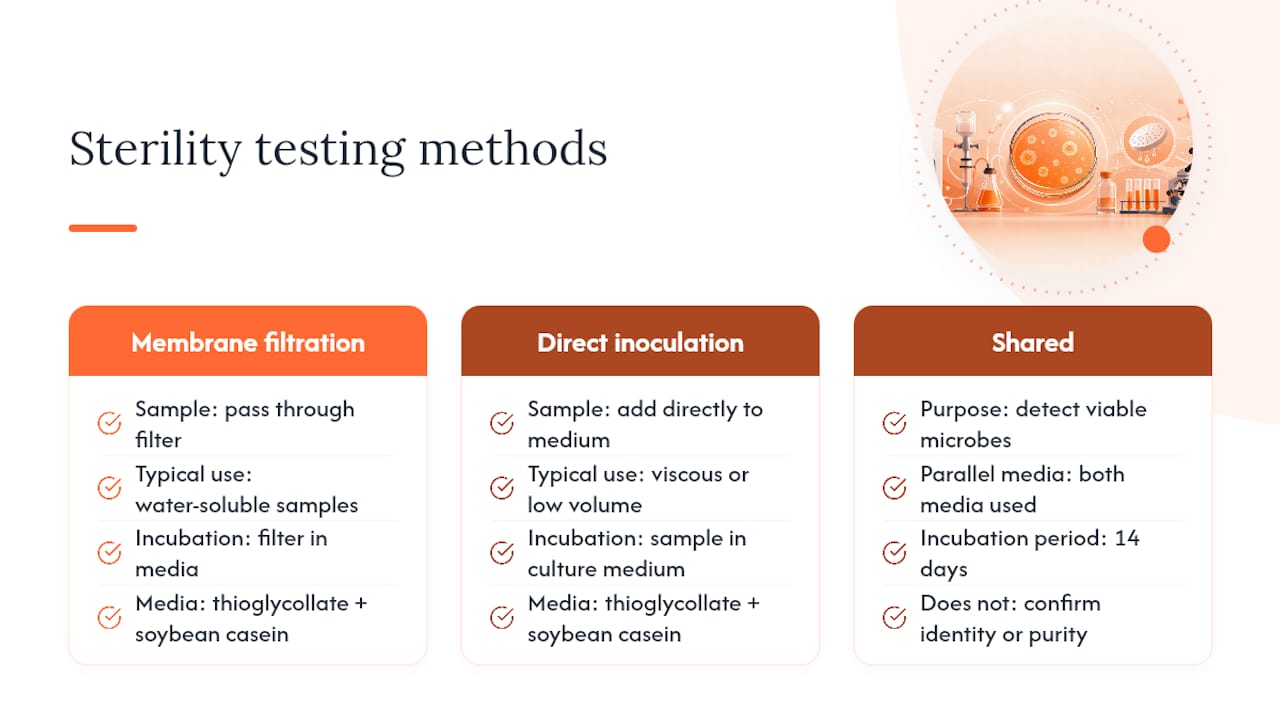
Membrane filtration tends to be the preferred method for water-soluble peptide solutions because it physically separates any contaminants from inhibitory substances that might otherwise mask microbial growth in the test itself. Direct inoculation gets used when filtration isn’t practical, such as with certain viscous or low-volume preparations.
Both methods require parallel testing against fluid thioglycollate medium and soybean casein digest medium to capture a broad range of aerobic, anaerobic, and fungal organisms. Neither method confirms peptide identity or purity. They confirm the absence of viable microorganisms in the tested sample, which is a separate quality dimension from the HPLC and MS verification this article focuses on.
For peptide buyers evaluating vendor claims, the practical takeaway is that HPLC and MS purity data and microbial testing data answer different questions entirely. A vendor citing one shouldn’t be assumed to have run the other, and a COA focused on purity and identity won’t mention sterility status at all unless the product is specifically marketed for sterile applications.
Regulatory Standards That Govern Peptide Quality Testing
Peptide quality testing in research and pharmaceutical contexts draws from a handful of overlapping frameworks. The FDA doesn’t maintain a peptide-specific testing mandate for research-use materials, but any peptide moving toward clinical or drug development pathways falls under current Good Manufacturing Practice (cGMP) expectations, which require documented, validated analytical methods for identity, purity, and strength.
The United States Pharmacopeia (USP) publishes general chapters that labs reference for method validation, including guidance on chromatographic methods and mass spectrometry identity confirmation. The European Pharmacopoeia (EP) runs a parallel set of monographs, and many peptide-specific compounds now have individual EP monographs specifying acceptable purity thresholds and test methods.
None of these frameworks legally require a research-use peptide vendor to publish a COA at all. That’s a voluntary transparency practice, not a regulatory mandate, which is exactly why COA quality varies so wildly across the market. A lab following USP-referenced chromatographic method validation principles produces a fundamentally more trustworthy chromatogram than one running an undisclosed, unvalidated method.
For buyers, the practical use of these standards isn’t citing chapter numbers. It’s recognizing that labs which reference USP or EP method principles in their reporting, and disclose validation parameters, are operating closer to a pharmaceutical quality mindset than vendors handing out a bare percentage with no method behind it.
Handling Samples Correctly Before Any Contamination Test
Contamination testing is only as good as the sample handling that precedes it. A peptide sample exposed to unfiltered air, handled with bare hands, or reconstituted with non-sterile water can pick up microbial contamination that has nothing to do with how the peptide was actually manufactured, producing a false positive that wrongly implicates the vendor.
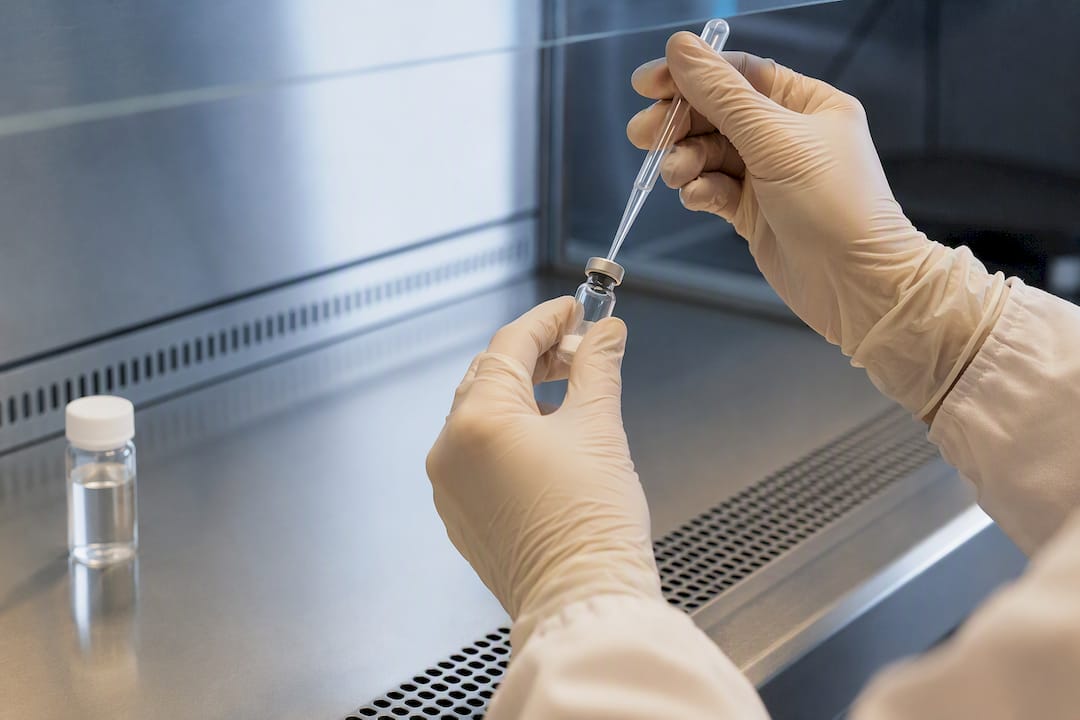
Proper procedure starts with a laminar flow hood or an equivalent controlled environment for opening and subsampling. Analysts work in gloves, use sterile diluents, and sanitize every surface the sample vial touches before it’s cracked open. Reconstitution, when required, uses validated sterile water for injection rather than tap or standard lab-grade water, since either can carry bacterial load invisible to the naked eye.
Sample transport and storage temperature matter too. A peptide sample that sits at room temperature for days before testing, or gets shipped without proper cold-chain handling, can develop microbial growth that reflects storage conditions rather than the original manufacturing environment. Chain-of-custody documentation, tracking exactly who handled the sample and when, protects both the testing lab and the vendor from disputes over where contamination actually originated.
For researchers submitting their own samples for any third-party testing, the same logic applies at a smaller scale: use the vial’s original sterile packaging where possible, avoid repeated freeze-thaw cycles before shipping, and ship with appropriate temperature control rather than assuming ambient shipping is good enough for a sensitive biological sample.
Why Peptides Present Unique Sterility Testing Challenges
Peptides sit in an awkward middle ground between small-molecule drugs and larger biologics like monoclonal antibodies, and that middle ground creates real testing headaches, as explained in this review of peptide serums. Peptides are often more sensitive to pH shifts and temperature than small molecules, but they lack the complex tertiary structure that makes some biologics naturally resistant to certain preservation methods.
One specific challenge: peptides can have inherent antimicrobial or growth-inhibitory properties depending on sequence and charge. Some cationic peptides actively suppress bacterial growth in a way that can mask contamination during direct inoculation testing, producing a false negative where microorganisms are present but not visibly growing in the test media. Labs experienced specifically with peptides know to account for this with inhibition-neutralization steps that a lab used to testing standard small-molecule drugs might skip entirely.
Peptides also degrade faster than many biologics once removed from controlled storage, which narrows the testing window. A monoclonal antibody might tolerate days at room temperature during shipping and testing logistics with minimal impact. Many peptides start losing structural integrity within hours under the same conditions, which means contamination testing has to happen on a tighter timeline or the results start reflecting degradation artifacts rather than true microbial status.
Scale is another factor. Biologics manufacturing typically happens in large, heavily monitored bioreactor systems with continuous environmental monitoring. A lot of peptide synthesis, especially for research-use suppliers, happens at smaller scale with less continuous oversight, which increases the odds that any single batch has inconsistent handling compared to the batch before it.
Reading Contamination Test Results Without Overreacting
A sterility or contamination test result is binary at the surface: growth or no growth. But interpreting what that binary result actually means requires context most buyers never see.
A “no growth” result over the full incubation period, typically 14 days for standard sterility methods, is a reasonably strong indicator of absence of viable contamination in the tested sample size. It is not proof the entire batch is contamination-free, since sterility testing by nature samples a fraction of the lot rather than every unit.
A “growth” result needs troubleshooting before you assume the peptide itself is the source. The first question is always whether the growth reflects a false positive from sample handling. Labs look at what organism grew, since common skin or environmental flora, such as certain Staphylococcus species, often point to contamination introduced during sampling rather than during manufacturing. A more unusual environmental organism, on the other hand, points more strongly toward a genuine manufacturing or packaging failure.
Repeat testing on a fresh sample from the same lot, handled under stricter aseptic conditions, is the standard next step when a first result is ambiguous. If the repeat test also shows growth, that’s a real signal the lot has an actual contamination problem rather than a handling artifact, and it should trigger a full lot investigation rather than a quiet retest-and-move-on.
For buyers who aren’t running these tests themselves, the practical lesson is patience with the process. A single ambiguous result from any vendor’s internal testing shouldn’t be read as automatic proof of a bad batch, but a vendor unwilling to explain their retest protocol or share raw incubation data should raise real concern.
Keeping Peptides Sterile from Synthesis Through Packaging
Sterility isn’t something you test into a product after the fact. It has to be built in at every stage, starting with the synthesis environment itself. Reputable manufacturers run solid-phase peptide synthesis and downstream purification in controlled cleanroom classifications appropriate to the product’s intended use, with continuous particulate and microbial environmental monitoring.
Purification and lyophilization (freeze-drying) are especially sensitive stages, since the peptide is exposed to open vessels and transfer steps where airborne contamination risk spikes. Facilities handling injectable-grade peptides typically use isolators or restricted-access barrier systems (RABS) during these transfer points, rather than relying purely on open cleanroom benchwork.
Final packaging matters just as much as the manufacturing steps before it. Vials need validated sterilization before fill, and the fill-finish process itself, whether manual or automated, is one of the highest-risk contamination points in the entire chain because it’s the last moment product is exposed before sealing. Terminal sterilization, where the sealed final product undergoes a validated sterilization step, offers stronger assurance than aseptic processing alone when the peptide’s chemistry can tolerate it, though many peptides are too heat-sensitive for terminal methods and depend entirely on aseptic technique throughout.
None of these upstream practices are visible to a buyer looking at a finished vial. That’s exactly why documentation, batch records, environmental monitoring logs, and validated process parameters, matters more for sterility assurance than any single test result on a single lot. A vendor that can produce that documentation on request is operating a fundamentally different quality system than one that can’t.
Why Aggregated Lab Data Changes How You Evaluate Vendors
Vendor trust in the peptide market is broken because verification has historically required buyers to either take marketing claims on faith or commission their own testing lot by lot. An aggregate platform that pulls independent HPLC and MS results, vendor ratings, and daily pricing across numerous verified sources into one comparison view exists to close that gap.
Aggregated, batch-level data reduces the trust problem to a research question instead of a leap of faith. When you can see purity and mass data across multiple vendors selling the same compound, reproducibility in your own dosing and potency work stops depending on which single vendor’s marketing you happened to believe.
— Ross
Compare COAs or Submit a Sample on Borenhealth
Reading a COA is only useful if you can compare it against something. An independent platform pulls lab-verified HPLC and mass spec results across numerous vendors into one place, so you can check purity and identity data side by side before you buy instead of after.

If a vendor’s COA is missing critical fields, or you just want a second opinion on a batch you already have, Borenhealth’s independent sample testing service runs the same HPLC and MS verification described throughout this guide on your actual sample. You get a lab-verified result tied to your lot number, not a generic reference document. Start by browsing current vendor ratings and lab results to see how the compounds you’re sourcing stack up, then submit a sample if you want batch-specific confirmation before your next purchase.