20 Minutes to Verify Peptide Purity: Two Lab Checks for Researchers
The minimum reliable check for any research peptide is two tests, not one: reverse-phase HPLC for area-percent purity, and mass spectrometry for identity confirmation. Everything else, amino acid analysis, residual TFA quantitation, endotoxin testing, NMR, gets added based on how much the experiment depends on exact dosing or biological activity. If the certificate of analysis is missing method details behind either core test, treat the purity number as unverified.
TL;DR:
- Confirm that peptide purity is verified with both reverse-phase HPLC and mass spectrometry tests, not just one, for reliable quality assessment.
- Ensure the HPLC method includes detailed metadata such as column type, gradient profile, detection wavelength, and run time to validate purity claims.
- Use mass spectrometry to confirm peptide identity and detect modifications or impurities that HPLC alone cannot distinguish.
- Measure absolute peptide content separately from purity, especially when precise dosing is critical, and request residual TFA quantitation for TFA salts.
- Verify peptide batch authenticity with independent testing upon receipt, focusing on mass spectrum and chromatogram consistency to prevent lot-to-lot variability issues.
Table of Contents
- How to Verify Peptide Purity With RP-HPLC Numbers
- Why Mass Spectrometry Confirms What HPLC Cannot
- What Absolute Peptide Content and Residual TFA Actually Tell You
- What Should You Check the Moment a Peptide Batch Arrives?
- Common Ways Purity Claims Get Misread
- When Should You Order Independent Peptide Testing?
- Where to Read More on Peptide Purity Methods
- The Checklist Beats the Certificate
- Sources
How to Verify Peptide Purity With RP-HPLC Numbers
Reverse-phase HPLC is the workhorse test, and the number it spits out, “98.2% purity” or similar, is an area percent. That figure represents the fraction of total UV absorbance sitting under the main peak relative to everything else on the chromatogram. It is not a direct measure of how much actual peptide is in the vial. It is a measure of how clean the separation looks under one specific set of run conditions.
That distinction matters because area percent is method-dependent. Two labs running the same batch can report different purity values if their columns, gradients, or integration settings differ, which is exactly why a real COA lists HPLC method metadata rather than just a bare percentage.
A COA worth trusting includes:
- Column type and particle size (commonly C18, 3 to 5 micron)
- Mobile phase composition and gradient profile
- Detection wavelength, usually 210 to 220 nm for peptide bonds
- Total run time and injection volume
- Integration parameters or at least a note that default thresholds were used
Pro Tip: If a vendor’s COA shows a single sharp peak with no visible baseline noise and no stated run time, ask for the raw chromatogram. A suspiciously clean trace on a short gradient often means impurities never had time to separate from the main peak, a problem analysts call co-elution.
If something looks off, a compressed baseline, an unusually short run, ask the vendor to rerun the sample on a longer gradient or share the integration parameters. Legitimate labs keep this data on hand because they generate it for every batch anyway.
Why Mass Spectrometry Confirms What HPLC Cannot
HPLC tells you how clean the sample looks. Mass spectrometry tells you what the sample actually is. That second question matters more than most researchers assume, because a chromatogram can show a beautiful single peak that turns out to be the wrong sequence entirely, a truncated version, a deamidated variant, or a completely unrelated contaminant sitting at the same retention time.
Three MS approaches show up on peptide COAs:
- ESI-LC-MS, which couples liquid chromatography with electrospray ionization for routine intact mass confirmation
- MALDI-TOF, faster and simpler, common for quick identity checks without a separation step
- High-resolution instruments (Orbitrap, Q-TOF), used when ppm-level mass accuracy is needed to catch subtle modifications
LC-MS in particular does double duty: because it separates the sample before ionizing it, it can flag impurities that co-elute with the main peak on a UV-only HPLC trace and would otherwise go completely undetected. A good LC-MS report shows the extracted ion chromatogram at the expected charge state, the mass spectrum at the peak apex, and a deconvoluted neutral mass with stated accuracy in parts per million or daltons.
Pro Tip: Compare the reported mass to the theoretical mass for the sequence. A difference of about +16 Da usually points to oxidation; a shift matching one missing residue suggests a deletion product from synthesis. Either one is worth flagging before you run a dose-response study on that lot.
What Absolute Peptide Content and Residual TFA Actually Tell You
HPLC area percent measures how clean the peak looks. It says nothing about how much of the vial’s mass is actual peptide versus salt, water, or counterion. That second number is absolute peptide content, sometimes called net peptide content, and it is usually measured by amino acid analysis (AAA) or nitrogen analysis rather than chromatography.
The gap between the two numbers can be significant. Most synthetic peptides are isolated as TFA salts, and residual trifluoroacetic acid commonly makes up a significant fraction of the total mass in that salt form.
For work where dosing precision matters, ask vendors for:
- Salt form (TFA, acetate, or free base)
- Residual TFA quantitation, typically by ion chromatography or NMR
- Net peptide content by AAA, not just HPLC area percent
- Endotoxin testing (LAL or recombinant factor C) for anything touching cell culture or in vivo work
- NMR confirmation when structural verification beyond mass is warranted
Skipping any of these on a quantitative pharmacology project is how lot-to-lot variability quietly wrecks a dose-response curve.
What Should You Check the Moment a Peptide Batch Arrives?
Run this sequence before the material touches an experiment:
- Read the COA fields first. Confirm sequence, salt form, HPLC method details, and MS data are all present with a recent analysis date.
- Run a short RP-HPLC injection on the received material if your lab has the capability, even a quick gradient is enough to catch gross mismatches with the vendor’s reported trace.
- Acquire an intact mass spectrum. A single LC-MS injection confirming the expected mass takes minutes and catches wrong-sequence or degraded material immediately.
- Decide: accept, request reanalysis, or escalate. If the mass matches and the chromatogram looks consistent with the COA, proceed. If either disagrees, ask the vendor for a fresh COA before requesting outside testing.
- Log everything. Lot number, raw chromatogram, mass spectrum, and analysis date belong in a permanent lab record, not just an email attachment.
Pro Tip: Set a standing rule for quantitative pharmacology work: verify every new lot, not just every new vendor. A supplier can pass QC on one batch and drift on the next.
Common Ways Purity Claims Get Misread
Watch for these signatures when reviewing MS data:
- +16 Da shift from the theoretical mass, consistent with methionine or tryptophan oxidation
- Mass matching a missing residue, indicating a deletion peptide from incomplete coupling during synthesis
- Multiple unresolved peaks in the deconvoluted spectrum, suggesting a heterogeneous mixture rather than a single species
Red flags on the paperwork itself matter just as much as the data: no stated column or gradient, an analysis date more than a year old, an HPLC trace with no reported mass accuracy anywhere on the sheet. Any one of those is reason enough to ask for a fresh report before committing the batch to a study.
When Should You Order Independent Peptide Testing?
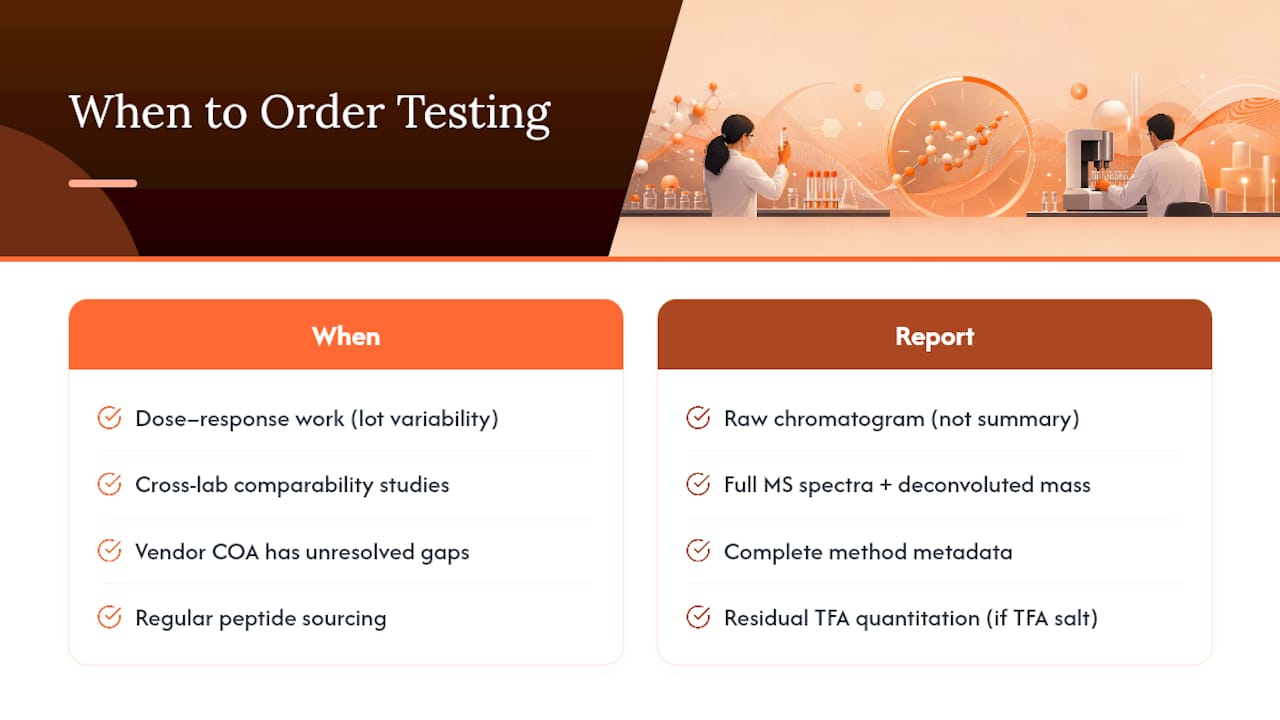
Independent testing earns its cost in a few specific situations: dose-response work where lot variability would confound results, cross-lab comparability studies, or any time a vendor’s COA has gaps that follow-up questions don’t resolve.
A report worth paying for includes the raw chromatogram, not just a summary number, full MS spectra with deconvoluted mass, complete method metadata, and residual TFA quantitation when the compound ships as a TFA salt. Anything less is a summary, not evidence.
This is the exact gap Borenhealth’s independent testing service was built to close. Researchers can commission third-party HPLC and mass spec analysis on a specific sample rather than relying solely on a vendor’s self-reported COA, and cross-reference results against lab-verified vendor comparisons covering more than 200 suppliers. For anyone sourcing peptides regularly, that combination turns “trust the paperwork” into “check the paperwork,” which is a meaningfully different position to run experiments from.
Where to Read More on Peptide Purity Methods
A few primary references cover the technical ground in more depth than any single article can:
- Compound Review’s breakdown of HPLC and mass spec standards explains exactly why a “98% pure” claim and actual peptide content by mass are two different numbers.
- Bachem’s quality control guide maps recommended purity grades to specific applications, useful for deciding how much purity a given experiment actually requires.
- Nexara Labs’ overview of MS, HPLC, and LAL testing makes the case for treating these as three orthogonal, non-substitutable checks rather than picking one.
- Institutional method primers, including materials from Cambridge’s medical school, offer technique-level detail on integration and mass accuracy for labs building out their own verification protocols.
The Checklist Beats the Certificate
That advice is backward. A COA is a claim, not a verification, and the entire point of running your own quick HPLC and mass spec check on arrival is that it costs a lab twenty minutes and catches problems a glossy PDF will never admit to.
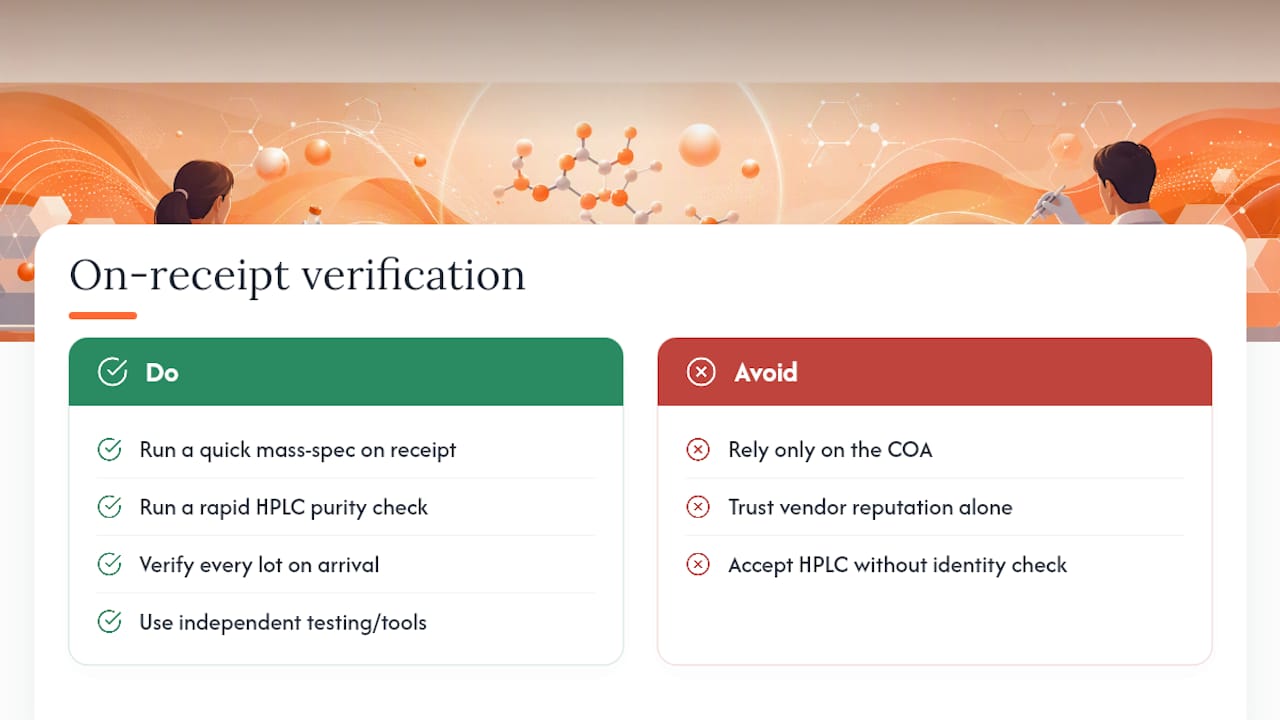
What gets underrated is how much of this risk is lot-specific, not vendor-specific. A supplier can pass every check on one batch and drift on the next because synthesis runs vary. That is why on-receipt verification, not vendor reputation alone, is the habit worth building.
If you take one thing from this, prioritize the mass spectrum. HPLC purity without an identity check is a clean-looking peak that might still be the wrong molecule. Independent testing and vendor comparison tools exist precisely because self-reported purity numbers, however professional they look, are still one party grading its own work.
— Ross
Sources
- HPLC vs Mass Spectrometry for Peptide Purity Testing: An Analytical Methods Guide | CertaPeptides (blog)
- Quality Control of Amino Acids & Peptides: A Guide | Bachem