6 COA Checks Labs Should Run to Verify Peptide Lot Consistency
Require a lot-specific certificate of analysis tied to the vial in hand, not a generic product-line document. Confirm identity with mass spectrometry (ideally MS/MS), check HPLC purity against a reported chromatogram, and verify net peptide content, not just area percent. Standards like CLSI C64 and independent platforms like Borenhealth exist precisely because these checks catch what a headline purity number hides. When a result will drive a quantitative conclusion, run an in-house check or send the vial to an independent lab before trusting it.
TL;DR:
- Confirm that the COA includes a lot number, test date, report number, and matching vial label to ensure batch-specific verification.
- Always verify the net peptide content and chromatogram images rather than relying solely on HPLC area percentages or summarized purity figures.
- Clear separation of identity (via mass spectrometry) and purity (via HPLC) is crucial, and combining multiple tests covers different quality aspects for reliable results.
- Insist on lot-specific documentation, traceability records, and compare chromatograms across lots to detect subtle shifts that generic assessments might miss.
- Use independent lab testing, especially for critical or high-stakes experiments, and keep frozen aliquots from each lot for future reference and troubleshooting.
Table of Contents
- What a Lot-Specific COA Actually Proves
- What to Check on Every COA You Receive
- How HPLC, Mass Spec, and Endotoxin Tests Actually Differ
- Why Vendors Test Some Lots and Not Others
- A Practical Workflow for Verifying Peptides on Arrival
- What a Trustworthy Independent Lab Report Includes
- When Full Batch Testing Is Worth It and When It Isn’t
- Check Vendor Lot Histories Before You Buy, Not After
- Sources
- FAQ
What a Lot-Specific COA Actually Proves
A certificate of analysis is a lab’s written statement that a specific batch of material meets stated specifications, and the operative word is specific. A genuine lot-level COA carries a lot number, a test date, a report number, and a testing lab’s identity, all tied to the exact vial you’re holding. A product-line COA, by contrast, describes a representative or historical batch. It tells you what the compound has looked like at some point, not what shipped to your bench this week.
That distinction changes what your data mean. If a vendor tests one lot per quarter and ships twelve, you’re trusting eleven vials to resemble the twelfth on faith. Impurity fingerprints can shift between lots even when the headline purity number stays flat, which means:
- Dose-response curves can shift subtly because actual peptide content varies lot to lot, even at identical nominal concentrations.
- Potency results that don’t replicate across cohorts sometimes trace back to a swapped lot, not biological noise.
- Structural impurities invisible in a single purity percentage can still interfere with binding or cell assays.
What to Check on Every COA You Receive
A COA is only useful if you know which fields carry real information and which are filler. Work through these in order:
- Product and lot identifiers. The lot number on the COA must match the vial label and the packing slip exactly. Any mismatch, even a single digit, is grounds for rejection.
- HPLC area percent. This tells you what fraction of UV-absorbing material belongs to the main peak, not what fraction of the vial’s mass is active peptide.
- Net peptide content (assay). This is the number that should actually drive your dosing calculations, and it’s frequently missing from vendor paperwork entirely.
- Counterion and salt form. TFA and acetate counterions plus residual moisture can knock a “98% pure” peptide down to roughly 70 to 80 percent by mass, so a purity claim without this context is incomplete.
- Chromatograms and spectra. A number without the underlying trace is a claim you can’t verify; ask for the actual image or raw file.
- Endotoxin/LAL or rFC results. For anything touching cell culture, know the reporting units (EU/mg or EU/mL) and the stated limit, not just a pass/fail flag.
How HPLC, Mass Spec, and Endotoxin Tests Actually Differ
Each of these three methods answers a different question, and no single one answers all of them. Confusing what they measure is one of the most common ways researchers overtrust a COA.
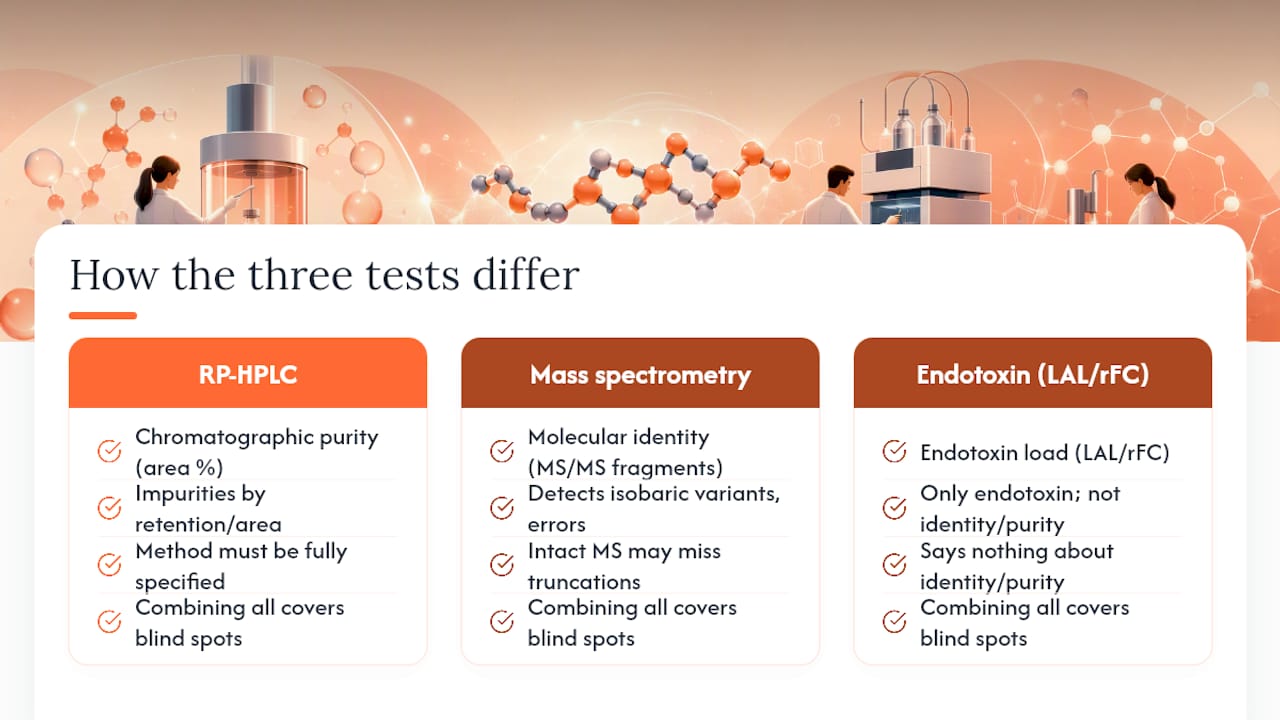
RP-HPLC reports chromatographic purity as an area percentage, but that number is only comparable across lots if the method details travel with it. Gradient, column type, and detection wavelength all shift retention times and peak shapes, so two labs running “the same” purity test can get different-looking chromatograms for identical material unless the method is fully specified.
Mass spectrometry confirms molecular identity, and MS/MS goes further by fragmenting the molecule to rule out isobaric variants, sequence errors, or truncated impurities that intact MS alone can miss. LAL or recombinant factor C (rFC) assays measure endotoxin load, full stop. They say nothing about identity or purity, and a clean LAL result next to a sketchy HPLC trace is not evidence of a good batch.
Pro Tip: Combining HPLC, mass spec, and endotoxin testing covers three independent blind spots that no single method resolves alone. Treat any one of them in isolation as a partial answer, not a verdict.
Why Vendors Test Some Lots and Not Others
Product-line testing characterizes a representative sample of a compound’s manufacturing history. Batch-level testing certifies the specific lot you’re about to receive. Vendors gravitate toward product-line testing because full batch-by-batch panels, especially with mass spec and endotoxin included, add real cost and turnaround time to every shipment, and many buyers never ask the difference.
That gap is exactly where lot-to-lot variability hides. Insist on these traceability items before you trust a shipment for anything quantitative:
- A lot number on the COA that matches the vial and the invoice, not just the product name.
- A report number and issue date you can reference if a discrepancy surfaces later.
- Documentation of sealed-sample provenance, meaning the tested aliquot can be traced back to the batch that shipped.
Overlaying chromatograms from consecutive lots is the fastest direct comparability check available, and it will surface shifts in minor peaks that a single purity percentage would never reveal.
A Practical Workflow for Verifying Peptides on Arrival
Set up a short protocol before shipments arrive so verification becomes routine rather than an afterthought.
- Administrative check. Confirm the lot ID on the vial matches the COA and packing list, the seal is intact, and there’s no visible discoloration, clumping, or gel formation.
- Quick analytical check. Run a short RP-HPLC pass and compare retention time and main peak area against the COA chromatogram; confirm mass by MS if your lab has bench access.
- Decision tree. If everything matches, log and proceed. If there’s a minor discrepancy, retest a second vial from the same lot before you conclude anything. If the mismatch is significant or the assay is quantitative, send the sample to an independent lab.
- Recordkeeping. Log every lot number against the experimental block it was used in, and keep a frozen aliquot from each lot so a later anomaly can be traced back to a specific vial rather than guessed at.
Pro Tip: A frozen aliquot costs almost nothing to store but can save weeks of debugging if a result won’t replicate six months from now.
What a Trustworthy Independent Lab Report Includes
When an in-house check flags a problem, or when the stakes of the assay simply justify it, send the sample out and treat batch traceability as part of your protocol, not an optional add-on. A useful third-party report includes sample provenance and chain of custody, the exact method identifiers used (column, gradient, MS mode), full chromatograms and spectra rather than summary numbers, integration tables, and a unique report number you can reference later.
Compare that report line by line against the vendor’s original COA. A discrepancy in retention time, an unexplained new peak, or a purity gap of more than a couple percentage points is enough to pause a study until it’s resolved. Chain of custody matters as much as the test itself: a seller-selected aliquot with no documented link back to your inventory isn’t independent verification, it’s just a second opinion on a different vial.
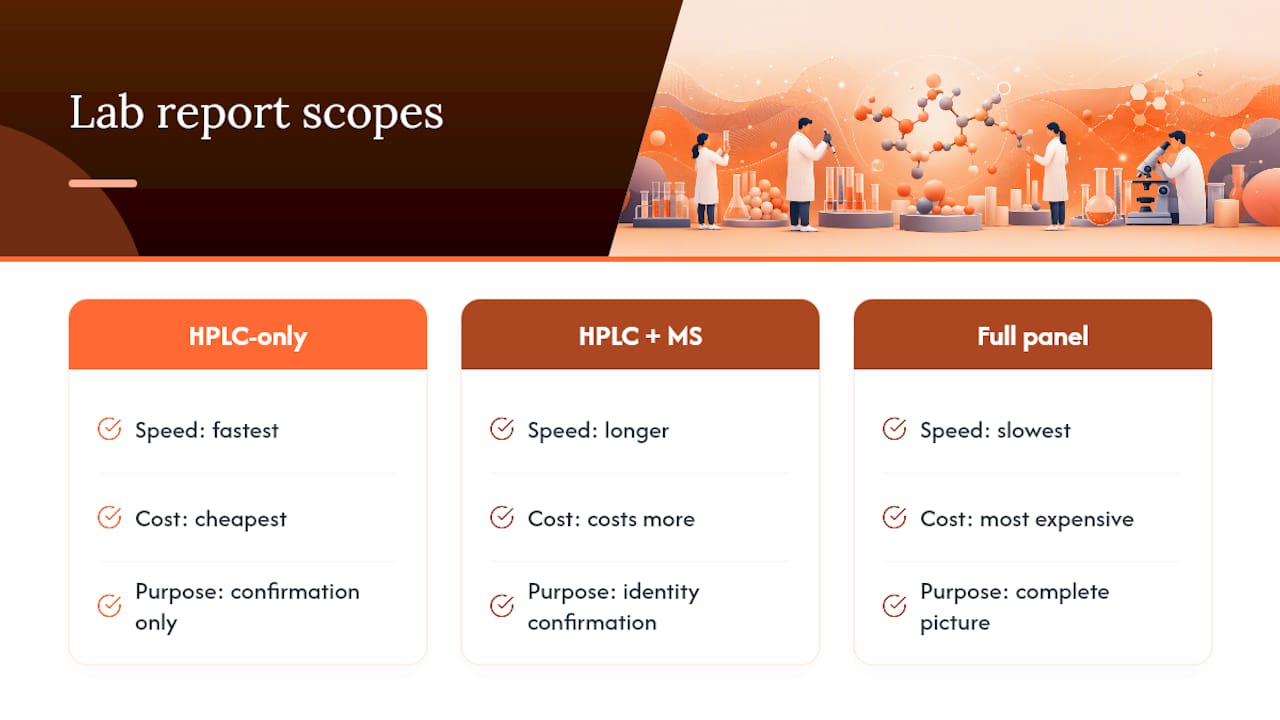
Turnaround and cost scale with scope. HPLC-only confirmation is the fastest and cheapest option. Adding mass spec for identity confirmation takes longer and costs more. A full panel with endotoxin testing is the slowest and most expensive, but it’s also the only version that gives you a complete picture.
When Full Batch Testing Is Worth It and When It Isn’t
Testing every lot makes sense for high-stakes quantitative work, dose-response studies, potency assays, anything feeding a publication or a regulatory submission. For broader exploratory screening, a documented sampling strategy plus a vendor’s provenance record is often a reasonable trade-off, provided you’re honest about the added uncertainty it introduces.
A recommended practice is to log every lot number in your methods section and keep aliquots for traceability. A discrepancy nobody can trace back to a specific vial is a discrepancy nobody can fix.
— Ross
Check Vendor Lot Histories Before You Buy, Not After
Most of the verification steps above assume you already have a vial in hand. There are platforms that check vendor testing history before you commit to a purchase by tracking independent HPLC and mass spectrometry results across many verified vendors, so you can see how a supplier’s lots have actually performed rather than relying on a single COA they chose to send you.
If you want a lot-specific answer for material you’ve already received, Borenhealth’s independent sample testing service runs HPLC and mass spec analysis on your actual vial for $100 per sample, one-off. For sourcing decisions, the vendor comparison database lets you check purity rankings and lab-verified results before you order. Vendors interested in listing verified lab data can review plans starting at $150 per month. If you’re evaluating a specific compound, browse lab-tested results by peptide to see how current lots stack up before your next order ships.
Sources
FAQ
How Can You Tell If a Peptide Has Gone Bad?
Look for visible clumping, discoloration, or a change in solubility compared to how the lot originally reconstituted. A peptide that won’t dissolve cleanly or forms a cloudy solution when the original lot didn’t is a strong signal to retest before use, not to guess.
How Do You Know If a Peptide Is High Quality?
High quality means the COA is lot-specific, includes both HPLC purity and net peptide content, and identity has been confirmed by mass spectrometry rather than by HPLC retention time alone. A vendor willing to provide full chromatograms and method details, not just a summary percentage, is a much stronger signal than the purity number by itself.
Is 98% Purity Good for a Peptide?
A 98% HPLC area percent result looks strong on paper, but it can still leave net peptide content as low as 70 to 80% once counterions and residual moisture are accounted for.
Why Does My Peptide Look Like Jelly After Reconstitution?
A gel-like texture usually points to peptide aggregation, often from concentration that’s too high, a pH mismatch with the peptide’s isoelectric point, or degradation from an off-spec lot. If a previous lot from the same vendor reconstituted normally, treat the jelly texture as a lot-consistency flag worth investigating with a fresh COA comparison or an independent retest.
What Does Borenhealth Cost to Use for Vendor Comparison?
Browsing vendor lab results and purity rankings on Borenhealth is free for researchers. Independent sample testing is available for $100 per sample, one-off, and vendors seeking listing plans can review current pricing on the vendor page.