Stop Wasting Weeks: Researchers' Five Minute Peptide Authenticity Check
Stop Wasting Weeks: Researchers’ Five Minute Peptide Authenticity Check
A peptide authenticity check is an independent confirmation that a vial matches its label, both in identity and purity, using analytical data you can trace back to a specific lab and instrument run. The first move is simple: pull up the Certificate of Analysis and confirm the batch or lot number matches your vial, then check that the COA links to a raw chromatogram and mass spectrum through a certificate ID or QR code. If it doesn’t, request the raw files or send a sample out for third-party testing before you use it.
TL;DR:
- Confirm the batch or lot number on the vial matches the COA and verify the certificate ID resolves to a genuine lab record with raw chromatogram and spectrum files.
- Ensure the COA includes method details such as column type, mobile phase, detection wavelength, and mass spectrometry data for proper validation of peptide identity and purity.
- Cross-check observed molecular mass against the theoretical mass within the instrument’s tolerance, and look for sequence confirmation through MS/MS fragmentation data.
- Be wary of COAs with missing raw data, suspiciously round purity percentages repeated across batches, or certificate links that do not resolve to an actual lab record.
- Use independent testing primarily for first orders, high-stakes work, or when vendor COA documentation lacks raw data or verifiable IDs for reliable authentication.
Table of Contents
- What Should Be on a Five-Minute COA Triage Checklist?
- What Fields Actually Belong On A Peptide COA?
- How Do HPLC, Mass Spectrometry, And Endotoxin Testing Actually Work?
- How Do You Verify A Vial Step By Step?
- Which Red Flags Mean You Should Stop And Investigate?
- When Should You Send A Sample For Independent Testing?
- Why Unverified Peptides Are A Reproducibility Problem, Not Just A Quality One
- Get Lab-Verified Data Before You Buy, Not After
- Where To Go For Deeper Technical Reading
- Sources
- FAQ
What Should Be on a Five-Minute COA Triage Checklist?
Most fake or padded COAs fall apart under five minutes of scrutiny, if you know where to look. Before trusting any certificate, run through this sequence in order:
- Batch and certificate ID. Confirm the lot number on the vial label matches the COA, and that a certificate ID or QR code resolves to an actual lab record rather than a static PDF.
- Raw data presence. Look for an actual chromatogram image and mass spectrum, not just a summary table with a purity percentage.
- Method parameters. The report should state column type, mobile phase, gradient, detection wavelength, and instrument model. A COA with no method section is telling you nothing verifiable.
- Mass match. Compare the observed mass against the theoretical mass for that peptide sequence. They should agree within the tolerance appropriate to the instrument used.
- Lab and analyst identity. A legitimate report names the testing lab, often an analyst or reviewer, and ideally an accreditation reference.
Genuine peak integration produces slightly irregular decimals, and identical COAs recycled across different orders are one of the more common signs of a copied or template document.
Pro Tip: Keep a saved folder of every COA you’ve ever verified, along with the certificate ID and the date you checked it. When a vendor’s “new” batch report looks suspiciously familiar, you’ll spot the recycled document in seconds.
What Fields Actually Belong On A Peptide COA?
Treat a COA as an evidence record, not a marketing sheet. Each field exists to prove a specific claim, and a missing field means that claim is unproven, not just unstated.
- Traceability fields: batch or lot ID and a sample ID that maps directly to the vial or order you received. If these numbers don’t match what’s printed on your product, the certificate isn’t for your material.
- HPLC data: a chromatogram image, the column used, mobile phase composition, gradient profile, and detection wavelength. Purity percentage is calculated from area-normalized peak integration, and peptide purity is typically measured at 214 to 220 nanometers, the range where peptide bonds absorb UV light most reliably.
- Mass spectrometry data: the observed mass-to-charge ratio, the deconvolved neutral mass, the instrument model, and the acquisition mode. When MS/MS fragment data is included, that’s stronger evidence of sequence identity than intact mass alone.
- Safety data: endotoxin levels in EU per milligram, sterility claims where relevant, residual solvent figures, and net peptide content (distinct from total peptide content, since salts and counter-ions add weight without adding active material).
A complete COA lists product identification, batch number, chromatogram with stated method parameters, and both observed and expected molecular weight alongside safety testing. Vague entries like “purity: high” or “tested for contaminants” with no numbers attached aren’t data. They’re filler dressed up to look like data, and you should ask the vendor directly for the missing specifics before you rely on the product.
How Do HPLC, Mass Spectrometry, And Endotoxin Testing Actually Work?
Each method answers a different question, and none of them substitutes for the others.
- HPLC (High-Performance Liquid Chromatography) separates compounds by how they interact with a column and mobile phase, then measures peak area to calculate purity. Co-eluting impurities can hide under the main peak and inflate the apparent purity number, which is why the wavelength and column details matter. Without them, you can’t judge whether the method was even capable of catching contaminants.
- Intact-mass MS confirms that the molecule’s overall weight matches what the sequence predicts. A mass match rules out large errors, wrong peptides, or major synthesis failures, but it can’t distinguish isomers (same atoms, different arrangement) and doesn’t prove the full amino acid sequence is correct.
- MS/MS (tandem mass spectrometry) fragments the peptide and reads the resulting pieces, giving genuine sequence-level evidence. Interpreting it well requires attention to fragment coverage, scoring thresholds, and false discovery rate, since database-search scores are method-dependent and shift with processing settings.
- LAL or rFC endotoxin testing measures bacterial endotoxin in endotoxin units per milligram (EU/mg). Neither HPLC nor MS can detect endotoxin. It’s a completely separate contamination pathway tied to manufacturing hygiene, not molecular structure.
A defensible batch characterization combines all three testing types: mass spectrometry for identity, HPLC for purity, and LAL or rFC for endotoxin. Skip one and you’ve left a documented blind spot in the report, no matter how clean the other two look.
How Do You Verify A Vial Step By Step?
Verification is a sequence, not a single glance at a percentage. Work through it in this order every time you receive a new batch.
- Match the sample. Confirm the lot number, sample ID, physical form, and COA issue date all line up with what’s in your hand. A COA dated months before your order, or listing a different lot, is a mismatch worth flagging immediately.
- Calculate expected molecular weight. Tools like ExPASy let you compute theoretical mass from a peptide’s amino acid sequence. Compare that number against the COA’s observed mass, allowing a small tolerance around the theoretical mass appropriate to the type of mass spectrometer used, per general instrument tolerance guidance.
- Read the chromatogram visually. A trustworthy result shows a single clean peak with a stable baseline and a retention time that’s plausible for the peptide’s size and hydrophobicity. Note the integration method and wavelength used.
- Verify traceability. Scan the certificate ID or QR code and confirm it resolves to a real lab record showing raw chromatograms, spectra, and analyst sign-off, rather than looping back to a generic vendor page.
- Decide whether to escalate. If any step fails, or if the material is going into a high-stakes experiment, send a retention sample to an independent lab for HPLC, LC-MS, and LAL testing.
Pro Tip: Before shipping a retention sample anywhere, label the vial with the original order ID and lot, photograph the sealed packaging, and use a tamper-evident seal. That chain-of-custody record is what makes a disputed result defensible later.
Which Red Flags Mean You Should Stop And Investigate?
Some issues are worth a follow-up email. Others mean you should not use the material until you get independent confirmation. Treat these as immediate-action triggers:
- No batch or lot number anywhere on the COA, or a lot number that doesn’t match the vial.
- Raw chromatogram or spectrum images missing, replaced only by a summary purity figure.
- Purity reported as a suspiciously round number, repeated identically across supposedly different batches.
- A certificate ID or QR code that doesn’t resolve, or points back to a marketing page instead of a lab record.
When HPLC purity looks fine but the mass spectrum shows an unexpected shift, don’t average the two results and call it good. Investigate the discrepancy directly, and ask whether MS/MS or peptide mapping was run to confirm sequence. Chromatogram shoulders, unusually early or late elution, or unresolved peak clusters usually point to synthesis byproducts or degradation, not measurement noise. Keep every verified COA, certificate ID, and any independent test report in a supplier quality file. It’s the record that makes your work reproducible and defensible if a result gets questioned later.
When Should You Send A Sample For Independent Testing?
Independent testing earns its cost in specific situations: first orders from a new supplier, experiments where a wrong result would waste weeks of work, and any compounding or preclinical application where impurity risk compounds downstream. The COA a vendor supplies only tells you what that vendor’s chosen lab reported. It doesn’t tell you whether that lab is honest, or whether the report was even generated from your batch.
A minimum-standard independent lab report should include:
- Raw chromatogram and spectrum files, not just cropped screenshots.
- Full method parameters: column, gradient, wavelength, and instrument model.
- An analyst review or sign-off, ideally with lab accreditation referenced.
- A certificate ID linked to a lab portal where the report can be reverified later.
Independent verification is considered best practice for critical-use materials specifically because it separates the testing lab from the selling vendor, removing the conflict of interest built into vendor-supplied paperwork. If you’re weighing which supplier to trust with a first order, Boren Health’s vendor comparison tool lets you check independent lab histories before you buy, and the test-sample service gives you a direct path to third-party verification when a vendor’s own COA isn’t enough.
Why Unverified Peptides Are A Reproducibility Problem, Not Just A Quality One
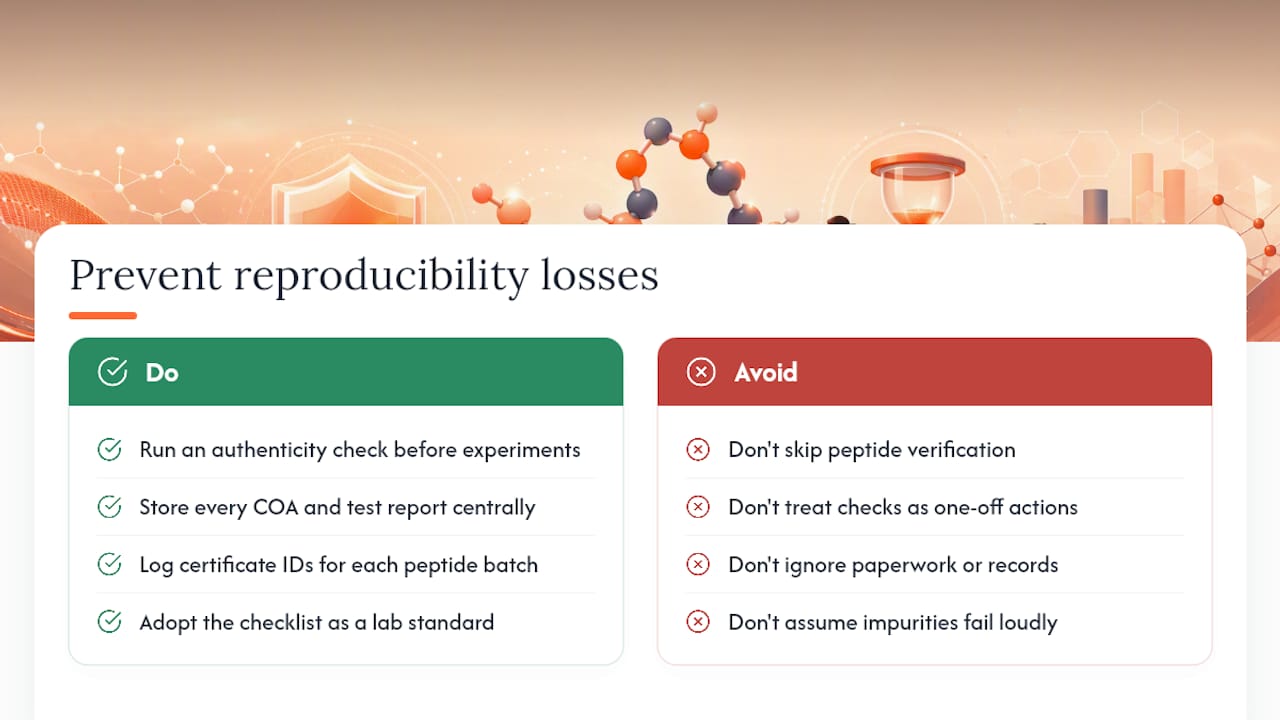
The real cost of skipping a peptide authenticity check isn’t a wasted vial. It’s the week or month you spend chasing a null result that was never about your hypothesis, it was about contaminated or misidentified material. Impure peptides don’t fail loudly. They fail quietly, producing inconsistent data that looks like biological noise until someone finally re-tests the batch.
Reproducibility in peptide research depends on paperwork as much as pipetting technique. Keep every COA, every independent test report, and every certificate ID you’ve verified in one place. That habit turns a one-time check into an institutional record, which matters the day a collaborator asks why your results don’t match theirs. Adopt the checklist above as a lab standard, not a one-off precaution.
— Ross
Get Lab-Verified Data Before You Buy, Not After
There are platforms available that offer researchers independent HPLC and mass spectrometry data on peptides, compared across many vendors, before money changes hands. Instead of relying on a single COA a seller chooses to show you, researchers can cross-check purity and identity data across suppliers and pick the ones with the cleanest independent records.
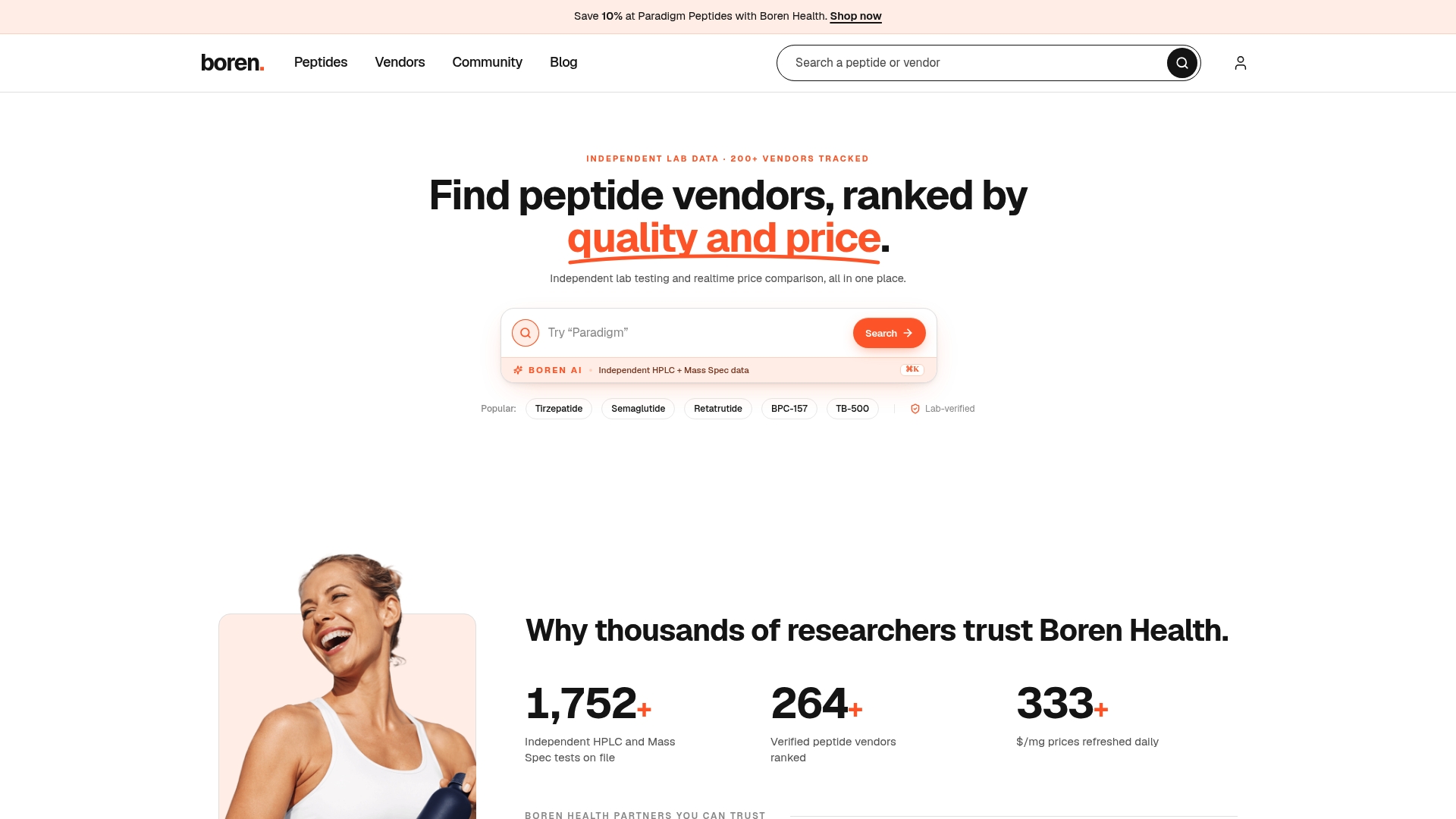
If you already have a vial in hand and the COA doesn’t hold up under the checklist above, order independent third-party testing directly and get raw chromatogram and mass spectrum data tied to your exact batch. For a first order from a new supplier, check verified vendor lab histories before you commit, so the authenticity check happens before the purchase instead of after a disappointing result.
Where To Go For Deeper Technical Reading
For readers who want to go past the checklist and into the underlying method science, these four sources cover the technical ground this article draws from:
- ApexLab’s explanation of mass spectrometry verification breaks down what intact mass and MS/MS each can and can’t prove.
- Nexara Labs USA’s piece on MS, HPLC, and LAL testing lays out why all three methods are needed together.
- PeptideVerify’s certificate verification hub lets you check a certificate ID or QR code against original lab records.
- PubMed’s methodology references on MS identification cover how database-search scoring actually works.
Sources
- Mass spectrometry peptide verification — ApexLab
- MS, HPLC, and LAL testing — Nexara Labs USA
- How to read a peptide COA — PeptideDefinition
- Verify certificate • PeptideVerify
FAQ
How Do I Know If A Peptide Company Is Legit?
Check whether the vendor’s COA includes a batch number, raw chromatogram and mass spectrum images, full method parameters, and a certificate ID that resolves to a real lab record. If any of those are missing, treat the vendor as unverified until an independent test confirms the material.
How Do I Spot A Fake Or Copied COA?
The clearest signs are round-number purity values repeated across different batches, missing raw data images, and a certificate ID or QR code that doesn’t resolve to an actual lab portal. Genuine measurements almost always produce slightly irregular decimals, not clean round numbers.
What Is The Most Reliable Way To Verify Peptide Purity?
No single test is enough on its own. HPLC measures purity, mass spectrometry confirms identity, and LAL or rFC testing checks for endotoxin. A defensible verification combines all three, ideally with data traceable to your specific batch.
Are Peptide Testing And Verification Websites Trustworthy?
It depends on whether the site links to raw lab data or just displays summary claims. Certificate verification portals that expose a certificate ID or QR code tied to original chromatograms and spectra are far more trustworthy than sites showing unlinked purity numbers alone. Platforms that aggregate independent HPLC and MS results across many vendors give researchers a way to cross-check claims before buying.
When Should I Pay For Independent Peptide Testing Instead Of Trusting The Vendor’s COA?
Send a sample out for independent testing on first orders from a new supplier, before any high-stakes experiment, and any time a vendor’s COA is missing raw data, method parameters, or a resolvable certificate ID.