Compare the vendors behind the claims
Use live pricing, lab results, and community reviews to evaluate peptide vendors before you click out.
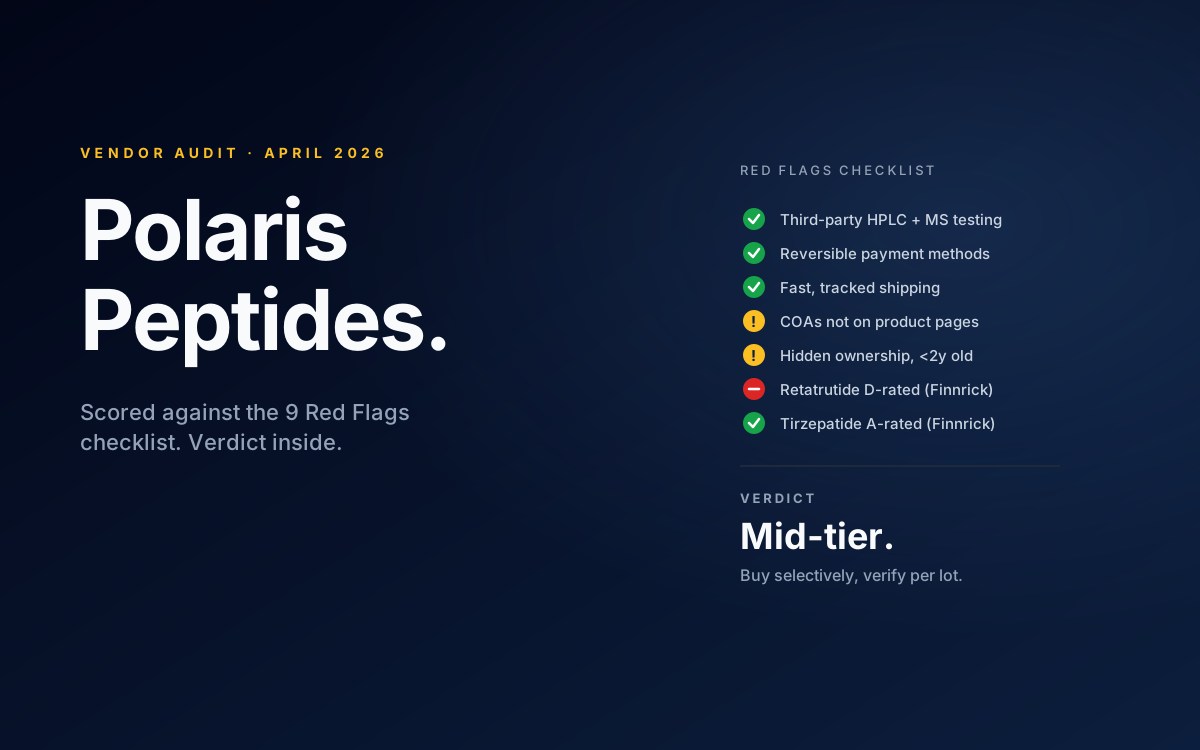
Polaris Peptides is not a scam — but it is not a category-leading vendor either. It is a real operating research-peptide supplier, accepts reversible payment methods, ships fast, and runs third-party HPLC testing. It also fails three of the nine items on our vendor red flags checklist, and independent testing shows compound-level quality varies dramatically. The headline finding: tirzepatide and PT-141 are A-rated and worth buying; retatrutide rates D and is not.
This audit applies the same nine-item methodology we use across the Boren vendor directory, grounded in publicly verifiable facts: the company's own published policies, third-party testing data from Finnrick Analytics, ScamAdviser's domain check, Trustpilot review patterns, and community reports on Reddit and the GLP-1 forum. Boren has not personally tested Polaris's products. Treat this as a structured aggregation of the public data, not a primary lab report.
For broader context — which compounds are evidence-backed at all and which are marketing — see our 2026 evidence-based peptide tier list. For the methodology behind this kind of audit, see 9 Peptide Vendor Red Flags.
What Polaris Peptides actually sells
Polaris Peptides operates at polarispeptides.com (US-facing) with related domains at polarispeptidesusa.com and polarispeptideslab.com. The catalog covers the standard research-peptide categories: GLP-1 class compounds (semaglutide, tirzepatide, retatrutide), recovery peptides (BPC-157, TB-500), the GH stack (CJC-1295, ipamorelin), GHK-Cu, PT-141, and a smaller set of cosmetic and longevity SKUs.
Operational facts that matter for the audit:
- HPLC + mass spectrometry testing advertised on every batch, targeting >99% purity.
- Payment methods: credit/debit card, ACH/eCheck, PayPal, Venmo, Zelle, CashApp, bank transfer, cryptocurrency (5% discount).
- Shipping: FedEx Ground / 2-Day Air or UPS Next Day Air, same-day or next-business-day fulfillment, free over $350.
- COA delivery: on request via customer support — not published on product pages.
- Company age: less than two years as a registered operating entity.
- Ownership: not publicly disclosed.
A note on the name. Polaris Peptides (polarispeptides.com) is distinct from Polar Peptides (polarpeptides.ca), a separate Canadian vendor. The two get conflated regularly in reviews and forums. Verify the URL character-by-character before ordering — the most active scam pattern in 2026 is registering near-identical domains to intercept misdirected traffic.
The 9 red flags scorecard
Running Polaris through our 9 Peptide Vendor Red Flags checklist, item by item.
1. Third-party COA — yellow
Polaris advertises HPLC + MS testing through an independent lab on every batch and will provide the COA on request. Two issues: COAs are not displayed on product pages (so you cannot verify the specific lot you are ordering before you order), and the testing lab is not always named publicly. Request the COA for your lot, email the testing lab to confirm the report number is real, and treat any vendor who cannot produce a verifiable lot-level COA as a hard fail.
2. Verifiable testing lab identity — yellow
Where Polaris does name a testing lab, the lab can typically be verified. The yellow rating is for inconsistency: not every product page or batch is paired with a named lab in the public-facing material. The accountability gap is small but real.
3. Reversible payment methods — green
Credit card, ACH, PayPal, Venmo, and Zelle are all accepted. This is one of the strongest signals on the scorecard. Vendors that refuse every reversible payment method are the ones expecting customer disputes; Polaris is not in that group.
4. No mandatory shipping insurance upsell — green
Standard FedEx and UPS rates, no fabricated "shipping insurance" line item that vendors use to extract a non-refundable deposit on a problem they intend to invent.
5. Pricing within market range — green
Polaris's pricing sits roughly at the median for the US-facing research-peptide market — not deeply under-cutting, not premium-priced. No pricing red flag.
6. Authentic review pattern — yellow
Trustpilot reviews skew positive (fast shipping, helpful customer service) but include enough complaints about batch variability and defective vials (vacuum seal failures, cloudy contents, pressure buildup) to read as authentic rather than brigaded. The yellow rating is for review-source concentration: most positive volume is on Trustpilot specifically, with a thinner footprint on Reddit and the GLP-1 forum than top-tier vendors typically have.
7. Distinct brand identity — yellow
Polaris is not mimicking another vendor's branding, but the surface confusion with Polar Peptides (polarpeptides.ca) and the cluster of look-alike Polaris-branded subdomains (polarispeptidesusa.com, polarispeptideslab.com) creates ambiguity. Verify the URL precisely.
8. Published QC standards — red
Polaris's public material describes the testing program in general terms (HPLC, MS, >99% purity) but does not publish a specific synthesis spec, contract manufacturer, country of synthesis, or shelf-life basis. Hidden ownership compounds this. This is the single weakest item on the scorecard.
9. Post-order customer service — green
Reports from Trustpilot and Reddit consistently describe responsive support that produces COAs when asked and resolves shipping issues within a reasonable window. This is one of the cleanest items on the scorecard.
Total: 5 of 9 green, 3 yellow, 1 red. That places Polaris in the "real vendor with operational issues" category — the median of the legitimate US-facing market. Below top-tier transparency benchmarks; above the wire-fraud threshold by a comfortable margin.
What independent testing actually shows
The most decision-relevant data on Polaris is not the company's own marketing; it is independent third-party purity testing.
Finnrick Analytics (last test: January 19, 2026) ran 97 samples across 9 Polaris products. The compound-level results:
| Product | Rating | Samples | Note |
|---|---|---|---|
| Tirzepatide | A | multiple | Strongest item in the catalog |
| PT-141 | A | multiple | Consistent quality |
| BPC-157 | B | multiple | Mid-quality, batch-stable |
| Semaglutide | C | multiple | Mediocre, meaningful variance |
| Retatrutide | D | 26 | Lowest rating, largest sample size |
The retatrutide finding is the load-bearing one. Twenty-six samples is enough to rule out outlier-batch explanations — the D rating reflects systemic quality issues on that product line, not a single bad lot. Retatrutide is also the most-counterfeited compound on the entire research-peptide market right now (we cover that in our GLP-1 comparison guide), so structural counterfeit risk on retatrutide is high category-wide. Polaris's specific rating compounds the category baseline.
The pattern is unusual but not unprecedented: a vendor can run a competent QC program on simpler peptides (PT-141, tirzepatide are both well-characterized) and still struggle with the more complex synthesis-and-storage requirements of a Phase 3-stage compound being reverse-engineered from publication data. Whatever the cause, the testing data is the data.
Customer review patterns
The aggregate review picture across Trustpilot, Reddit, the GLP-1 forum, and dedicated peptide-review sites converges on a consistent profile:
- 70–75% customer satisfaction, mid-tier for the category.
- Most-reported positive: fast shipping (1–2 business days domestic), responsive customer service, COA delivery within 24–48 hours of request.
- Most-reported negative: batch-to-batch variability on the same product. Defective vials (vacuum seal failures, cloudy reconstituted product, pressure buildup) appear in roughly 5–10% of negative reviews.
- Reddit footprint: thinner than top-tier vendors. No coordinated takedown campaigns visible, but also less week-over-week reliability data than the most-discussed vendors generate.
The pattern is consistent with the testing data: Polaris executes on logistics and basic QC, and falters on the harder QC question of cross-batch consistency.
Compound-by-compound recommendation
Practical translation of the audit, for someone actually about to place an order:
- Tirzepatide — buy. A-rated independent testing, high-volume product line with fewer batch issues than the rest of the catalog. Among Polaris SKUs, this is the strongest pick.
- PT-141 — buy. A-rated, consistent. Fine-quality option for that compound class.
- BPC-157 — buy with COA verification. B-rated overall but counterfeit risk is high on BPC-157 industry-wide. Always request the lot-specific COA before reconstituting.
- GHK-Cu, ipamorelin, CJC-1295 — buy with COA verification. Not specifically tested in the Finnrick dataset cited, but compound-level synthesis is well-characterized and the operational signals are good.
- Semaglutide — consider alternatives. C-rating + counterfeit-prevalent category. Vendors with stronger semaglutide-specific COAs exist.
- Retatrutide — do not buy from Polaris. D-rating across 26 samples is the strongest negative signal in the audit. Source from a vendor with verifiable lot-level COAs and a track record on retatrutide specifically. Most of the market struggles here; this is not a Polaris-only issue, but Polaris's data is the worst we have on the compound today.
For a fuller view of the GLP-1 class and what to look for in retatrutide-class sourcing specifically, see Retatrutide vs. Tirzepatide vs. Semaglutide: 2026 Comparison Guide.
How to verify yourself
Three checks, ordered by leverage:
- Email Polaris and request the COA for your specific lot before you reconstitute. A real COA names the testing lab, lists the methods (HPLC, MS), reports the lot number, and is signed. Verify the report number with the testing lab directly.
- Cross-check the compound against independent test datasets. Finnrick Analytics, peer-reviewed comparison sites, and active threads on the research forum will give you a wider sample than any single COA can.
- Match the compound choice to the audit data. The strongest items in Polaris's catalog (tirzepatide, PT-141) align with the public testing record. The weakest item (retatrutide) does not. Letting the testing data guide product selection inside a vendor is a more productive question than picking the vendor on overall reputation alone.
Bottom line
Polaris Peptides is legit, mid-tier, and uneven by product. The vendor passes most of our 9-red-flag checklist with three yellow flags (COA publication model, ownership transparency, review-source concentration) and one red (published QC standards). Independent testing places tirzepatide and PT-141 among the strongest items in the catalog and retatrutide among the weakest in the entire research-peptide market.
The question is not "is Polaris Peptides legit?" The answer to that is yes. The right question is "which Polaris products are worth buying and which are not?" — and on that question, the public data has a clear answer.
For the broader vendor audit framework see our 9 Red Flags checklist. For compound-level evidence grading across the entire research-peptide market, our 2026 evidence-based tier list is the place to start.
Frequently asked questions
- Is Polaris Peptides legit?
Yes — Polaris Peptides is a real, operating research-peptide vendor, not a scam. ScamAdviser flags the domain as legitimate, the company accepts reversible payment methods (credit card, ACH, PayPal), provides certificates of analysis on request, and ships within 1–2 business days. The caveat: independent testing shows quality varies meaningfully between products. Polaris is mid-tier — buy selectively rather than category-wide.
- Does Polaris Peptides provide certificates of analysis (COAs)?
Yes, but you have to ask. Polaris claims every batch undergoes third-party HPLC and mass spectrometry testing with results targeting >99% purity. The COAs are not displayed on product pages — you must email customer support and request the COA for the specific lot you received. That request-only model is a yellow flag versus vendors who publish COAs proactively.
- What is the best product to buy from Polaris Peptides?
Based on Finnrick Analytics' independent testing of 97 samples across 9 Polaris products, tirzepatide and PT-141 are A-rated and represent the strongest items in the catalog. Semaglutide is C-rated. Retatrutide received a D rating across 26 samples — the single weakest result and the one we would not recommend buying from Polaris. See our GLP-1 comparison guide for category context.
- How long does Polaris Peptides take to ship?
Orders typically ship same-day or next business day after payment confirmation, with most orders shipping within 1–2 business days. Shipping options include FedEx Ground, FedEx 2-Day Air, and UPS Next Day Air. Free shipping is available on orders over $350. Crypto payments receive a 5% discount that stacks with coupon codes.
- Is Polaris Peptides better than Polar Peptides?
They are different companies. Polaris Peptides (polarispeptides.com) is a US-based research-peptide vendor. Polar Peptides (polarpeptides.ca) is a Canadian vendor with a separate Trustpilot page and product catalog. The naming similarity causes regular confusion — verify the URL character-by-character before ordering. Counterfeit storefronts in this category sometimes register near-identical domains specifically to intercept misdirected traffic.
Sources
- Polaris Peptides — Payment & Shipping page
- Polaris Peptides — Peptide Research FAQ
- Polaris Peptides — Trustpilot review page
- ScamAdviser — polarispeptides.com legitimacy check
- PeptidesExplorer — Polaris Peptides Reviews 2026
- Peptide Dossier — Polaris Peptides Review 2026
- BestPeptidesCompanies — Polaris Peptides Review 2026
- SeekPeptides — Polaris tirzepatide complete guide with lab results
Save vendors and track price drops
Create a free account to save your shortlist and get alerts when new prices or lab tests are added.