Require a Lot Specific CoA to Vet Peptide Suppliers for Researchers
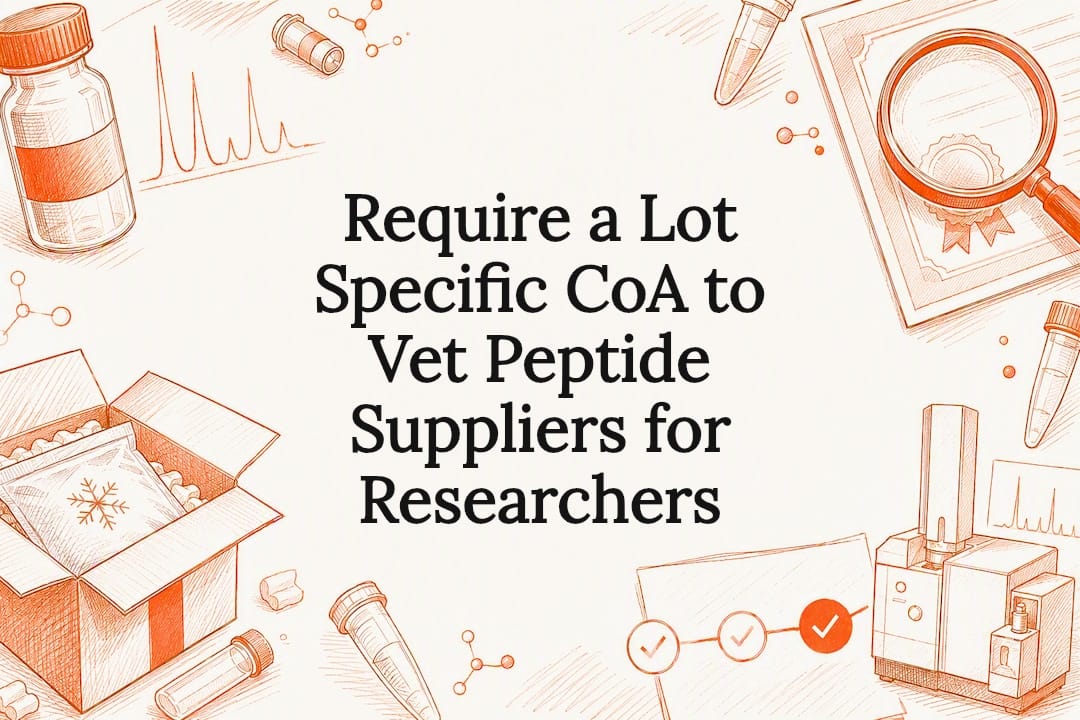
Require a lot-specific Certificate of Analysis with a chromatogram and mass-spectrometry identity result from a named, independent lab before you pay for anything. If the vendor cannot produce that document tied to the exact lot you’re buying, walk away. Match the lot number on the CoA to the lot number on the vial and shipping label, and hold payment until cold-chain handling and lab credentials check out too.
TL;DR:
- Obtaining a lot-specific Certificate of Analysis with a chromatogram and mass-spectrometry identity result from an independent lab is essential before payment, and a mismatch on lot number invalidates the CoA.
- Verifying the lab’s accreditation, the presence of a clear test date, and viewing actual chromatogram images are critical steps to confirm peptide purity and true identity.
- Reputable suppliers ship peptides in insulated packaging with temperature indicators, and inspecting shipment condition upon arrival helps prevent degraded or compromised products.
- Independent lab verification, not just supplier claims, is necessary, and platforms that compile verified testing data can speed up the qualification process.
- Price signals often hide quality issues; very low prices on complex peptides should trigger suspicion, while bulk discounts only apply after initial qualification.
Table of Contents
- What Criteria Actually Separate a Reliable Peptide Supplier From a Risky One?
- How Do You Read and Verify a Certificate of Analysis?
- Can You Trust a Supplier’s In-House Testing Claims?
- What Should You Check When a Peptide Shipment Arrives?
- What Are the Concrete Steps to Verify a Supplier and Spot Red Flags?
- How Do You Run an Initial Qualification Order Before Committing?
- How Do Lab-Verified Vendor Platforms Speed Up Supplier Qualification?
- What Do Peptide Prices Actually Tell You About Quality?
- Should You Worry About Minimum Order Quantities?
- What Payment Methods Signal a Legitimate Supplier?
- How Responsive Should Customer Support Actually Be?
- What Regulatory Certifications Should a Peptide Supplier Have?
- Supplier Selection Is Part of Your Experimental Design, Not a Procurement Afterthought
- Get Independent Verification Before You Trust a New Supplier
- Sources
- FAQ
What Criteria Actually Separate a Reliable Peptide Supplier From a Risky One?
Not every item on a vetting checklist carries equal weight, and treating them as equal is how researchers end up trusting a vendor that fails on the one thing that mattered.
The single non-negotiable is a lot-specific CoA with a chromatogram and mass-spectrometry identity result. Without both, you have no defensible evidence the vial contains what the label says. A gross-weight percentage on a PDF means nothing without the underlying trace.
Here’s how the criteria stack up in priority order:
- Lot-specific CoA, chromatogram, and MS identity (critical, disqualifying if absent): this is the floor, not a bonus feature.
- Named independent testing lab with ISO/IEC 17025 signals (critical to high): in-house-only testing is a conflict of interest, not a quality assurance.
- Net peptide content vs. gross weight, plus salt/counterion disclosure (high): a vial listing “5 mg” gross weight can contain meaningfully less actual peptide once acetate or trifluoroacetate salt content is subtracted.
- Endotoxin (LAL) and bioburden data (high, when the application is sensitive to biological contamination).
- Cold-chain logistics and domestic fulfillment (high): peptides degrade under heat and repeated freeze-thaw cycles during transit.
- Verifiable business legitimacy (recommended): a real address, business registration, and a named technical contact who can answer method questions.
Weight the first two heavily. Everything else refines confidence; those two establish whether confidence is possible at all.
How Do You Read and Verify a Certificate of Analysis?
A CoA is only useful if it is legible, current, and matched to your exact purchase. Suppliers who reuse the same generic CoA across every batch are handing you a marketing document, not evidence.
Walk through the document in this order:
- Lot number. Confirm it appears on the CoA, the vial label, and the shipping manifest, all matching exactly.
- Test date. A CoA dated years before your purchase, or missing a date entirely, tells you nothing about the batch in your hand.
- Named lab and method. The report should identify the testing facility by name and specify the HPLC method used, not just a purity number.
- Chromatogram image. A stated purity percentage with no visible trace is close to worthless. You need to see peak shape, baseline stability, and whether shoulder peaks suggest impurities the summary number hides.
- MS result. The measured mass should match the expected molecular weight of the peptide within a reasonable tolerance.
- Net peptide content and counterion. This tells you what you’re actually dosing, not what the vial weighs.
- Endotoxin data, where the application calls for it.
Pro Tip: Open the chromatogram at full resolution before you buy. A blurry, low-resolution image pasted into a CoA template is a common trick for hiding a rough baseline or an unlabeled shoulder peak.
Industry sourcing guides consistently flag this same pattern: a CoA that isn’t tied to the shipped lot isn’t a valid CoA at all, regardless of how official it looks.

Can You Trust a Supplier’s In-House Testing Claims?
No, not on their own. In-house testing is not fraudulent by default, but it removes the one check that makes a purity claim independently verifiable: a lab with no financial stake in the result.
ISO/IEC 17025 accreditation is the standard that demonstrates a lab’s technical competence and quality management for testing and calibration work. It’s not a rubber stamp; it means the lab has been audited against a defined set of procedural requirements.
When a supplier names a testing lab, verify it rather than taking the name at face value:
- Confirm the lab’s accreditation and check whether the scope of that accreditation actually covers peptide analysis, not just food testing or metals.
- Look for lab branding, letterhead, and a report format consistent with the lab’s own public materials, not a generic template.
- Check for an analyst signature and a report date. Anonymous, unsigned reports are a red flag on their own.
- Contact the lab directly if the volume of your purchase justifies it. A supplier that discourages this is telling you something.
What Should You Check When a Peptide Shipment Arrives?
Peptides are sensitive to heat and repeated freeze-thaw cycles, and how a supplier ships a product tells you almost as much as the CoA does.
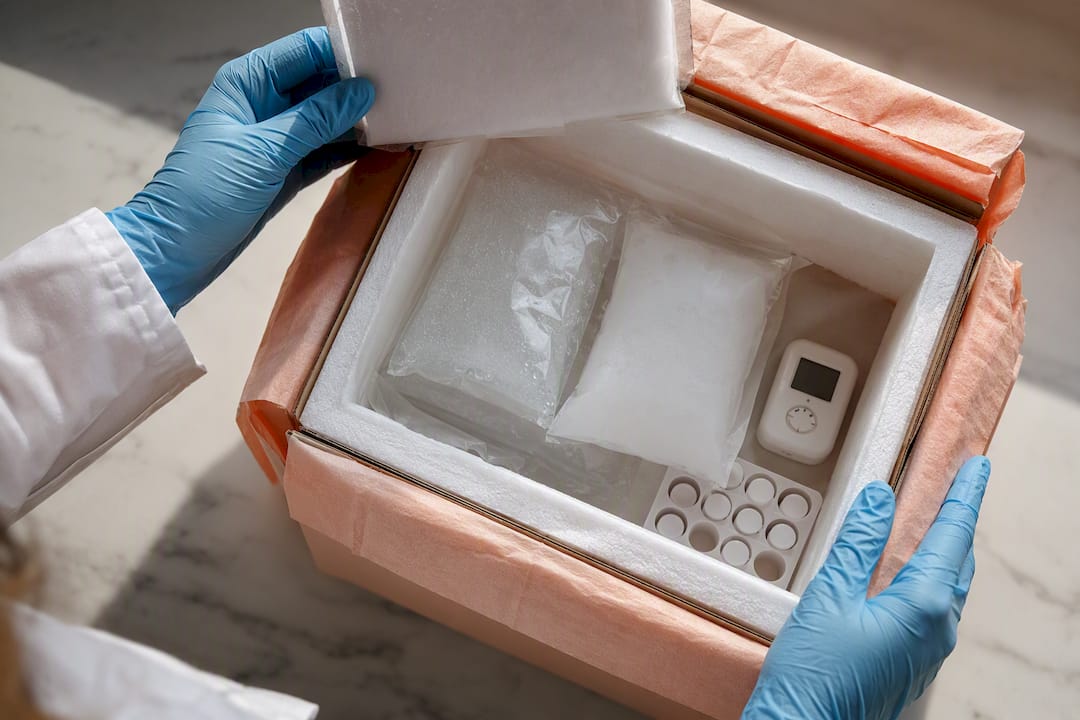
Reputable suppliers use insulated packaging, frozen or validated cold packs suited to the specific peptide, and often a temperature indicator or data logger inside the box. Domestic fulfillment reduces risk simply because transit time is shorter; international drop-shipping with customs delays multiplies the number of hours a peptide can sit at an uncontrolled temperature.
When your order arrives, check before you even open the vial:
- Packaging condition: intact insulation, no signs of a crushed or compromised box.
- Temperature indicator or logger reading, if included, confirming the shipment stayed within range.
- Vial label and lot number, matched against the CoA you already reviewed.
- Desiccant presence for lyophilized products, and any temperature log the supplier provides.
A supplier that ships peptides in a padded envelope with no thermal protection has already failed this check, no matter what the CoA says.
What Are the Concrete Steps to Verify a Supplier and Spot Red Flags?
Verification is a sequence, not a single judgment call. Work through it in order and refuse to proceed past a failed step.
- Request the CoA before you pay. Confirm it’s lot-specific and that the lab is named.
- Cross-check the lot number against what will actually ship, not a “representative” batch.
- Inspect the chromatogram for resolution and peak clarity.
- Search public regulatory records for the supplier’s name, including FDA warning letters and import alerts related to compounding and peptide products.
- Test responsiveness by asking a specific technical question, such as the HPLC column or gradient used. A knowledgeable technical contact answers directly; a sales-only operation deflects.
Certain patterns should disqualify a supplier outright: reused CoAs across multiple lots, a bare “99%+ purity” claim with no method disclosed, marketing language implying human dosing for a product labeled research-use-only, an unnamed testing lab, or an inability to provide a physical business address.
Pro Tip: Ask for the CoA of a lot you’re not buying yet, as a test. A supplier who can produce a fresh, correctly dated, lot-matched CoA on request is behaving very differently from one who sends the same file every time.
How Do You Run an Initial Qualification Order Before Committing?
Treat your first purchase from any new supplier as a qualification test, not a production order. This is standard practice in reagent procurement generally, and peptides deserve the same discipline.
Start by defining what “pass” means before you place the order: the specific peptide form, expected molecular weight, minimum acceptable purity, and any endotoxin threshold relevant to your application. A defensible evaluation needs exact material specification and lot-to-report traceability established up front, not reverse-engineered after the fact.
Then:
- Place a small initial order rather than a bulk purchase.
- Verify the CoA and confirm the vial’s lot number matches it exactly on arrival.
- Send a portion of the sample to an independent lab for confirmation testing, typically in the $150 to $350 range for standard identity and purity work, and compare that result against the vendor’s own CoA.
- Record a disposition, pass, conditional pass, or reject, with the date and the reviewer’s name, and keep it in a supplier qualification file you can produce during an audit.
How Do Lab-Verified Vendor Platforms Speed Up Supplier Qualification?
Manually running independent tests on every candidate supplier is slow, and it’s exactly the bottleneck that pushes researchers to skip verification when a deadline looms.
Boren Health compiles independent HPLC and mass-spectrometry lab data across over 200 verified peptide vendors, with daily price updates so purity and cost can be compared side by side rather than researched vendor by vendor. For peptides with high sourcing scrutiny, such as Tirzepatide and Semaglutide, lab-verified purity scores flag inconsistencies between a vendor’s own CoA and independent results before you place an order. Platforms built this way don’t replace your own qualification testing, but they narrow the candidate list to vendors whose documentation has already survived outside scrutiny, which cuts real time out of the process.
What Do Peptide Prices Actually Tell You About Quality?
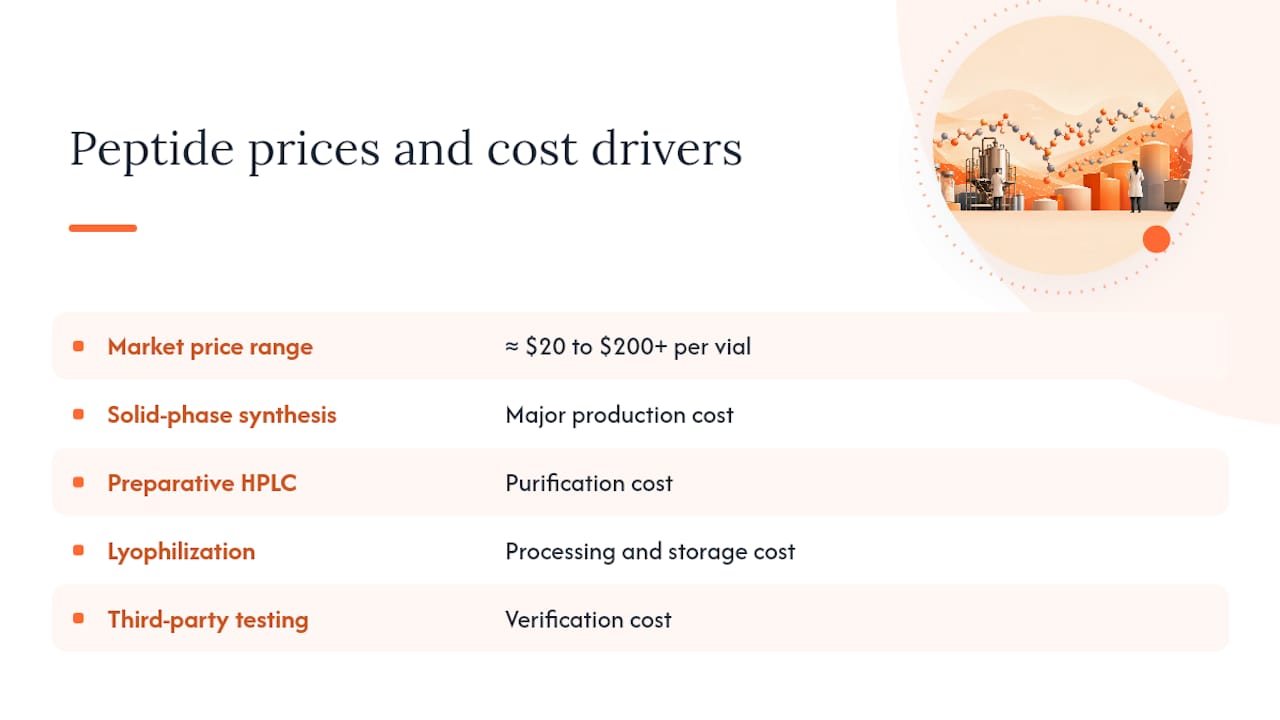
Price alone is a weak quality signal, but price patterns across the market are informative. Research-grade peptides commonly range from roughly $20 to over $200 per vial, depending on the peptide, vial size, and purity grade, with specialty or longer-chain peptides like Retatrutide typically priced higher than shorter, well-established sequences.
What matters more than the raw number is what sits behind it. A vendor pricing 5 mg of a complex peptide at a fraction of the market average is either absorbing a loss to build volume, cutting corners on synthesis purity, or padding gross weight with excess salt content that inflates the apparent yield. None of those explanations should make you comfortable.
Legitimate suppliers price around the cost of solid-phase peptide synthesis, purification (typically preparative HPLC), lyophilization, and third-party testing, all of which add real cost per batch. When a listing undercuts that structure by a wide margin with no explanation, treat it as a red flag rather than a bargain.
Bulk pricing tiers are common and legitimate; a per-milligram discount at higher vial counts reflects real economies of scale in production runs. What should raise suspicion is a supplier offering steep discounts specifically on peptides that are difficult or expensive to synthesize correctly, since that’s rarely where genuine cost savings show up. Compare pricing against a broader market view rather than any single listing in isolation, and treat unusually low prices on complex, high-demand peptides as a prompt for extra scrutiny, not a reason to buy in bulk immediately.
Should You Worry About Minimum Order Quantities?
Most research peptide suppliers sell by the vial, with minimum orders as low as a single unit, which works in your favor during qualification testing because it lets you validate a supplier without committing to volume you haven’t verified yet.
Bulk purchasing becomes relevant once a supplier has passed your qualification protocol. Reputable vendors typically offer tiered pricing at defined quantity breaks, often starting around 10 vials and again at larger case-lot quantities, with per-unit cost dropping at each tier. Some suppliers also offer custom synthesis runs for labs needing non-standard sequences or larger batch sizes, though these usually carry longer lead times and separate qualification requirements since custom runs are effectively a new product each time.
The practical rule: never let a bulk discount talk you into skipping the single-vial qualification step. Qualify small, then scale the order size once the supplier has a track record with your lab specifically, not just a favorable CoA on one lot.
What Payment Methods Signal a Legitimate Supplier?
Payment options tell you a surprising amount about how a supplier operates. Established vendors with real banking relationships typically accept credit cards, ACH transfers, or established payment processors, and they can issue proper invoices with business registration details.
Suppliers who accept only cryptocurrency or wire transfers to personal accounts, with no invoice and no way to dispute a bad shipment, have structured their payment process specifically to avoid chargebacks and accountability. That’s not automatically disqualifying on its own, since some legitimate international vendors lean on crypto for practical banking reasons, but it removes your recourse if a lot fails testing.
Look for clear terms on returns, replacement policy for damaged or degraded shipments, and whether the supplier requires full payment before providing tracking information. A supplier confident in their product usually offers a reasonable dispute window; one that demands payment with no recourse is telling you they expect problems.
How Responsive Should Customer Support Actually Be?
Technical responsiveness is one of the most underused vetting signals available, and it costs nothing to test before you buy.
Send a specific question, not a general inquiry, about the HPLC gradient used for a particular peptide, the counterion form, or the endotoxin testing method. A supplier with real technical staff answers with specifics, often within a business day. A supplier running purely on a sales team either deflects, sends a generic response copied from a product page, or takes days to reply through a support ticket system with no named contact.
This matters beyond convenience. If a batch arrives with a discrepancy between the CoA and what you receive, or the chromatogram raises a question, you need someone on the other end who understands the chemistry well enough to respond meaningfully, not just process a refund request. Suppliers with a named technical contact, a real phone number, and a verifiable business address tend to be the same ones that pass documentation checks. The two signals travel together more often than not.
What Regulatory Certifications Should a Peptide Supplier Have?
Regulatory status depends heavily on what the peptide is being used for and where you’re located, and suppliers routinely blur this distinction to their advantage.
Products sold for research use only (RUO) exist in a different regulatory category than compounded pharmaceutical peptides intended for human administration. The FDA’s guidance on peptides in human drug compounding lays out the classifications and expectations that apply when a peptide moves toward clinical or compounding use, and a supplier making human-dosing claims on an RUO-labeled product is operating outside that framework, not inside a gray area.
Legitimate research suppliers should disclose RUO status clearly, avoid dosing language aimed at human administration, and be able to describe their synthesis and quality control process without evasion. Regulatory expectations also vary meaningfully by country, and researchers sourcing internationally should check the legal classification and import rules in their own jurisdiction rather than assuming U.S. or EU frameworks apply uniformly everywhere.
None of this replaces the CoA and independent testing requirements covered earlier. A supplier can be fully compliant on paper and still ship a batch that fails identity confirmation. Regulatory standing tells you the supplier operates within legal boundaries; it doesn’t tell you what’s actually in the vial.
Supplier Selection Is Part of Your Experimental Design, Not a Procurement Afterthought
Reproducibility problems traced to reagent variability don’t stop at antibodies and cell lines. A peptide with inconsistent purity between lots is a hidden variable in every downstream result, and most labs never document the decision that let it in the door.
Treat every new supplier relationship as something you write down: qualification date, test results, disposition, reviewer. Retest periodically rather than assuming a passed lot from six months ago still represents current production. That file is what turns “we trust this vendor” into something you can actually defend later.
— Ross
Get Independent Verification Before You Trust a New Supplier
Every step in this checklist takes time you may not have when a deadline is close, and reading CoAs manually across a dozen candidate vendors is exactly the kind of work researchers skip under pressure. Borenhealth exists to shortcut that without cutting corners on the verification itself.
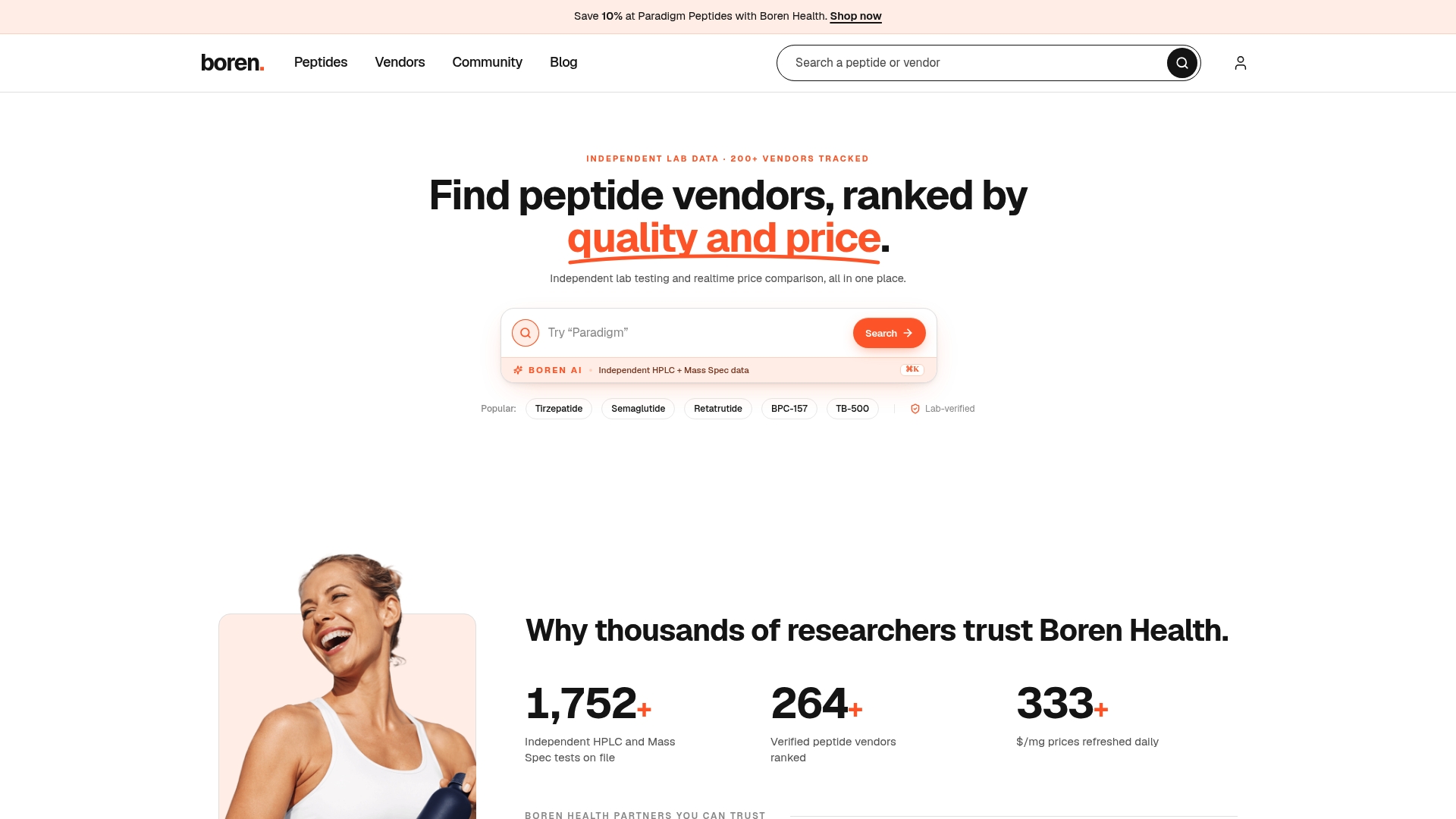
The vendor comparison pages already carry lab-verified purity scores across more than 200 suppliers, so you can screen candidates against independent HPLC and mass-spectrometry data before you ever request a quote. If you want to qualify a specific lot from a new vendor rather than rely on published scores alone, the Test My Peptide Sample service gives you an independent lab result on your own shipment, which is the same qualification step this article recommends, just faster to execute. For a side-by-side look at purity and pricing across peptides like Tirzepatide and Semaglutide, the product comparison pages are worth checking before you place your next order.
Sources
FAQ
Who Is the Most Trusted Peptide Supplier?
No single supplier holds universal trust; trust is earned lot by lot through a valid CoA, a named independent lab, and consistent results across repeat orders, not a brand reputation alone.
Which Is the Most Reputable Peptide Company?
Reputation built on years in business and customer reviews is a useful starting signal, but it’s not a substitute for batch-specific documentation and independent testing on the exact lot you’re buying.
Where Do Peptide Sellers Get Their Products?
Most research peptide sellers source from contract synthesis labs using solid-phase peptide synthesis, then resell under their own brand. Some also operate their own synthesis and purification facilities.
How Do I Know if a Peptide Supplier Is Legit?
Confirm they provide a lot-specific CoA with a chromatogram and MS identity result from a named lab, disclose net peptide content and RUO status clearly, and respond to specific technical questions with real answers rather than deflection.