3 Must Haves for Third Party Peptide Testing: Labs, Tests, and Proof

A trustworthy peptide certificate of analysis rests on three non-negotiables: an independent third-party lab, a batch-specific COA, and orthogonal confirmation methods such as HPLC paired with mass spectrometry. For any biological or clinical research use, add endotoxin and sterility data to that list, and favor labs holding ISO/IEC 17025 accreditation whenever the work allows for it.
TL;DR:
- Batch-specific certificates of analysis should be verified by matching lot numbers and raw chromatogram data to ensure sample integrity.
- Analyzed peptides require a combination of RP-HPLC for purity, LC-MS for mass identity, and MS/MS or peptide mapping for sequence confirmation.
- Accreditation under ISO/IEC 17025 indicates a formal quality system but does not guarantee all necessary tests like endotoxin or sterility.
- Community and portal reports can hint at quality but lack batch verification and raw data access, making them unreliable without further confirmation.
- For biological or safety applications, endotoxin and sterility data are essential, and relying solely on purity and identity testing risks missing critical safety issues.
Table of Contents
- How do different lab and report types compare?
- Which analytical methods actually prove what
- How to read and verify a certificate of analysis
- Choosing a lab and setting expectations
- Cross-checking vendor claims with independent platform data
- What level of scrutiny actually matters
- Compare verified lab data before you buy
- FAQ
- Sources
- Primary sources and standards for verification
How do different lab and report types compare?
Not every “third-party tested” claim means the same thing, and researchers who treat them as interchangeable end up trusting reports that were never built to answer their questions. Three broad categories cover most of what circulates in the peptide space.
Accredited analytical labs operate under formal quality systems, typically ISO/IEC 17025, and run full panels covering purity, identity, concentration, and often endotoxin or microbial testing. Common commercial panels come from labs that run solid analytical work without formal accreditation: they often deliver RP-HPLC and mass spec results but may skip raw chromatogram disclosure or endotoxin testing unless specifically requested. Community or portal-based reports, the kind shared in forums or posted as screenshots, vary widely in reliability since there is often no way to confirm the sample tested matches the batch a buyer receives.
| Lab/report type | Accreditation | Typical panel | Raw data access | Batch-specific COA |
|---|---|---|---|---|
| Accredited analytical lab | ISO/IEC 17025 common | Purity, identity, concentration, endotoxin/sterility | Usually available on request | Yes |
| Common commercial panel | Rarely formal | Purity, identity (HPLC/MS) | Sometimes, often summarized only | Often, but verification varies |
| Community/portal report | None | Inconsistent, single-method common | Rarely | Rarely confirmed |
A few practical notes shape how to use this table:
- Accreditation signals a functioning quality system, not automatic coverage of every test a given study needs.
- A narrow panel from an accredited lab can still miss endotoxin or sequence-level checks if those weren’t ordered.
- Community reports can be a useful early signal but should never substitute for a batch-matched COA before a purchase decision.
The blind spot that catches researchers off guard is assuming “third-party tested” implies the same depth across all three categories. It doesn’t, and the panel scope matters more than the label.
Which analytical methods actually prove what
Reading a COA means knowing what each listed method can and cannot confirm. Reverse-phase HPLC (RP-HPLC) reports relative purity as a percentage of peak area, telling you how much of the sample elutes as the main peak versus impurities, but it says nothing about whether that main peak is the correct molecule. Liquid chromatography mass spectrometry (LC-MS) confirms identity by matching observed mass to expected mass, which is a stronger check but still has a gap: two peptides with swapped amino acids can share an identical mass. Tandem mass spectrometry (MS/MS) or peptide mapping fragments the molecule and reads out sequence-level detail, which is the method that actually confirms the amino acid order rather than just the total weight.
- RP-HPLC measures relative purity by peak area, not molecular identity.
- LC-MS confirms mass-based identity but can miss sequence errors with matching mass.
- MS/MS or peptide mapping confirms sequence fidelity, catching substitutions that mass alone cannot.
- Endotoxin (LAL) and sterility assays are separate tests entirely, required whenever material touches biological or cell-based work.
A peptide quality assessment that relies on a single test leaves real gaps: combining RP-HPLC, LC-MS, and dedicated endotoxin assays is standard practice because no single method proves purity, identity, and safety at once.
This is the orthogonality principle in practice. A sequence confirmation gap exists in routine panels that report intact mass only: identical mass can mask a sequence error that only MS/MS, peptide mapping, or NMR would catch. Regulatory guidance on analytical methods also expects labs proposing alternate procedures to document comparability data showing the substitute method performs equivalently, which is worth asking about when a lab’s report lists an unfamiliar technique.

How to read and verify a certificate of analysis
A COA is only as useful as the fields it discloses. Work through it methodically before trusting the numbers on the summary page.
- Confirm the batch or lot number on the COA matches the batch number on the product you received, not a generic reference sample.
- Check that each method is named with parameters, not just a method name with no instrument or column details.
- Look for raw chromatograms and spectra, not just a summary purity percentage with no underlying data.
- Verify acceptance criteria are stated (the purity threshold the lab considered a pass) rather than just a result with no benchmark.
- Cross-check any accreditation logo against the accreditor’s public registry using the certificate number listed.
Red flags include COAs with no batch number, purity results with no raw data behind them, and accreditation claims that cannot be verified against a public registry. A short checklist for reading COA elements is also useful background when comparing vendor claims against lab data.
Pro Tip: Email the lab directly asking for the raw chromatogram file tied to your specific batch number before relying on a summary PDF.
Choosing a lab and setting expectations
Selecting a lab or vetting a vendor’s COA comes down to a short, repeatable checklist rather than a judgment call made fresh each time.
- Confirm accreditation status and check it against the accreditor’s registry.
- Match panel scope to your use case: purity and identity at minimum, endotoxin and sterility for biological work.
- Require orthogonal methods, ideally RP-HPLC plus LC-MS, with MS/MS for sequence-sensitive studies.
- Ask for raw data access, not just summarized results.
- Confirm the COA is batch-specific and matches a verifiable chain of custody.
- Clarify turnaround time and pricing model before committing to a sample.
Turnaround and depth trade off against each other: a same-week purity check costs less and tells you less than a full panel with sequence confirmation. For low-risk exploratory work, purity and identity minimums may be enough. For anything biological, in vivo, or safety-adjacent, endotoxin and sterility data become a minimum, not an upgrade. A quick verification email just confirms batch match and raw data availability; a detailed request asks for full method parameters and acceptance criteria; an escalation email asks the lab to confirm its accreditation certificate number directly.
Cross-checking vendor claims with independent platform data
Matching a vendor’s COA against independent data is faster when that data already exists in one place. Boren Health publishes HPLC and mass spectrometry results across more than 200 vendors alongside daily price comparisons, which gives researchers a way to screen vendors before requesting a batch-specific COA directly. A practical workflow: check published purity and identity data for a vendor first, then request the raw COA file for the exact batch being purchased to confirm it matches what’s publicly shown.

What level of scrutiny actually matters
My rule of thumb: match the rigor to the risk. Exploratory, non-biological bench work can run on purity and identity data alone, but anything touching cells, animals, or planned in vivo work needs endotoxin and sterility results as a floor, not an optional add-on. Sequence-level confirmation and bioassays earn their cost when the molecule’s exact structure determines whether an experiment means anything at all. The one place not to cut corners is batch-specific verification: a COA for a different lot tells you nothing about what’s in your vial.
— Ross
Compare verified lab data before you buy
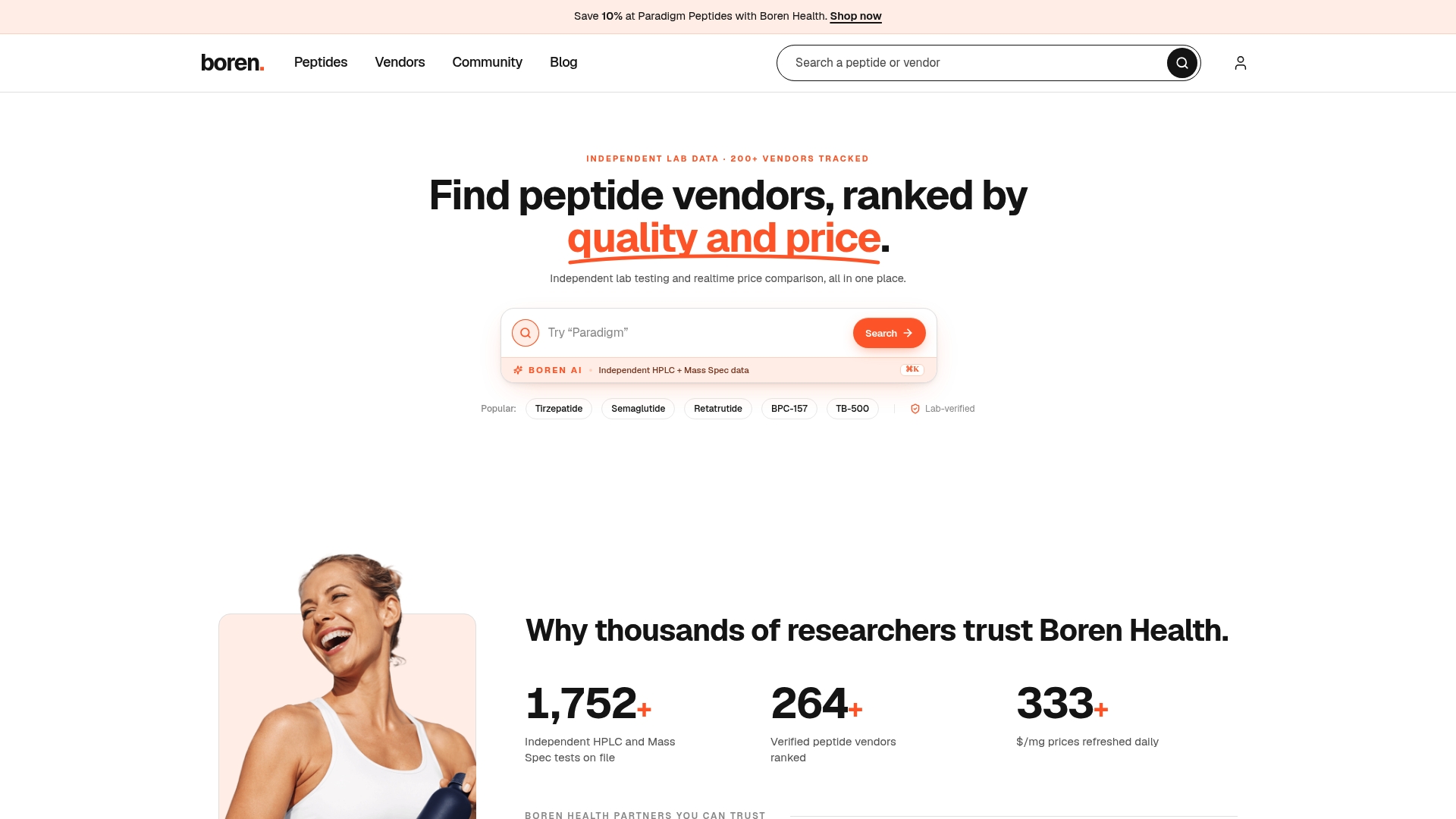
We publish independent HPLC and mass spectrometry results across a wide range of vendors, with daily price updates so researchers can weigh purity data against cost in one place. We don’t sell peptides ourselves, so every ranking reflects lab results rather than advertising placement.
- Browse vendor comparisons by research goal on our goals pages, covering peptides researched for weight loss, muscle growth, skin, and more.
- Labs and vendors looking to list verified results can review our plans for vendors, including Standard, Premium, and Enterprise tiers.
Check current vendor rankings and lab data before your next purchase.
This article is general information, not a substitute for advice from a qualified doctor. Consult a qualified healthcare professional about your own circumstances before acting on anything here.
FAQ
What is the most trustworthy peptide company?
Trustworthiness depends on verifiable batch-specific COAs, orthogonal testing methods, and transparent raw data rather than any single company’s reputation. Cross-checking independent lab data, such as published HPLC and mass spectrometry results, against a vendor’s own COA for the exact batch purchased is the most reliable way to judge trust on a case-by-case basis.
How do I test if my peptides are real?
Confirming identity requires an independent lab running RP-HPLC for purity alongside LC-MS for mass-based identity confirmation, since a single method leaves gaps. For sequence-level certainty, MS/MS or peptide mapping is needed because identical mass can still mask a sequence error.
Are biotech peptides third-party tested?
Many vendors advertise third-party testing, but the depth varies widely between accredited labs, common commercial panels, and informal community reports. A batch-specific COA with raw chromatograms and stated acceptance criteria is the only reliable way to confirm a specific product was actually tested rather than a reference sample.
Can you get tested for peptide use?
That question usually refers to drug screening for peptide compounds in a person, which is a different process from laboratory purity or identity testing of a product sample. Peptide use detection depends on the specific compound and testing method involved and falls outside standard third-party product testing panels, so it’s best directed to a toxicology or medical testing provider.
Sources
- Peptide quality control: essential tests — ISL Lab resources
- Analytical Procedures and Methods Validation for Drugs and Biologics — FDA
- Sequence verification and peptide characterization — PubMed Central article
- ISO/IEC 17025:2017 overview — ISO
- USP: Characterization and regulatory expectations — USP materials