15–30% Less Peptide: Semaglutide Formulations for Lab Buyers
For laboratory use, semaglutide formulations means lyophilized research-grade peptide powder in different salt forms, not a branded injectable pen. Before you trust a lot for dosing, verify three things on the Certificate of Analysis: HPLC purity of at least 98%, mass spectrometry identity near 4,113.58 Da, and stated net peptide content. Lab-verified vendor results can help you check these numbers before you buy.
TL;DR:
- Verify the net peptide content on the Certificate of Analysis to accurately calculate dosing, as label weight often includes salt mass that can overstate peptide amount.
- Recognize that salt forms like acetate or sodium do not affect the peptide’s activity but can influence the total mass, requiring correction for accurate dosing.
- Handle lyophilized powder gently, store it cold and dark, and reconstitute with slow addition and gentle swirling to maintain peptide integrity.
- Prioritize lot-specific analytical data, such as independent lab testing and verified vendor COAs, over price or reputation when sourcing research-grade semaglutide.
Table of Contents
- Semaglutide Formulations for Research: Powder, Salts, and What the Labels Actually Mean
- What a Real COA Should Prove: HPLC, Mass Spec, and Net Peptide Content
- Vial Sizes, Excipients, and Keeping Your Peptide Intact
- Turning a COA Into a Working Concentration: A Step-by-Step Example
- How Batch-Level Testing Actually Reduces Sourcing Risk
- The Real Priority Order Most Buyers Get Backward
- Verified Listings and Lab Testing When You’re Ready to Source
- Sources
Semaglutide Formulations for Research: Powder, Salts, and What the Labels Actually Mean
Every legitimate research supplier ships semaglutide as lyophilized powder, not liquid. Freeze-drying removes water, which is what keeps a 31-residue GLP-1 analog from degrading on the shelf. A semaglutide monograph from American Peptides confirms the molecular formula as C187H291N45O59, with a molecular weight near 4,113.58, and describes lyophilized powder as the standard commercial presentation for research use.
Where things get confusing is the salt form. Vendors label their product “semaglutide acetate,” “semaglutide sodium,” or just “semaglutide,” and buyers often assume these differ pharmacologically. They don’t, in any meaningful sense for bench work. Acetate and sodium counterions get chosen during manufacturing for stability and ease of processing during lyophilization, and once you reconstitute the peptide in diluent, that salt dissociates. The peptide itself does the work.
The catch is weight accounting. Acetate salt adds roughly 2.9% extra mass to the vial compared to the free peptide base, so a vendor who labels a vial by total salt weight without net peptide content is quietly overstating how much active peptide you’re actually getting.
Three things to check before you assume a label tells you anything useful:
- Whether the vendor discloses salt form at all, or just writes “semaglutide”
- Whether net peptide content is reported separately from total vial weight
- Whether the COA distinguishes gross mass from corrected peptide mass
Skip any of these and you’re guessing at your real concentration, not calculating it.
What a Real COA Should Prove: HPLC, Mass Spec, and Net Peptide Content
A COA that only states “purity: 99%” with no supporting method data is not verification, it’s marketing copy. Real analytical rigor rests on three independent measurements working together.
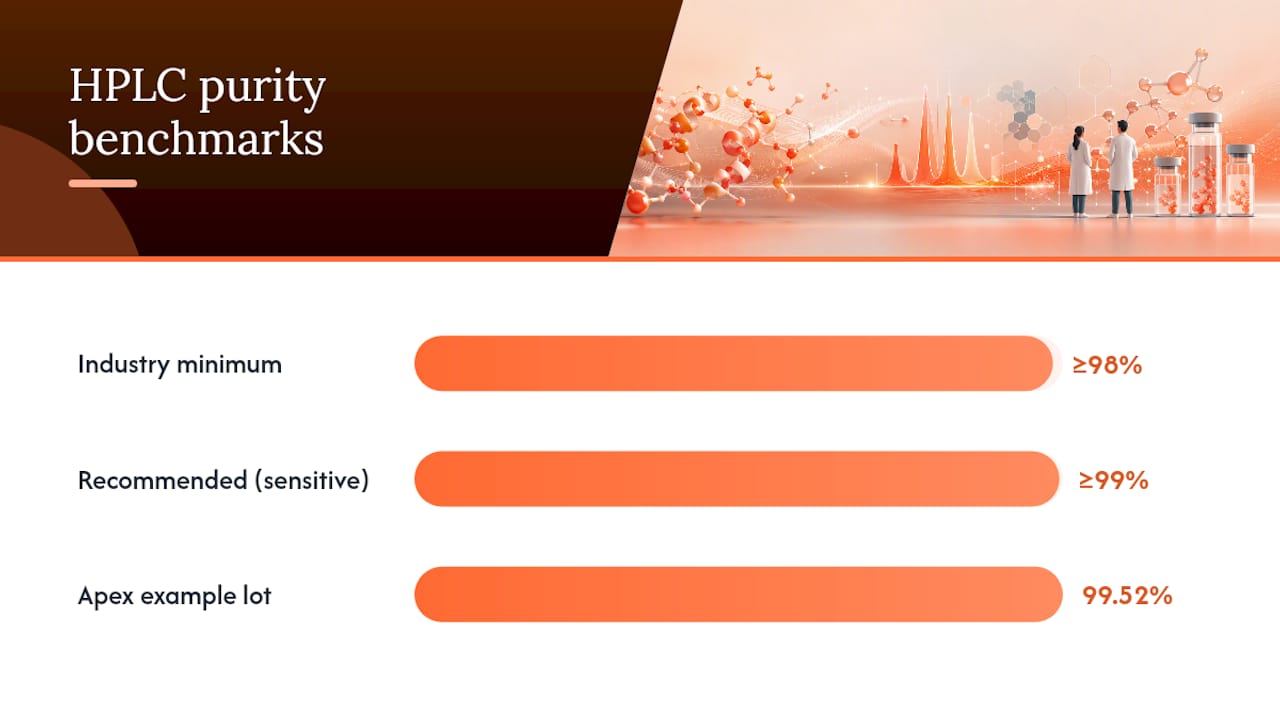
- HPLC purity. Industry guidance calls for a minimum of ≥98% area percent for general research use, with ≥99% recommended for sensitive assay work where trace impurities can skew results, according to purity testing standards published by Palmetto Peptides. A purity number without method parameters, meaning the column type, the solvent gradient, and the detection wavelength, is close to meaningless, since purity values are only comparable across vendors when the method is disclosed.
- Mass spectrometry identity. HPLC tells you a sample is homogeneous, not that it’s actually semaglutide. A chromatographically similar but structurally wrong peptide can produce a clean HPLC trace and still be worthless for your assay. MS confirmation against the expected mass of roughly 4,113.58 Da closes that gap, which is why peer-reviewed peptide analysis standards treat HPLC and MS as a required pair rather than substitutes for one another. This matters even more for acylated GLP-1 analogues, where a partial or incorrect acylation can still elute cleanly on HPLC if the method wasn’t developed carefully.
- Net peptide content. Reported separately from HPLC purity, this figure typically runs 70 to 85% of total vial mass and directly changes your dosing math.
Net peptide content isn’t optional data, it’s the number your concentration calculations depend on. A vial that reports 99% HPLC purity but skips net peptide content has told you the peptide is clean, not how much of it is actually in the vial.
For cell-based assays, ask for endotoxin (LAL) results too. A target below 1 EU/mg is the reasonable bar for sensitive work, and any vendor unwilling to share it is telling you something about their process. A real published example makes the standard concrete: an Apex Laboratory COA for a semaglutide lot reported 99.52% HPLC purity against a measured mass of 4,113.46 Da, essentially matching the expected 4,113.58 Da target.
Vial Sizes, Excipients, and Keeping Your Peptide Intact
Nominal vial labels like 1 mg, 2 mg, or 5 mg tell you the target fill weight, not the active peptide content. Two vials both labeled “5 mg” from different vendors can hold meaningfully different amounts of real semaglutide once you account for salt mass and net peptide percentage, which is exactly why the label alone is not a specification you can calculate from.
Most lyophilized formulations include a bulking agent, commonly mannitol, that gives the freeze-dried cake structure and makes it reconstitute evenly instead of collapsing into an uneven clump. Some formulations include a mild preservative to extend post-reconstitution stability, though this varies by vendor and isn’t universal.
Handling matters more than most buyers assume:
- Add diluent slowly, down the vial wall, rather than dropping it straight onto the powder
- Swirl gently to dissolve; avoid vigorous shaking, which can shear the peptide structure
- Store lyophilized powder cold, dry, and dark, with long-term storage at around negative 20°C
- Once reconstituted, work within a limited refrigerated window rather than assuming indefinite stability
Manufacturing and stability notes on GLP-1 peptide handling back this pattern: lyophilized product holds up far better over time than reconstituted solution, and reconstituted stability windows depend heavily on whether a preservative is present.
Pro Tip: Label your reconstituted vial with the exact reconstitution date and diluent volume, not just the lot number. Six weeks from now, “I think I added 2 mL” is not a number you can build an experiment on.
Turning a COA Into a Working Concentration: A Step-by-Step Example
Reading a COA is only half the job. Converting it into an accurate mg/mL working concentration is where most dosing errors actually happen.
Start by confirming five fields are present before you trust the lot at all: HPLC purity percentage, MS-confirmed mass, net peptide content, endotoxin result (if relevant to your assay), and the lot ID with test date. Missing any of these means you’re working from an incomplete document, not a real specification.
- Note the labeled vial weight. Say the vial is labeled 5 mg.
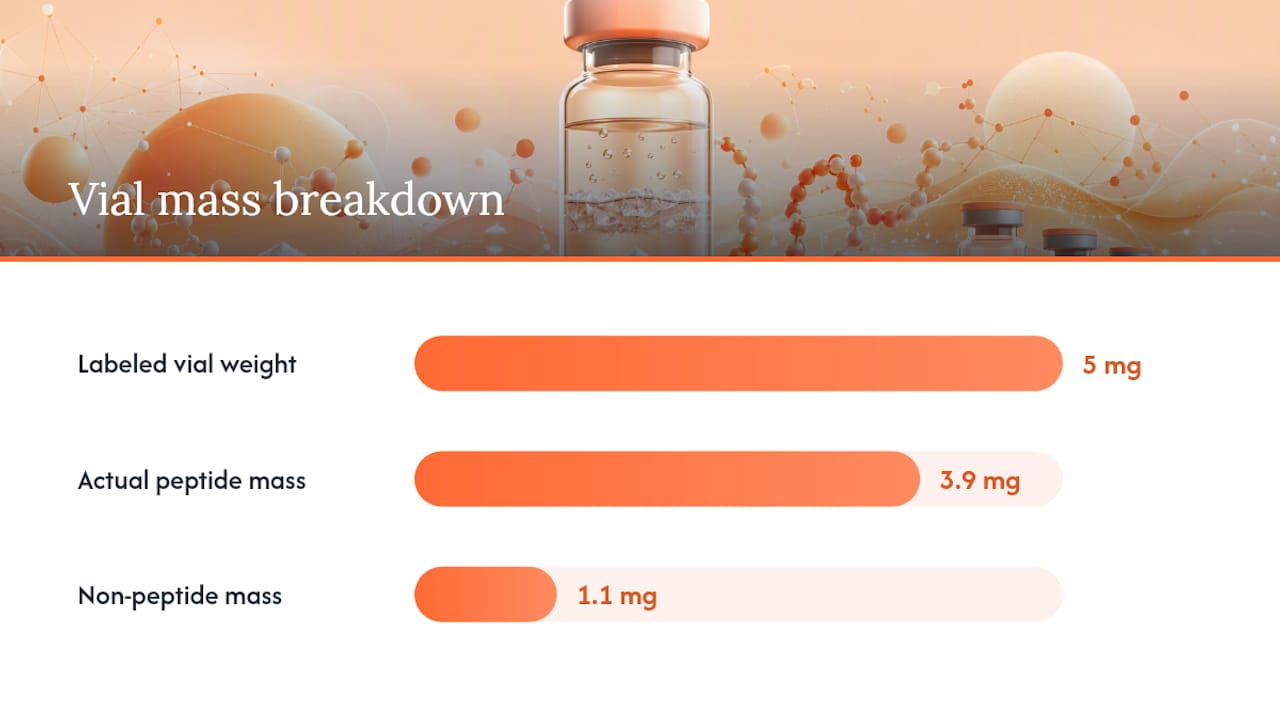
- Apply net peptide content. If the COA states 78% net peptide content, actual peptide mass is 5 mg × 0.78 = 3.9 mg, not 5 mg.
- Correct for salt labeling if net content isn’t stated separately. If a vendor only discloses “acetate salt” without net peptide content, and you have reason to believe the label reflects total salt weight, subtract roughly 2.9% for the acetate mass before treating the remainder as peptide, then flag the lot for follow-up since this is an estimate, not a measurement.
- Divide by reconstitution volume. Adding 2 mL of diluent to that 3.9 mg gives a working concentration of 1.95 mg/mL.
| COA field | Example value | Why it matters |
|---|---|---|
| Labeled vial weight | 5 mg | Starting point, not the answer |
| Net peptide content | 78% | Converts label weight to real peptide mass |
| Corrected peptide mass | 3.9 mg | The number you actually dose from |
| Reconstitution volume | 2 mL | Determines final mg/mL |
| Working concentration | 1.95 mg/mL | What goes into your protocol |
The net peptide content calculation guidance from Palmetto Peptides uses this exact logic: a labeled vial without a net content correction routinely overstates actual peptide by 15 to 30%. Skip step two and every downstream calculation in your protocol inherits that error.
How Batch-Level Testing Actually Reduces Sourcing Risk
Most of the risk in sourcing research semaglutide doesn’t come from bad chemistry, it comes from vendors who never publish lot-specific data at all. A purity claim on a product page means nothing if it isn’t tied to the actual lot number sitting in your freezer.
That gap can be addressed by verifying peptides through HPLC and mass spectrometry testing and maintaining a database of vendor-linked COAs across many verified vendors, with daily price updates so purity and cost can be weighed together instead of separately.
Before you commit to a purchase, use that data the way you’d use any lab reference:
- Confirm the specific lot’s COA exists, not just a generic product-page purity claim
- Compare net peptide content across two or three vendors carrying the same peptide, since prices at the same nominal purity often diverge sharply
- Check endotoxin results if your work involves cell-based assays
- Cross-reference vendor pages like Pure Lab Peptides’ lab results or Pure Peptides.Bio’s COA data to see how different suppliers present the same analytical categories
If a lot arrives without documentation that matches what you were shown pre-purchase, that’s a fixable problem, not one you have to absorb silently, using independent third-party lab testing to confirm what you actually received.
The Real Priority Order Most Buyers Get Backward
Most sourcing advice fixates on price and vendor reputation first, purity second. That ordering is backward. A cheap vial with unverifiable purity isn’t a bargain, it’s an unknown variable sitting in your freezer that will eventually show up as noise in your data.
The evidence here points to a clear priority stack: net peptide content and MS-confirmed identity matter more than a bare HPLC number, because HPLC alone can’t catch a wrong or partially acylated peptide that happens to elute cleanly.
What gets overrated is brand loyalty to a single vendor. What gets underrated is reading method parameters on a COA, the column, gradient, and detection wavelength, because a purity number without them can’t actually be compared against a competing vendor’s claim. If you take one thing from this guide, make it this: demand net peptide content on every lot, every time, before it factors into a single calculation.
— Ross
Verified Listings and Lab Testing When You’re Ready to Source
Independent HPLC and mass spectrometry results tied to the specific lot you’re considering, not a generic purity claim reused across every batch, provide essential verification beyond vendor product pages. That distinction is the entire point of sourcing-first verification.
Every claim in this guide, net peptide content, MS identity near 4,113.58 Da, HPLC method disclosure, only matters if you can check it against the lot in front of you. Browse verified vendor listings and lab-tested purity scores before your next order, and if a lot you already purchased didn’t come with a matching COA, submit it for independent testing to see exactly what you’re working with.
Sources
- Peer-reviewed article summarizing peptide analysis standards (PMC)
- Purity testing and quality standards for semaglutide research peptides (Palmetto Peptides)
- Semaglutide monograph and product notes (American Peptides)