10% Impurities in Peptides: Why Research Use Only Means Risk for Labs

Research Use Only (RUO) means a product is sold for laboratory research and not for diagnostic or clinical decision-making. Using an RUO-labeled product for patient testing, treatment, or reporting results into a medical record is mislabeling, and it is the exact behavior that the FDA and EU IVDR regulators are built to catch.
TL;DR:
- Using RUO-labeled products for clinical testing or patient reports is illegal and can trigger regulatory action, regardless of the label.
- Marketing claims or instructions suggesting clinical use, dosing, or patient outcomes violate RUO regulations and can reclassify the product as a diagnostic or drug.
- European regulations require active assessment of a product’s actual use and claims, not just labeling, to determine if IVDR restrictions apply.
- Vendors often provide certificates of analysis, but independent testing like HPLC and mass spectrometry helps verify purity and detect impurities, especially in compounded products.
- Proper documentation, including detailed experiment records and vendor data, is essential to maintain compliance and defend research use during audits.
Table of Contents
- What “Research Use Only” means in practice
- FDA guidance on RUO and IUO limits for U.S. labs
- EU IVDR scope and the conditional RUO exclusion
- Common misuses and enforcement examples
- Practical lab guidance for staying compliant with RUO products
- RUO peptides, compounded products, and purity risks
- Vendor due diligence checklist before you buy
- Why independent lab data matters for RUO risk
- How Boren Health supports vendor verification
- FAQ
- Sources
What “Research Use Only” means in practice
RUO labeling tells a buyer that a manufacturer built and validated a product for laboratory investigation, not for diagnosing or managing a patient. In practice, that covers activities like method development, analyte identification, assay optimization, and general research into biological mechanisms. It does not cover using the same material to generate a result that informs a clinician’s decision or that gets entered into a patient’s chart.
The label on the box is only part of the story. Regulators look at the full picture, including the manufacturer’s website claims, instructions for use, sales materials, and any dosing or treatment guidance attached to the product, to determine what the product is actually intended for. This is often called the “intended use” doctrine, and it matters more than the printed label itself.
A simple contrast helps. A peptide sold with a certificate of analysis and a note that it is for laboratory research fits squarely within RUO. The same peptide sold with a suggested human dosing schedule, injection frequency, or claims about treating a condition starts to look like an unapproved drug or an Investigational Use Only (IUO) product, regardless of what the label says.

FDA guidance on RUO and IUO limits for U.S. labs
The FDA’s guidance on distribution of in vitro diagnostic products labeled RUO or IUO lays out a “totality of circumstances” test. Rather than taking the label at face value, the agency weighs labeling, promotional claims, and instructions together to decide whether a product is genuinely intended for research or is functioning as an unapproved diagnostic.
Separate Bioresearch Monitoring guidance spells out the hard limits. An RUO-labeled IVD is meant strictly for research use, not in diagnostic procedures, and is restricted to activities like method development and analyte identification. Using that same product for a clinical purpose, including reporting a result into a patient’s medical record, counts as mislabeling even if it happens for a single patient.
A few patterns reliably draw regulatory attention:
- Marketing language that references diagnosis, treatment, or patient outcomes rather than research applications.
- Published dosing tables or administration schedules alongside an RUO product.
- Clinical testimonials or case reports used to promote a research-labeled item.
- Sales targeting clinical laboratories or physician offices instead of research institutions.
Any of these can shift a product out of the “research only” category in the eyes of regulators, no matter what the label says.
EU IVDR scope and the conditional RUO exclusion
Under Regulation (EU) 2017/746, products intended purely for general laboratory research are generally excluded from IVDR scope. That exclusion is conditional, not automatic. If a product’s characteristics or a manufacturer’s own claims indicate it is intended for in vitro diagnostic examination, the exemption falls away and IVDR requirements apply.
This means European labs and manufacturers cannot rely on an RUO label alone to stay outside the regulation. Related MDCG guidance on qualifying in vitro diagnostic medical devices reinforces that classification depends on actual use and promotion, not packaging language.
For a European laboratory, the practical takeaway is straightforward: keep RUO materials inside genuine research protocols, avoid any promotional or internal language that frames results as diagnostic, and flag any product whose marketing drifts toward clinical claims for compliance review before it reaches a bench that touches patient samples.
Common misuses and enforcement examples
Misuse of RUO materials tends to follow a recognizable pattern: a product sold for research starts showing up in marketing copy, sales conversations, or lab workflows that look a lot like clinical testing. Red flags include:
- Dosing tables or administration protocols published alongside a research-only product.
- Claims about patient outcomes, symptom relief, or treatment efficacy.
- Marketing pitched directly at clinics, physicians, or patient-facing practices rather than research institutions.
The FDA has issued warning letters when it found these patterns. One example enforcement action involved promotional and distribution practices that regulators found inconsistent with an RUO label, a reminder that the agency reads marketing and sales conduct as part of the product’s real intended use.
For a lab, using RUO materials clinically creates liability that goes beyond a single warning letter. Results generated from an uncleared diagnostic and then reported into a patient record can expose a laboratory to regulatory action, invalidate downstream clinical decisions, and create legal exposure if a patient is harmed. The safer posture is to treat any drift toward clinical claims as a signal to stop and review, not a minor labeling detail.
Practical lab guidance for staying compliant with RUO products
Staying inside RUO boundaries is mostly a matter of discipline in documentation and experiment design. A few steps make the difference between a defensible research program and an exposed one:
- Keep a signed certificate of analysis (COA) on file for every lot of RUO material you use.
- Document the specific research purpose for each experiment, such as method development or analyte characterization, separate from any clinical activity.
- Never enter RUO-derived results into a patient’s medical record or use them to guide a treatment decision.
- Review vendor marketing and instructions periodically, since a manufacturer’s claims can change a product’s regulatory status even if the label does not.
- If a project needs to move toward clinical application, work with your institutional review board or quality group to transition to IUO or IVD-labeled materials rather than stretching an RUO product’s use.
Good recordkeeping also pays off during an audit. Data integrity practices borrowed from GxP environments, like the ones outlined in this MHRA data integrity guide, give labs a template for documenting methods, retaining samples, and showing regulators that RUO materials stayed inside research use throughout a project.
Pro Tip: Keep a running log that ties each RUO lot number to its specific experiment and purpose. It turns a routine audit from a scramble into a five-minute review.
RUO peptides, compounded products, and purity risks
Peptides sold for research differ from FDA-approved therapeutics in a basic way: research-grade material does not go through the same manufacturing controls, batch consistency checks, or quality assurance pathway that an approved drug does. That gap matters most when compounded products enter the picture.
Independent testing has already flagged real risks. Published analysis identified a previously uncharacterized impurity in compounded tirzepatide and B12 products, present at levels reaching roughly 10% of total protein content in the samples studied. An impurity at that level can affect both the research data generated from a sample and, more seriously, patient safety if the material is ever used outside a controlled research setting.
A certificate of analysis from a vendor does not catch everything. Independent HPLC and mass spectrometry testing can reveal impurities that a standard COA misses entirely, which makes third-party verification a meaningful step before any peptide gets anywhere near a study design that could touch patient-adjacent work.
Vendor due diligence checklist before you buy
Before placing an order, ask any peptide or reagent vendor for the documentation that backs up an RUO claim:
- A current certificate of analysis for the specific lot you’re buying, not a generic template.
- Batch-level test reports showing purity and identity confirmation.
- Stability data and manufacturing site details.
- A clear retention-sample policy in case questions come up later.
Treat a few patterns as warning signs: clinical dosing instructions printed alongside an RUO item, no COA available on request, or a vendor that cannot explain its own retention or testing policy. None of those fit a genuine research-only product.
Where possible, go a step further than the paperwork. Independent HPLC and mass spectrometry testing, sample retention, and a request for raw data behind any vendor-supplied results give a lab its own evidence rather than relying entirely on a vendor’s claims.
Pro Tip: Ask for raw chromatography data, not just a summary purity percentage. A single number can hide a messy chromatogram.
Why independent lab data matters for RUO risk
Most of the risk around RUO materials comes down to a gap between what a label says and what a vendor can actually prove. A COA is a claim, not independent verification, and the compounded tirzepatide findings mentioned earlier show how much a purity number can miss when nobody outside the manufacturer checks it.
Independent HPLC and mass spectrometry testing closes part of that gap by giving researchers a result that does not depend on trusting a vendor’s own paperwork. Published, lot-specific test methods also support reproducibility, since another lab can compare its own results against a documented testing protocol instead of guessing at what a vendor’s internal process actually measured.
The deeper lesson from the regulatory record is that “RUO” is a description of intended use, not a guarantee of quality. Verifying that quality independently is a separate job, and it is one that falls on the lab, not the label.
— Ross
How Boren Health supports vendor verification
We built our platform around the gap described above: an RUO label tells you what a product is for, not whether it is pure. Our independent HPLC and mass spectrometry testing covers vendors across numerous peptides, so you can check a certificate of analysis against lab results before you place an order.
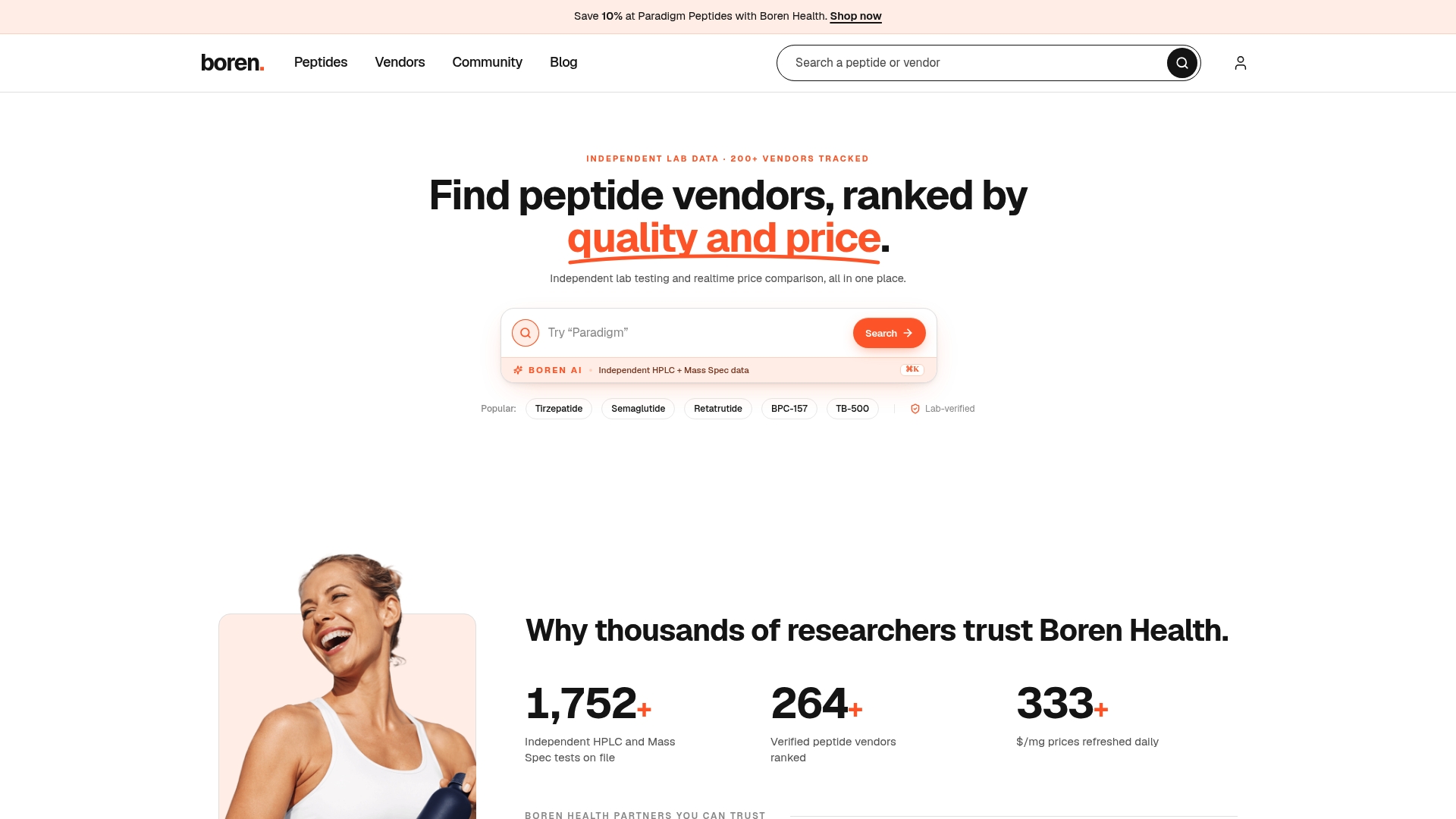
On our platform, you can:
- Compare independent purity and identity results across verified vendors.
- Review vendor price updates alongside lab data for the same product.
- Browse peptides organized by research goal on our goals page, covering areas from weight loss to gut health.
If you’re sourcing peptides for a research program and want vendor data you did not have to generate yourself, start with our vendor comparison platform.
This article is general information, not a substitute for advice from a qualified doctor. Consult a qualified healthcare professional about your own circumstances before acting on anything here.
FAQ
What is research use only?
Research Use Only (RUO) is a labeling category for products, often laboratory reagents or diagnostic components, that manufacturers intend strictly for research applications like method development and analyte identification. It is not a certification of safety or approval for diagnosing or treating patients.
What does it mean for research purposes only?
“For research purposes only” signals that a product has not gone through the regulatory clearance required for clinical or diagnostic use. Using it to generate a result that informs patient care, or reporting that result into a medical record, is considered mislabeling by the FDA.
What is the FDA definition of “research use only”?
The FDA evaluates RUO status using a “totality of circumstances” approach, weighing the product’s label, promotional claims, and instructions together rather than the label alone, as described in its guidance on RUO and IUO products. A product marketed with clinical claims can lose its RUO status even if the label still says “research use only.”
What are research use only materials?
RUO materials include reagents, assay components, and compounds like research-grade peptides that are intended for laboratory investigation rather than patient diagnosis or treatment. Because manufacturing and quality controls for these materials differ from those required for approved therapeutics, independent testing such as HPLC and mass spectrometry is a practical way to verify purity before use in any sensitive study.