Peptide Shelf Life for Labs: Keep Lyophilized Powder at −20°C to −80°C

Lyophilized peptides stored cold and dry retain potency far longer than peptides already dissolved in solution. If you take one action today, make it this: keep powders sealed at −20°C or colder, and split any reconstituted solution into single-use aliquots instead of refreezing one vial over and over. Solutions typically hold up for weeks to months; lyophilized powder can last months to years, depending on the peptide.
TL;DR:
- Lyophilized peptides stored at −20°C or colder can last for years, while aqueous solutions typically degrade within days to weeks without proper containment.
- Peptides rich in methionine, asparagine, or cysteine degrade faster due to oxidation, hydrolysis, or aggregation, especially with repeated freeze-thaw cycles.
- Aliquotting reconstituted solutions into single-use volumes and minimizing freeze-thaw cycles can significantly extend peptide stability and prevent aggregation.
- Reconstituted peptides should be kept at or below their optimal pH and oxygen exposure minimized to reduce chemical degradation.
- Regular stability testing with HPLC, MS, and SEC helps verify peptide integrity and determine accurate shelf life for lab use.
Table of Contents
- How long do lyophilized powders, refrigerated solutions, and frozen solutions last?
- What causes peptides to degrade, and how fast does it happen?
- Storage and handling protocols your lab can adopt today
- How should you handle reconstitution, aliquoting, and in-use storage?
- How do you estimate shelf life and monitor stability over time?
- Where should a lab manager focus limited time and budget?
- Verifying peptide quality before you ever reach the freezer
- FAQ
- Sources
How long do lyophilized powders, refrigerated solutions, and frozen solutions last?
The form a peptide is in when you store it matters more than almost any other variable. Lyophilized (freeze-dried) powder is the most stable state because removing water eliminates the main pathway for hydrolysis and related chemical breakdown. Guidance for mass spectrometry assays recommends storing lyophilized peptides at −20°C to −80°C for stretches longer than six months. A desiccator should be added to control humidity.
A peptide stability review backs this up from the formulation side: most lyophilized peptides remain stable for several years when kept at −20°C, while aqueous solutions degrade faster and need a cold chain to slow the process.
- Lyophilized powder: months to multiple years at −20°C or colder, peptide-dependent.
- Refrigerated solution (2-8°C): realistic for short-term, in-use work, typically days to a few weeks before chemical degradation or microbial risk becomes a concern.
- Frozen solution: freezing buys meaningful extra time over refrigeration, and reconstituted calibrators are best kept at ≤ −70°C for longer-term storage.
None of these ranges are fixed. A peptide heavy in methionine or asparagine residues will degrade faster than a simpler sequence under identical conditions, so treat these windows as starting points, not guarantees.
What causes peptides to degrade, and how fast does it happen?
Degradation runs along two tracks: chemical and physical. Chemical pathways include hydrolysis, deamidation, and oxidation, all of which speed up at the wrong pH or in the presence of oxygen. Physical pathways include aggregation, surface adsorption, and freeze-thaw damage, which become more likely as concentration rises or when a peptide repeatedly contacts air-liquid or vial-wall interfaces.
A review of peptide physical stability lists sequence, concentration, pH, excipients, temperature, agitation, and interfaces as the main drivers of aggregation, noting that freeze-thaw cycling and mechanical agitation are common triggers in lab settings.
Watch these sequence risk flags closely: cysteine (disulfide formation and scrambling), methionine and tryptophan (oxidation-prone), and asparagine or glutamine (deamidation-prone).
- Hydrolysis and deamidation accelerate outside a peptide’s optimal pH range, often near neutral for sensitive sequences.
- Oxidation speeds up with headspace oxygen exposure, which is why sealed, air-minimized packaging matters.
- Aggregation risk climbs with concentration and with repeated freeze-thaw cycling.
- Excipients like surfactants can reduce surface adsorption but may introduce their own stability trade-offs.
A peptide’s own formulation choices, including buffer and excipient selection, change how fast it degrades even at the same storage temperature, according to strategies reviewed for aqueous peptide stability.
Storage and handling protocols your lab can adopt today
Turning the science above into bench practice comes down to a short set of rules, applied consistently.
- Seal lyophilized powder immediately after receipt or use, store it in a desiccator, and keep the freezer between −20°C and −80°C depending on how long you expect to hold the stock.
- Choose vials with minimal headspace and use amber or opaque packaging for light-sensitive peptides.
- Keep reconstituted solutions at or below pH ranges appropriate to the peptide, and exclude oxygen where possible, including through inert-gas blanketing for especially sensitive sequences.
- Limit working solution concentration to what the assay needs. Higher concentrations raise aggregation risk.
- Aliquot every reconstituted batch into single-use volumes the moment it is prepared, label each tube with peptide, concentration, date, and lot, and freeze immediately.
- Warm sealed vials in a desiccator before opening so condensation does not introduce moisture into the powder.
Pro Tip: Treat every freeze-thaw cycle as irreversible wear on the sample: aliquoting before the first freeze costs a few minutes and saves an entire batch from aggregation later.
Operationally, the biggest single improvement most labs can make is simple: stop drawing repeated small volumes from one stock tube. Each freeze-thaw cycle introduces ice crystal formation and local solute concentration spikes that push peptides toward aggregation, so a batch that is aliquoted once at the start tends to outlast one that is cycled repeatedly, even if both are stored at the same temperature.

How should you handle reconstitution, aliquoting, and in-use storage?
Solvent choice matters as much as temperature once a peptide is in solution. Sterile water and bacteriostatic water are the common choices for aqueous work, while DMSO is sometimes used for poorly soluble sequences. Avoid long-term storage in organic solvents unless the peptide’s own stability data supports it.
- Reconstitute only the volume you plan to use soon, then aliquot the rest before the first freeze cycle.
- Label every aliquot with peptide identity, concentration, solvent, and preparation date.
- Thaw a single aliquot per use and discard any unused portion rather than refreezing it.
- Log each freeze-thaw event so you can track how many cycles a batch of aliquots has collectively experienced.
The commonly cited in-use window for reconstituted peptides is often tied to sterility labeling conventions rather than a hard chemical degradation cutoff, so labs should treat it as a conservative default and confirm chemical stability separately when a longer window matters for a specific project.
How do you estimate shelf life and monitor stability over time?
Set a baseline the moment a peptide stock arrives, then recheck periodically rather than waiting for a problem to show up mid-experiment. Reference standard programs use accelerated thermal degradation studies alongside real-time monitoring to establish shelf life and confirm continued suitability for use, and the same logic scales down to a working lab bench.
- Run RP-HPLC for purity and MS for identity confirmation on receipt, and again at set intervals for critical stocks.
- Add SEC when aggregation is a concern, since it flags high molecular weight species that HPLC alone can miss.
- Watch for loss against label claim or the appearance of new impurity peaks as early warning signs.
A practical quarantine trigger many labs use is a purity drop outside the 90 to 110% label claim range, paired with any new high molecular weight peak on SEC. Where resources allow, accelerated stability testing combined with kinetic modeling can project long-term shelf life faster than waiting out real-time storage.
Where should a lab manager focus limited time and budget?
Not every peptide deserves the same level of care. We would put QC and aliquoting effort into expensive or experiment-critical peptides first, and accept simple refrigerated storage for routine, low-risk stocks where a shorter shelf life is not a real cost. Ask any vendor for their own stability data, then verify it independently rather than taking a datasheet at face value. Document your handling steps and hold the line on single-use aliquots for anything sensitive to aggregation.
— Ross
Verifying peptide quality before you ever reach the freezer
Storage protocols only protect a peptide that was pure and correctly identified to begin with. Before you ever get to the point of aliquoting a vial, it helps to know whether the vendor’s purity and identity claims hold up under independent HPLC and mass spectrometry testing. Lab-verified data comparing vendors across many peptides with price updates can help researchers prioritize suppliers whose results are backed by testing rather than a label.
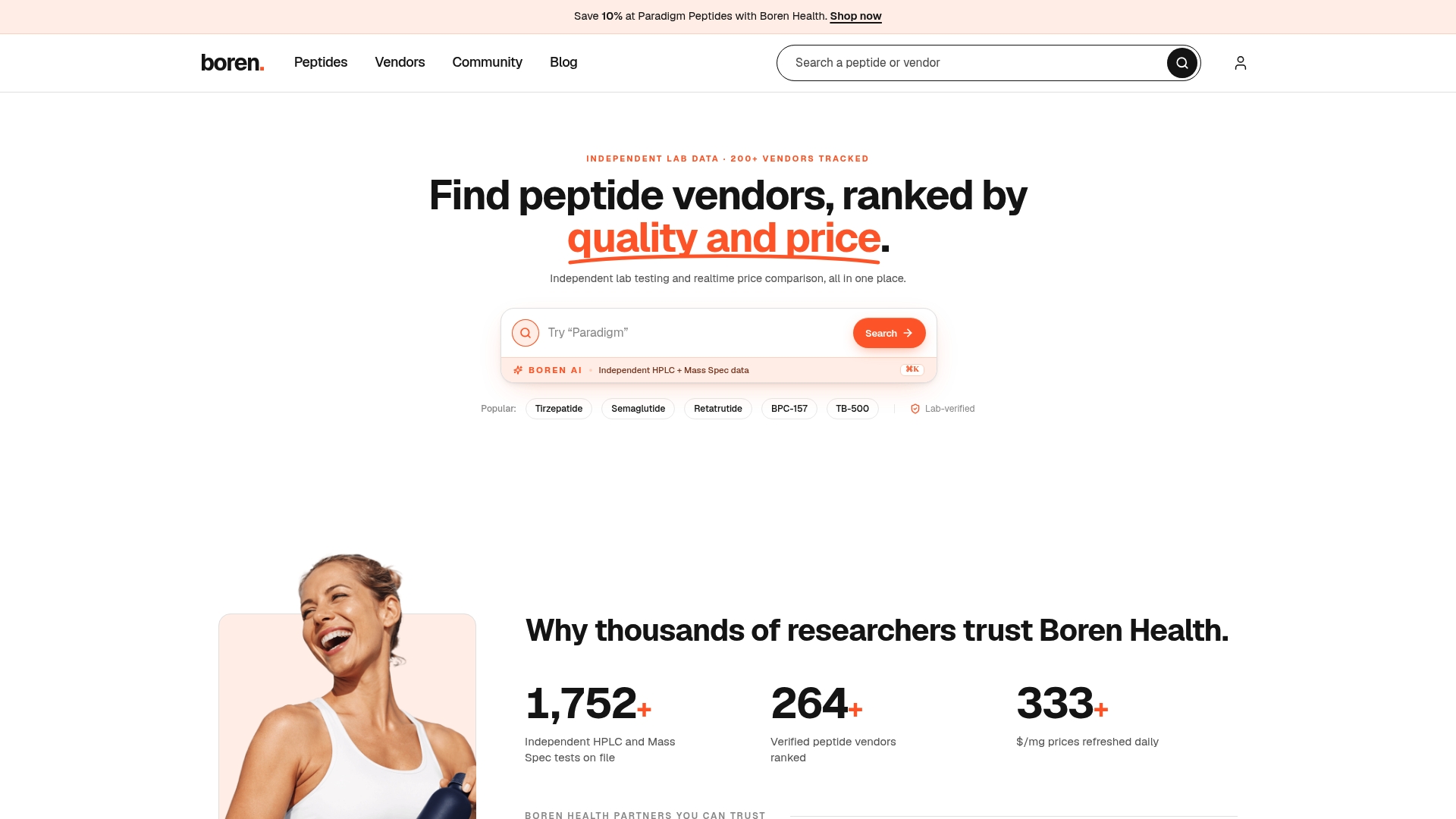
For labs researching specific applications, from weight loss to healing and recovery, reviewing vendor comparisons and plans before you order gives you a head start on the stability work covered above: you are building a storage protocol around a peptide you already trust.
FAQ
How long do peptides last once they are reconstituted?
Reconstituted peptides are commonly used within a conservative time window driven by sterility labeling conventions rather than a strict chemical degradation limit. Refrigeration at 2-8°C supports this window for routine work, while freezing single-use aliquots extends usable life further for sensitive peptides.
What temperature should I store lyophilized peptide powder at?
Lyophilized peptides are generally stored at −20°C to −80°C for long-term stability, sealed and kept in a desiccator to control humidity. Many lyophilized peptides remain stable for several years under these conditions, though sequence-specific sensitivity varies.
Why does freeze-thaw cycling damage peptides?
Repeated freezing and thawing creates ice crystal formation and local spikes in solute concentration, both of which push peptides toward aggregation. The practical fix is aliquoting a stock into single-use volumes before the first freeze, so each tube experiences at most one freeze-thaw cycle.
What lab tests confirm a peptide is still stable?
RP-HPLC confirms purity, mass spectrometry confirms identity, and size exclusion chromatography (SEC) flags aggregation through high molecular weight species. A common acceptance range is 90 to 110% of label claim, with any new impurity or aggregation peak treated as a quarantine trigger.
Does peptide concentration affect how long it stays stable?
Higher concentrations generally raise the risk of aggregation, particularly during freeze-thaw cycling or contact with container surfaces. Keeping working solutions at the lowest concentration your assay allows is a simple way to extend usable stability.