95% vs 80% Peptides: Choosing Peptide Purity Levels for Lab Assays
Screening and hit-finding work tolerates crude or desalted peptide (moderate purity typically around the 50 to 70% range). Antibody production and most bioassays need at least higher purity generally in the 80 to 90% range. Quantitative in vitro potency work wants high purity typically 95% or above. Receptor selectivity studies, NMR, and reference standards demand very high purity generally 98 to 99% or above, and clinical-grade material sits under separate regulatory thresholds entirely. None of that matters if the certificate of analysis lacks mass spec confirmation and net peptide content, because HPLC percentage alone can’t tell you what’s actually in the vial.
TL;DR:
- Peptides used for screening can be crude or desalted, but higher purity levels are essential for bioassays, potency testing, and clinical applications.
- HPLC purity percentages alone are unreliable without mass spectrometry confirmation of molecular weight and sequence; a complete COA should include MS spectra and net peptide content.
- For sensitive assays, order at least 95% purity, and always request additional data like water content and residual solvents to ensure accurate dosing and reproducibility.
- Independent third-party testing provides critical validation beyond vendor COAs, especially for high-stakes experiments where purity discrepancies could invalidate results.
- Most ordering mistakes stem from over-reliance on HPLC percentage alone, rather than matching purity to assay sensitivity and demanding comprehensive documentation.
Table of Contents
- Understanding the Different Peptide Purity Levels
- Matching Purity to Your Experiment: A Practical Guide
- How Peptide Purity Gets Measured and What the Numbers Actually Mean
- A Checklist for Ordering the Right Purity Grade
- Why Independent Verification Changes the Sourcing Equation
- The Real Gap in How Researchers Think About Purity
- Sources
Understanding the Different Peptide Purity Levels
Vendors generally sell peptides in four grades, and each one carries different analytical baggage.
Crude peptide comes straight off the resin after cleavage, with no purification beyond basic workup.
It’s still not something you’d want for anything quantitative.
The UNC High-Throughput Peptide Synthesis and Array Facility associates both grades with actual reversed-phase HPLC and mass spec data delivered alongside the peptide, not just a marketing claim.
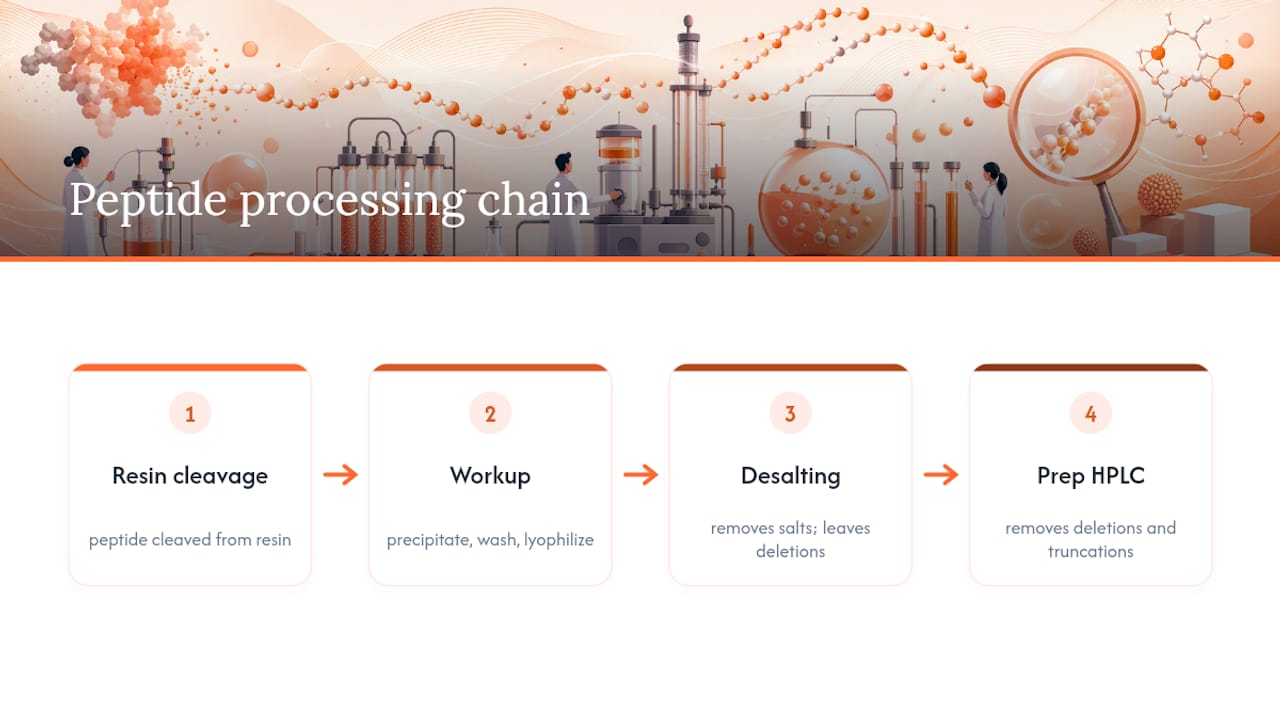
The processing chain matters here. After cleavage, the crude peptide gets precipitated, washed, and lyophilized before any purification starts. Desalting removes ionic contaminants but leaves deletion sequences and truncated byproducts intact. Only preparative HPLC separates those structurally similar impurities from your target sequence, which is why desalted and HPLC-purified peptides can look similar on paper but behave very differently in a sensitive assay.
Turnaround reflects that complexity gap. Crude and desalted orders usually ship in one to two weeks. Build that lag into your experimental timeline before you’re a week from a grant deadline wondering why your order hasn’t landed.
Matching Purity to Your Experiment: A Practical Guide
The purity you need depends entirely on how sensitive your assay is to structurally related contaminants, not on some universal notion of “good enough” peptide.
High-throughput screening and initial hit identification tolerate crude or desalted material because you’re looking for signal, not precision. Below that, deletion sequences and truncated fragments start competing for binding sites or triggering off-target effects that are hard to distinguish from your actual result.
Quantitative enzyme assays and in vitro potency studies push the bar to 95% or higher, a threshold ILS Laboratories also recommends for in vivo work, where dosing accuracy and reproducibility depend on knowing exactly what mass of active peptide you’re administering.
Synthesis scale drives how much peptide you actually get at each grade. The table below reflects typical mg yields reported by UNC’s peptide synthesis facility.
Pro Tip: If your assay is borderline between two purity tiers, order the higher grade for your first pilot run. Re-ordering mid-study because early data looked noisy costs more in time than the purity upgrade would have cost up front.
How Peptide Purity Gets Measured and What the Numbers Actually Mean
HPLC purity is calculated from integrated peak areas: the main peak’s area divided by the total area of everything detected by UV, expressed as a percentage. That number has real blind spots. It doesn’t see counter-ions, it can miss non-UV-absorbing species, and it says nothing about residual solvents left over from synthesis, as Optimum Formula’s guide to peptide purity lays out clearly.
That’s why mass spectrometry isn’t optional for serious work. HRMS or ESI-MS confirms the molecular weight and sequence match what you ordered, and it can catch coeluting impurities that hide under the same HPLC peak as your target compound. Instant Peptides treats HPLC and MS as a paired standard for exactly this reason: one measures purity, the other confirms identity.

The USP’s reference standard guidance addresses this directly with mass-balance approaches that correct for counter-ions and water content to assign an absolute purity value, not just a chromatographic one.
A complete COA should include:
- HPLC chromatogram showing the main peak and any resolved impurities
- MS spectrum confirming molecular identity
- Net peptide content, corrected for counter-ions and water
- Water content, typically by Karl Fischer titration
- Residual solvent data
- Endotoxin testing, if the peptide is going into cell culture
Regulatory frameworks back up why this granularity matters. The 2026 Springer review on synthetic peptide characterization cites Ph. Eur.
A Checklist for Ordering the Right Purity Grade
Work through this before you place an order, not after your data comes back inconsistent.
- Define assay sensitivity first. Decide how much a trace impurity, particularly a deletion sequence with similar structure to your target, could skew your readout.
- Decide whether you need MS-confirmed identity. For anything beyond crude screening, the answer is almost always yes.
- Pick the minimum HPLC percentage that preserves validity. Going higher than the assay requires just adds cost and turnaround for no scientific benefit.
- Request net peptide content and water data, not just an HPLC percentage on a spec sheet.
- Factor in synthesis scale and yield. Confirm the vendor’s mg output at your chosen purity actually covers your full experimental plan, including repeats.
- Set aside budget for re-purification in case an early batch underperforms and needs a cleaner remake.
Red flags worth walking away from: no MS data, no net peptide content figure, no water or residual solvent reporting, or no endotoxin data when the peptide is destined for cell culture. Any one of these gaps means you’re buying on faith.
Why Independent Verification Changes the Sourcing Equation
Vendor-issued COAs vary enormously in rigor, and a single in-house HPLC run isn’t the same thing as independent confirmation. Borenhealth aggregates lab reports and runs independent HPLC and MS testing across more than 200 peptide vendors, which surfaces the gap between what a listing claims and what an outside lab actually finds.
An independent report should mirror the same structure a rigorous in-house COA follows: HPLC chromatogram, MS confirmation, net peptide content, water content, and residual solvent data, all reported together rather than piecemeal. That consistency is what makes a result reproducible across labs, not just plausible on a single spec sheet.
If you’re about to run a critical experiment on a new batch, sending a sample through independent third-party testing before committing bench time is far cheaper than discovering a purity mismatch after the data comes back uninterpretable. Cross-checking a vendor’s published purity score against Borenhealth’s vendor comparison platform before you order is the lower-friction version of the same idea.
The Real Gap in How Researchers Think About Purity
Most guidance on peptide purity treats the HPLC percentage as the whole story, and that’s the biggest blind spot in how labs order material. I’d argue the field has over-indexed on chasing purity percentages upward when the smarter move is matching purity to assay sensitivity and demanding better documentation at whatever grade you choose.
Where conventional advice actually falls short is documentation literacy: researchers accept a bare HPLC chromatogram as sufficient proof far too often, when net peptide content and MS confirmation are the numbers that predict reproducibility.
If you order one thing differently after reading this, make it your habit of requesting net peptide content on every quote, and verify a critical batch independently before it anchors a paper. That single change catches more sourcing problems than any purity upgrade.
— Ross
Sources
- General Description of Services | UNC High-Throughput Peptide Synthesis and Array Facility
- Peptide Purity: HPLC & Mass Spec Guide | Optimum Formula
- Peptide Quality Control: Essential Tests for Research-Use Peptides | ILS Laboratories
- Reference standards to support quality of synthetic peptide therapeutics | USP