Reject Blank COAs: 5 Step Lab Checklist for Peptide Endotoxin Testing
Yes: peptides intended for injection, in vivo work, or sensitive cell-culture assays require verified endotoxin testing before use. The governing methods are the Limulus amebocyte lysate (LAL) assay and recombinant Factor C (rFC), run under USP <85>. The first thing to check is not the vendor’s reputation but the certificate of analysis itself: does it list a numeric EU/mL value tied to the actual lot number? If that field is blank, treat the batch as untested.
TL;DR:
- Ensure the certificate of analysis lists a numeric EU/mL value tied to the lot number; a blank or missing value indicates untested status.
- Recognize that peptides can be sterile but still contain harmful endotoxin levels that activate immune responses or skew assay results.
- Understand that endotoxin contamination accumulates through synthesis, equipment, purification, and storage, making thorough depyrogenation essential.
- Use kinetic chromogenic LAL or recombinant Factor C tests for high sensitivity and low-level quantitation, especially for injectable or sensitive applications.
- Verify that endotoxin results are recent, from an independent lab, matched to your lot, and include a clear numeric value before acceptance.
Table of Contents
- What Peptide Endotoxin Testing Actually Confirms
- What Endotoxins Are and Why They Matter for Peptide Work
- Where Endotoxin Enters the Peptide Production Chain
- How LAL and rFC Testing Methods Actually Work
- Reading Results Against USP <85> and Application Limits
- Preparing Samples and Controlling for Assay Interference
- A Repeatable COA Checklist Before You Accept a Lot
- How Borenhealth’s Lab Data Reduces Vendor Guesswork
- When to Accept, Test, or Reject a Peptide Lot
- The Overlooked Gap Between “Tested” and “Verified”
- Sources
What Peptide Endotoxin Testing Actually Confirms
Peptide endotoxin testing measures how much bacterial lipopolysaccharide (LPS) survives into your final product, reported in endotoxin units per milliliter (EU/mL). It answers a different question than sterility testing does. A peptide can be perfectly sterile, meaning free of live organisms, and still carry enough dead bacterial debris to trigger a pyrogenic reaction or wreck a cell-based assay. That distinction trips up a surprising number of buyers who assume “sterile” and “endotoxin-free” mean the same thing.
Quick reference for lab acceptance:
- Injectable use: requires a validated numeric endotoxin result on the COA, evaluated against a dose-based limit, not a flat cutoff.
- Intrathecal or CNS-adjacent use: apply the stricter intrathecal limit; do not substitute the general injectable threshold.
- Cell culture and in vitro assays: aim for endotoxin at or below a low level generally considered safe to avoid confounding results, since cultured cells are notably sensitive to LPS.
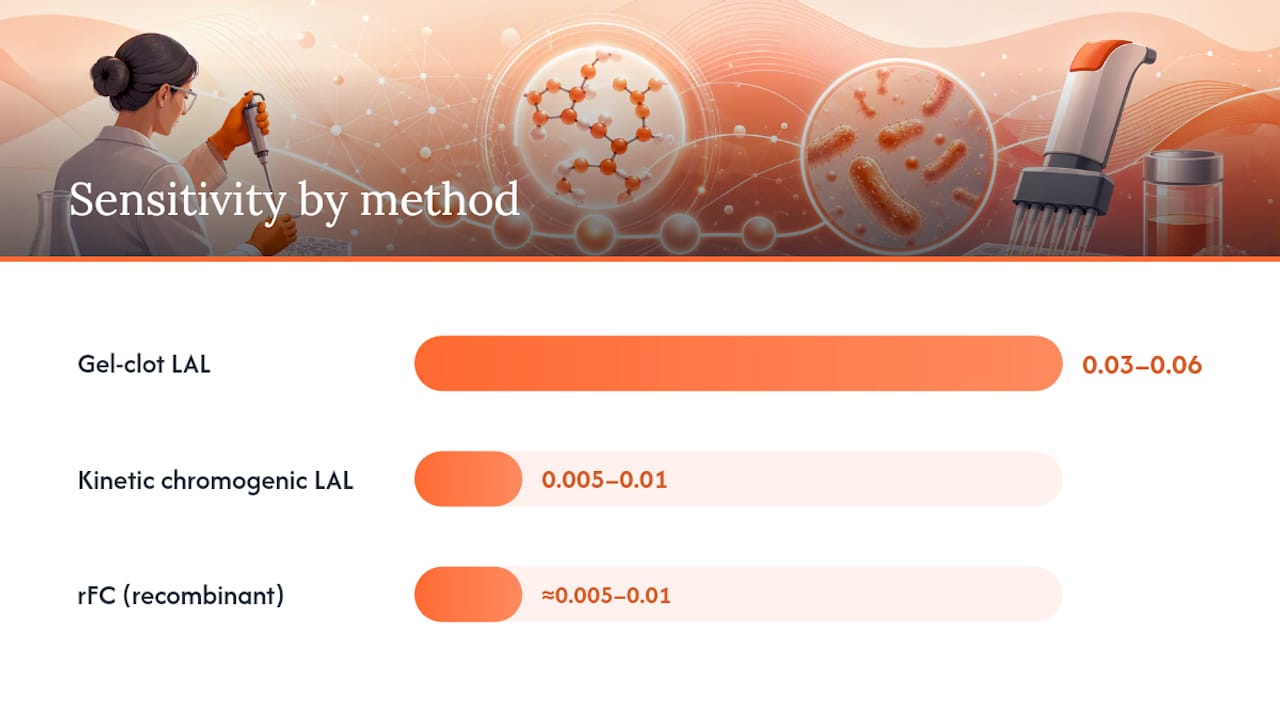
- Test sensitivity: kinetic chromogenic LAL platforms commonly resolve down to 0.005 to 0.01 EU/mL, while basic gel-clot kits typically stop around 0.03 to 0.06 EU/mL.
- Turnaround: third-party quantitative testing generally takes a few business days; in-house kinetic assays can return same-day results.
Red flags worth rejecting on sight: a blank endotoxin field, a lot number on the COA that doesn’t match the vial, a result reported without units, or a “pass/fail” statement with no numeric value behind it.
What Endotoxins Are and Why They Matter for Peptide Work
Endotoxin is lipopolysaccharide, a structural component of the outer membrane of gram-negative bacteria like E. coli. The toxic part is a fragment called lipid A, which is what your immune system, or your cultured cells, actually react to. Even after the bacterium itself is dead, lipid A keeps its shape and keeps triggering a response.
That persistence is the whole problem. Standard sterilization methods, autoclaving, gamma irradiation, 0.2-micron filtration, kill or remove bacteria but do essentially nothing to LPS, which survives sterilization intact because it isn’t a living organism to begin with. A peptide vial can pass a sterility test with flying colors and still deliver a meaningful endotoxin load.
In practice, this shows up two ways. In vivo, endotoxin triggers fever, inflammation, and in high enough doses, septic shock, which is exactly why regulators set strict per-kilogram dosing limits for injectables. In vitro, the effects are subtler but just as disruptive: LPS activates toll-like receptor 4 on immune and many non-immune cell lines, throwing off cytokine assays, skewing proliferation data, and making it look like your peptide has an effect it doesn’t actually have. Researchers troubleshooting an assay that “just won’t reproduce” often find LPS contamination as the hidden variable, not the peptide itself.
Where Endotoxin Enters the Peptide Production Chain
Contamination rarely comes from one dramatic failure. It usually accumulates across several ordinary steps, each adding a small amount of risk.
- Synthesis: raw materials, resin, reagents, and especially water used during solid-phase peptide synthesis can carry gram-negative bacterial residue if sourced or stored improperly.
- Equipment cross-contamination: shared glassware, tubing, and reaction vessels that aren’t properly depyrogenated between batches carry LPS forward from one production run to the next.
- Purification: HPLC columns, mobile-phase solvents, and buffer salts are common overlooked sources, particularly when water isn’t Water for Bacterial Endotoxin Testing (BET) grade.
- Lyophilization and vial filling: the freeze-drying chamber, stoppers, and filling line introduce risk anywhere product sits exposed to non-sterile air or surfaces.
- Storage and reconstitution: even a perfectly clean lot can pick up endotoxin at the bench if a researcher reconstitutes it with non-BET water or a contaminated syringe.
Because LPS adheres tightly to glass, plastic, and metal surfaces and forms stable aggregates, it doesn’t wash away as easily as most people assume, which is why validated depyrogenation, not just cleaning, matters at each of these points.
Pro Tip: If you’re troubleshooting an unexplained assay failure, don’t just re-test the peptide. Test the water and buffers you reconstituted it with. A surprising number of “bad lot” complaints trace back to non-BET water at the bench.
How LAL and rFC Testing Methods Actually Work
Three LAL formats dominate peptide quality control, and each trades sensitivity for speed and simplicity differently.
Gel-clot LAL is the oldest and simplest format. You mix sample with lysate reagent, incubate, and check whether a firm gel forms. It’s a yes/no, pass/fail test rather than a quantitative one, with typical sensitivity around 0.03 to 0.06 EU/mL. It’s cheap and requires minimal equipment, but it won’t tell you how much endotoxin is present, only whether it crosses a threshold.
Kinetic turbidimetric LAL tracks the cloudiness that develops as the LAL reaction proceeds, measuring optical density over time to generate an actual EU/mL value. It’s quantitative and reasonably sensitive, making it a common middle-ground choice for routine batch release testing.
Chromogenic LAL uses a synthetic substrate that releases a colored compound proportional to the enzymatic reaction endotoxin triggers. Kinetic chromogenic platforms, including instruments like the Charles River Endosafe nexgen-PTS, routinely achieve sensitivities around 0.005 to 0.01 EU/mL, making this the format most labs reach for when they need precise, low-level quantitation on peptide lots headed for sensitive assays or injectable use.
Recombinant Factor C (rFC) takes a different route entirely. Instead of relying on horseshoe crab blood lysate, rFC uses a recombinant protein that reacts specifically with endotoxin in a single-enzyme cascade. That specificity matters: standard LAL reagents can cross-react with beta-glucans from fungal or cellulose sources, producing false positives. Labs working with peptides purified through cellulose-based filters or that see recurring unexplained “positive” results should consider rFC as an alternative precisely because it sidesteps glucan interference.
A quick comparison:
| Method | Quantitative? | Typical sensitivity | Main advantage |
|---|---|---|---|
| Gel-clot | No (pass/fail) | ~0.03–0.06 EU/mL | Simple, low-cost, minimal equipment |
| Kinetic turbidimetric | Yes | Moderate | Good for routine batch quantitation |
| Kinetic chromogenic | Yes | ~0.005–0.01 EU/mL | High sensitivity, fast, widely automated |
| rFC | Yes | Comparable to chromogenic | Avoids glucan cross-reactivity |
Reading Results Against USP <85> and Application Limits
A numeric EU/mL result only means something once you check it against the right limit for your specific application, and that starts with the Maximum Valid Dilution.
MVD, defined under USP <85>, sets the furthest you can dilute a sample before the assay stops being sensitive enough to detect a meaningful endotoxin level. It’s calculated from the endotoxin limit, the labeled potency or concentration of the product, and the assay’s lysate sensitivity. Testing beyond the MVD risks a false negative, so any lab report should state the dilution used, not just the final EU/mL figure.
Application limits vary sharply by route and use case:
- Injectable products: limits are typically dose-based, often cited around 5 EU/kg of body weight per hour for parenteral drugs, meaning acceptable EU/mL depends directly on dosing volume and frequency.
- Intrathecal administration: the limit tightens considerably given direct CNS exposure; treat intrathecal-intended peptides with the stricter standard, never the general injectable one.
- Cell culture reagents: no single regulatory number applies, but a practical working target of 0.5 EU/mL or below is widely used to avoid confounding cytokine and proliferation assays.
When you evaluate a COA, check four things together: the assay type used (gel-clot, turbidimetric, chromogenic, or rFC), the reported units (EU/mL, never just “pass”), the lot number matching your physical vial, and the test date relative to manufacture. A result missing any of these four is incomplete, regardless of what number it shows.
Preparing Samples and Controlling for Assay Interference
Endotoxin assays fail quietly more often than they fail loudly, usually because of interference nobody checked for. A structured prep sequence catches most of it.
- Calculate your MVD first. Work from your peptide’s concentration, the relevant endotoxin limit for your application, and your lysate’s labeled sensitivity, per USP <85> guidance.
- Run a spike recovery (inhibition/enhancement) test. Add a known endotoxin standard to your sample and confirm you recover 50 to 200% of the expected value; recovery outside that range signals interference that needs correcting before you trust any result.
- Adjust pH if needed. LAL reactions are sensitive to pH outside roughly 6 to 8; peptide samples with strongly acidic or basic buffers often need neutralizing before testing.
- Use Water for BET exclusively. Standard lab-grade or even USP purified water can carry trace endotoxin that skews low-level readings.
- Depyrogenate glassware and equipment. Dry heat at high temperature for a validated time destroys LPS on reusable labware; rinsing alone does not.
Common interfering excipients in peptide formulations include high protein concentrations, certain chelators, and some preservatives, all of which can suppress or exaggerate the LAL reaction.
Pro Tip: If your spike recovery keeps failing, try a higher dilution before assuming your peptide is the problem. Many “un-testable” samples turn out to just need a larger dilution factor to escape their own matrix interference.
A Repeatable COA Checklist Before You Accept a Lot
Before accepting any peptide lot, run the certificate of analysis through five checks:
- Numeric endotoxin value present, expressed in EU/mL, not a pass/fail statement alone.
- Lot number on the COA matches the lot number physically printed on your vial or bag.
- Sterility statement included and clearly distinguished from the endotoxin result, since they answer different questions.
- Testing lab identified, ideally an independent third-party lab rather than the vendor’s own internal QC.
- Test date recorded and reasonably close to the manufacture or shipment date.
Blank endotoxin fields are common across peptide vendor listings, and a blank field does not mean low endotoxin. It almost always means the assay was never run. Treat it exactly like a missing safety data sheet: not a green light, a gap.
If a vendor sends a COA with a mismatched lot number or an unexplained blank, don’t argue the point. Request a re-issued COA tied to your specific lot, or commission independent third-party testing. For peptides headed into regulatory-adjacent or compounding workflows, pair endotoxin testing with a combined panel covering heavy metals and residual solvents rather than running each analysis separately.
How Borenhealth’s Lab Data Reduces Vendor Guesswork
Borenhealth exists because too many peptide COAs leave researchers guessing. The platform aggregates independent HPLC and mass spectrometry verification alongside endotoxin data across more than 200 vendors, so you’re not relying on a single seller’s internal paperwork to judge purity or contamination risk.
High-resolution HPLC coupled with mass spectrometry confirms peptide identity and purity, but it doesn’t test for endotoxin on its own, which is exactly why pairing that data with a validated LAL or rFC result on the same lot matters. Vendor listings on the platform surface both fields together where available, letting you compare purity percentage and endotoxin status side by side instead of hunting through separate PDFs.
If your own vendor’s COA comes back incomplete, blank, or inconsistent, you can submit a sample for independent third-party testing and get lab-verified results back rather than taking a seller’s word for it. That single step turns a guess into a documented answer.
When to Accept, Test, or Reject a Peptide Lot
Match your action to your intended use, not to how the vendor markets the product.
- Accept without further testing only when the COA shows a numeric EU/mL result under the appropriate limit, matched to your lot, from an independent lab, dated recently.
- Run an in-house rapid test (gel-clot or a basic kinetic kit) when the COA is present but you want spot-check confirmation before a sensitive experiment, especially for cell culture work.
- Send out for third-party quantitative testing when the COA is blank, mismatched, or unverifiable, and the peptide is headed for in vivo or injectable use.
- Reject outright any lot where the vendor can’t produce a lot-matched numeric result on request.
For routine procurement, spot-check roughly every third or fourth lot from an established vendor even with a clean COA history, and always pair endotoxin testing with a sterility check for anything injectable.
The Overlooked Gap Between “Tested” and “Verified”
Most guidance on this topic treats endotoxin testing as a compliance checkbox: run the LAL assay, get a number, move on. That framing undersells the actual risk, which sits less in the assay itself and more in what happens before and after it. A validated chromogenic LAL result is only as trustworthy as the sample handling, dilution math, and lot tracking behind it.
The conventional advice also overweights sterility as a proxy for safety. It isn’t. Dead bacteria leave LPS behind, and that fragment doesn’t care whether your autoclave cycle was perfect. If there’s one habit worth building over any other, it’s refusing to accept a blank endotoxin field as anything other than an untested batch, regardless of how polished the rest of the paperwork looks.
Where researchers should focus first isn’t the assay format debate, gel-clot versus chromogenic versus rFC matters less than most people think, if the underlying documentation discipline is weak. Get the COA habits right: numeric value, matched lot, named lab, recent date. Everything downstream, method selection, interference troubleshooting, MVD calculation, only pays off once that baseline is solid.
— Ross
This article is general information, not a substitute for advice from a qualified doctor. Consult a qualified healthcare professional about your own circumstances before acting on anything here.