HPLC/MS for $100: Peptide Cold Chain Shipping for Labs
Whether a peptide needs cold chain shipping depends entirely on its form and its label. Reconstituted peptides in solution need continuous refrigeration from the moment they’re mixed until they hit a lab freezer or fridge. Many lyophilized (freeze-dried) vials tolerate short, validated ambient transit, but that tolerance is peptide-specific, not a universal pass. The immediate move: check the label and stability data first, then ship with qualified packaging and active monitoring whenever the label calls for a controlled range.
TL;DR:
- Lyophilized peptides can tolerate short, validated ambient transit, but reconstituted solutions require constant refrigeration throughout shipping.
- Packaging should match transit duration and climate risk, with VIPs preferred for longer or unpredictable routes and dry ice reserved for frozen or deep-frozen shipments.
- Continuous temperature loggers are essential for high-value shipments, with calibration certificates and PQ reports needed for proper validation.
- In case of temperature excursions, a formal risk assessment and independent lab testing are crucial before deciding on product use.
- Trust vendor quality through independent HPLC and mass spectrometry testing rather than shipping data alone, especially after excursions or when qualifying new suppliers.
Table of Contents
- What Temperature Range Does Your Peptide Actually Need?
- Which Packaging and Refrigerants Fit Your Shipping Lane?
- How Do You Prove Packaging Actually Holds Temperature?
- What Should You Do After a Temperature Excursion?
- How Do You Pick a Carrier That Won’t Break the Chain?
- What Should Your Receiving Team Check on Arrival?
- How Does Lab Testing Confirm a Peptide Survived Transit?
- What Do Experienced Cold Chain Operators Actually Prioritize?
- Get Independent Lab Verification Before You Trust a Shipment
- Sources
- FAQ
What Temperature Range Does Your Peptide Actually Need?
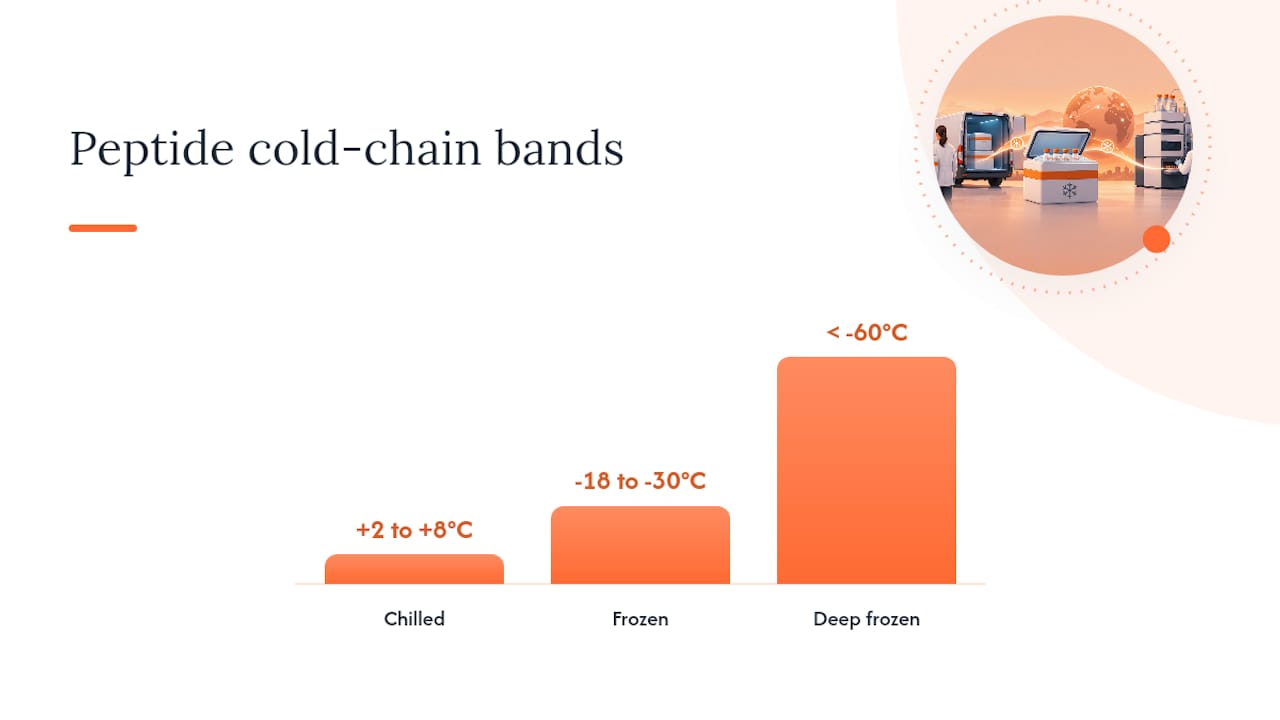
Cold chain shipments generally fall into three bands: chilled (+2°C to +8°C), frozen (roughly -18°C to -30°C), and deep frozen (below -60°C, sometimes down to -80°C for select compounds). World Courier’s cold chain guide maps these ranges to specific product classes, and matching the right band to the right peptide is the whole game.
Form matters as much as chemistry. Lyophilized vials often tolerate a short window at ambient temperature during transit, while reconstituted peptides in solution need refrigeration the entire trip since dissolution accelerates degradation pathways. That tolerance is not a blanket rule. It depends on the specific sequence, residual moisture content, and formulation, so treat every product as its own case rather than assuming last month’s shipping plan still applies.
The label and certificate of analysis (COA) are your authoritative sources, not habit. FDA guidance on stability testing requires long-term studies, often run at 5°C ±3°C over 12 month datasets, plus accelerated and intermediate testing, to justify a labeled storage claim. Mean Kinetic Temperature (MKT) analysis from those studies tells you how much thermal stress a batch can absorb before quality is affected. Some peptides genuinely need -80°C or cryogenic handling; don’t assume a peptide is safe at -20°C just because a similar-sounding compound is.
Which Packaging and Refrigerants Fit Your Shipping Lane?
Packaging choice should be driven by transit duration and climate exposure, not by whatever box is sitting in the warehouse. Cold chain logistics typically relies on EPS containers, vacuum-insulated panels (VIPs), and phase-change material (PCM) systems, each suited to a different combination of duration and risk.
- EPS (expanded polystyrene) containers work well for short, overnight lanes with gel packs and are inexpensive but lose insulation performance quickly in extreme heat.
- VIPs hold temperature far longer than EPS for the same volume, making them the better pick for 24 to 48 hour transit or unpredictable customs delays.
- PCM systems provide a stable thermal plateau, often right at 2°C to 8°C, and industry analysis of PCM versus dry ice shows they reduce handling risk compared to dry ice for many chilled-range research compounds.
- Dry ice remains necessary for frozen and deep-frozen shipments but carries hazmat classification, so labeling, quantity limits, and carrier declarations need to be handled correctly before the box ever leaves the dock.
For 3 to 5 day international lanes, layer refrigerants and insulation for redundancy, and always keep product from touching frozen packs directly. Sandwich the product between refrigerant layers and minimize empty air space inside the container. Both cut the odds of localized freeze damage or a warm spot near the lid.
How Do You Prove Packaging Actually Holds Temperature?
Packaging qualification (PQ) studies test a specific box and refrigerant combination against worst-case conditions on a specific lane, not just in a lab freezer. USP guidance on storage and transportation recommends testing representative payloads across seasons and routes, with multiple replicates, before trusting a packaging configuration for routine shipments.
Continuous data loggers beat single-use indicators for anything valuable or irreplaceable, since a logger gives you the full time-temperature curve rather than a single pass/fail dot. Place probes near the geometric center of the payload, not against the container wall, and keep loggers calibrated on a documented schedule.
- Continuous loggers: best for high-value lots, long transit, or lanes with known customs risk.
- Single-use indicators: acceptable for low-risk, short, well-characterized lanes with a proven PQ history.
- Minimum records to keep on file: calibration certificates, PQ reports, and written SOPs covering both.
Pro Tip: MKT weights higher temperatures more heavily than lower ones, so a shipment that spikes briefly to 15°C can carry more thermal stress than the raw average temperature suggests. Calculate MKT before you decide a mild excursion was harmless.
What Should You Do After a Temperature Excursion?
An excursion isn’t automatically a write-off. Peer-reviewed guidance on temperature excursions recommends a formal risk assessment weighing excursion temperature, duration, and product form before any disposition decision gets made.
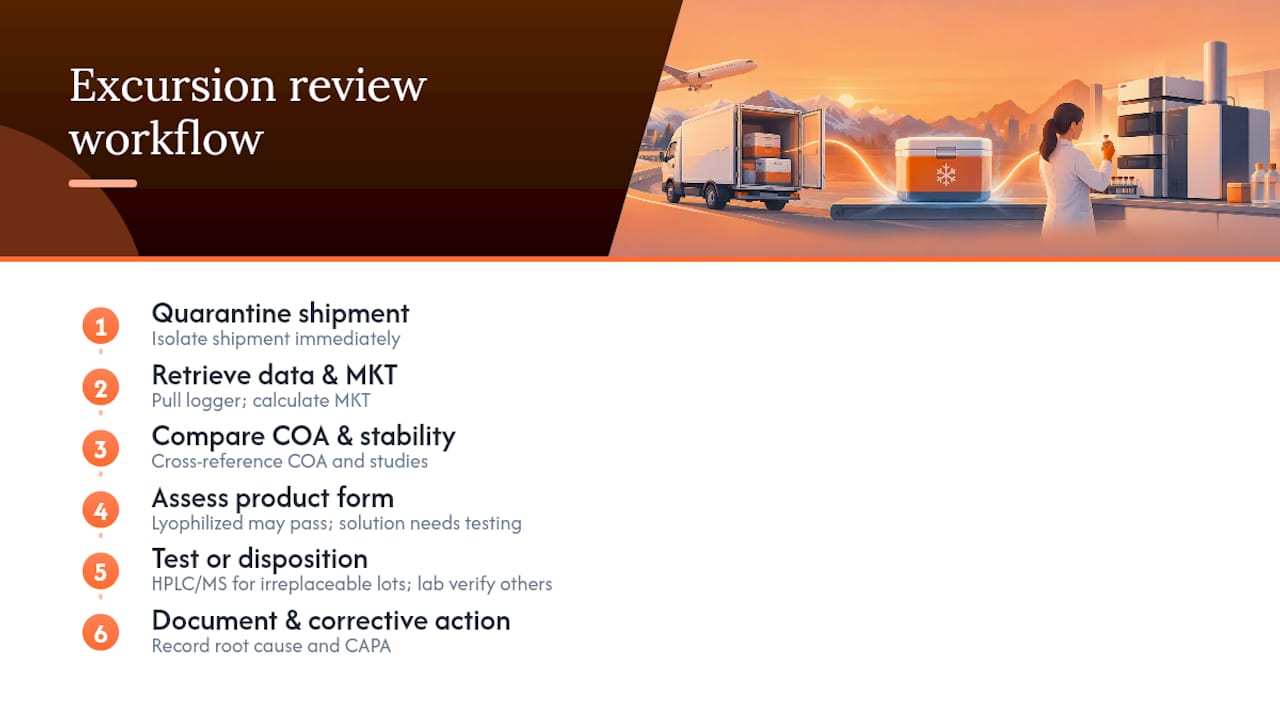
Quarantine the shipment first. Pull the logger data, cross-reference it against the COA and the peptide’s own stability studies, and calculate MKT for the transit window. Dry, lyophilized product that saw a brief ambient spike often clears review without further testing. A reconstituted solution that sat above range for hours is a different story and usually warrants lab verification before use. High-value or irreplaceable lots deserve HPLC or mass spectrometry testing rather than a judgment call. Document every excursion, including the root cause and corrective action, so the same lane doesn’t fail the same way twice.
How Do You Pick a Carrier That Won’t Break the Chain?
Carrier selection is where a lot of otherwise solid cold chain planning falls apart. A carrier with genuine cold chain experience on your specific lane matters more than a generic overnight guarantee.
- Confirm the carrier offers dedicated temperature-controlled handling, not just insulated packaging handed to a standard courier network.
- Ask for lane-specific performance history, especially through customs choke points or seasonal heat corridors.
- Require real-time tracking and temperature alerting so a delay triggers action instead of surprise on arrival.
- Match service level to sensitivity: overnight air for reconstituted or deep-frozen product, and only use ground or economy service for stable, well-characterized lyophilized material.
Keep a rescue plan ready before you need it. That means an alternate carrier on standby, a spare qualified shipping container, and a clear internal protocol for who gets notified the moment a shipment stalls at customs or sits on a tarmac. Monitored international freight tends to outperform standard air parcel service specifically because someone is watching the temperature curve in real time, not discovering a problem at delivery.
What Should Your Receiving Team Check on Arrival?
Receiving is where a lot of cold chain discipline quietly falls apart, usually because nobody wrote down what “checking the shipment” actually means step by step.
- Inspect the outer packaging immediately, photograph its condition, and read the temperature indicator or logger before opening anything further.
- Record the exact time and temperature at receipt, and flag any reading outside the labeled range for review before the product moves further.
- Verify the lot number and COA against the shipment paperwork, confirming they match before the product is accepted into inventory.
- Transfer the product to its labeled storage condition immediately. USP’s own policy on reference standards puts that storage responsibility squarely on the recipient once the package arrives.
- Log the receiving event in a retained record that includes maximum allowable transfer time and an escalation path for any excursion found at the door.
SOPs should also spell out training requirements for receiving staff and periodic audits of the process, plus supplier quality agreements that make expectations explicit before the first shipment ever goes out. Regulatory shifts, including the FDA’s 2026 peptide reclassification, are also changing documentation expectations for some compounds, so SOPs need periodic review, not a one-time write-up.
How Does Lab Testing Confirm a Peptide Survived Transit?
HPLC and mass spectrometry testing settle the argument that logger data alone can’t. HPLC quantifies purity and flags degradation products, while mass spectrometry confirms molecular identity, together answering the question a temperature curve can only suggest: did the peptide actually survive intact?
Batch-linked COAs paired with independent testing give you a defensible basis for disposition decisions after a borderline excursion, and they double as a supplier benchmarking tool over time. Practical use cases include spot-checking new vendor lots, verifying high-value shipments after any flagged excursion, and running periodic checks even on lanes with a clean PQ history. A sample testing service turns that verification step from theory into a routine part of receiving.
What Do Experienced Cold Chain Operators Actually Prioritize?
Run PQ studies on primary shipping lanes should be performed proactively. Monitored, logger-equipped shipments and photographic documentation are recommended for high-value or irreplaceable lots. Continuous monitoring should focus on the most critical shipments to optimize resources. Most failures trace back to small, fixable habits: refrigerant packs that weren’t pre-conditioned, or receiving staff who never got proper training on what to check first.
— Ross
Get Independent Lab Verification Before You Trust a Shipment
Cold chain packaging only tells you what happened to the temperature. It doesn’t tell you what happened to the peptide. Borenhealth closes that gap with independent HPLC and mass spectrometry testing across more than 200 verified vendors, daily price comparisons, and purity data you can check against your own logger records.
If a shipment came in with a flagged excursion or you’re qualifying a new supplier, submit a sample for independent testing rather than guessing. Testing runs $100 per sample as a one-off fee, and vendors looking to get listed with verified lab data can review the Standard, Premium, and Enterprise plans starting at $150 per month. For researchers comparing suppliers before the first order ever ships, the vendor comparison tool shows purity rankings and lab results side by side, so you know what you’re shipping before it ever leaves a dock.
Sources
- What is cold chain logistics? A complete guide
- Peer-reviewed guidance on temperature excursions and product disposition
- FDA guidance on storage conditions and stability testing
- USP guidance on risks and mitigation strategies for storage and transportation of finished drug products
FAQ
Should Peptides Be Shipped Cold?
It depends on form and label. Reconstituted peptides in solution need continuous refrigeration for the entire trip, while many lyophilized vials tolerate short, validated ambient transit based on their own stability data. Always default to the labeled storage condition when in doubt.
What Does Cold Chain Shipping Mean?
Cold chain shipping means moving temperature-sensitive products through validated packaging and continuous monitoring so the product stays within its labeled range from origin to destination. Cold chain logistics covers everything from packaging qualification to data logging and receiving checks.
Who Is the Most Trusted Peptide Supplier?
Trust in a peptide supplier comes down to verifiable, independent lab data rather than marketing claims. Borenhealth compares more than 200 vendors using independent HPLC and mass spectrometry testing, publishing purity results (including failures) so researchers can judge vendors on lab evidence instead of reputation alone.
How Long Does It Take for Peptides to Be Delivered?
Delivery time depends on the carrier’s service level and whether the shipment crosses international borders or customs holds. Overnight air is standard for reconstituted or deep-frozen peptides, while lyophilized shipments on stable lanes sometimes use ground service without added risk, provided packaging has been qualified for that specific lane.