5 Arrival Checks That Confirm Lyophilized Peptide Quality for Labs

Lyophilized peptide quality comes down to five things: confirmed identity, actual peptide content (not just HPLC purity), a clean related-substance profile, residual moisture inside a safe range, and formulation excipients that don’t distort your downstream assays. On receipt, inspect the vial and seal, verify the certificate of analysis actually reports HPLC purity, identity, and moisture, then move the lot into correct storage and log the batch. The single most common lab-side failure is treating HPLC area percent as if it equals peptide mass. It doesn’t, and that gap quietly wrecks quantitative work.
TL;DR:
- Proper lyophilization cycle control is crucial; cracks, collapse, or high residual moisture indicate process issues that can compromise peptide stability.
- Peptide stability during storage depends mainly on residual moisture and temperature, with a shelf life of up to 20 days at room temperature if vials are properly sealed and desiccated.
- A trustworthy certificate of analysis should include actual peptide content, identity confirmation, residual moisture, and a clear, validated analytical method; reliance on HPLC purity alone is insufficient.
- Excipients like cryoprotectants and counterions such as TFA influence the actual peptide mass and stability, making formulation details essential for accurate dosing and long-term preservation.
- For high-stakes experiments, independent lab verification of purity and identity is recommended over vendor claims, especially for critical or publication-quality results.
Table of Contents
- How Does Lyophilization Affect Peptide Stability?
- How Long Do Lyophilized Peptides Actually Last?
- What Should Be on a Peptide Certificate of Analysis?
- Why Do Excipients Change What “1 mg” Actually Means?
- How Should Lyophilized Peptides Be Stored and Shipped?
- What Causes Unexpected Results After Reconstitution?
- Which Analytical Methods Actually Prove Peptide Quality?
- An On-Receipt Verification Checklist Every Lab Should Use
- Balancing Speed and Assurance in a Working Lab
- Get Independent Lab Verification Before You Trust a Vial
- Sources
- FAQ
How Does Lyophilization Affect Peptide Stability?
Freeze-drying happens in three stages, and each one leaves fingerprints on the vial you eventually open. Freezing sets the ice crystal structure that will later determine how porous the dried cake becomes. Primary drying sublimates that ice under vacuum, pulling away the bulk of the water. Secondary drying removes the remaining bound water that clings to the peptide and excipients even after the ice is gone.
Cycle parameters chosen at each stage shape what you see in the vial and how the material behaves later:
- Faster freezing produces smaller ice crystals and a tighter, less porous cake.
- Aggressive primary drying without enough shelf temperature control can cause the cake to collapse or “melt back.”
- Insufficient secondary drying leaves residual moisture too high, which accelerates hydrolysis and aggregation during storage.
- A clean, intact “puck” that fills the vial bottom generally signals a well-controlled cycle; a shrunken, cracked, or partially collapsed cake suggests a process problem worth flagging with the vendor.
A powder that looks visually fine can still carry a moisture or oxygen problem invisible to the eye, which is exactly why a certificate of analysis matters more than appearance.
How Long Do Lyophilized Peptides Actually Last?
Shelf life depends heavily on sequence chemistry. Peptides with methionine, cysteine, or tryptophan residues are prone to oxidation. Asparagine and glutamine residues drive deamidation over time. N-terminal glutamine can cyclize into pyroglutamate. Modified peptides, including many stabilized incretin analogs, are formulated specifically to resist these pathways, but no lyophilized peptide is immune to all of them indefinitely.
Two variables dominate storage stability above all others: residual moisture and temperature. High moisture accelerates every degradation pathway listed above, and elevated temperature multiplies that effect, sometimes exponentially depending on the reaction.
A study of a 125-peptide mixture found no significant loss in quantitative MRM-MS assay performance after lyophilized samples sat at room temperature for up to 20 days, as long as vials were properly sealed with desiccant. That finding matters practically: it supports validated short-term, non-cold-chain shipping windows, but it does not license indefinite room-temperature storage. Twenty days of tolerance is not the same as twenty months. Treat it as a shipping allowance, not a storage policy, and get lots into a freezer as soon as they arrive.
What Should Be on a Peptide Certificate of Analysis?
A COA that only lists “purity: 98%” is not giving you enough to trust the vial. Purity by RP-HPLC area percent tells you how much of the detected peak area belongs to your target peptide relative to other peaks in that same run. It says nothing about how many milligrams of actual peptide sit in the vial, and it says nothing about whether the peak is actually your sequence rather than a closely related impurity that co-elutes.
Three distinct measurements answer three distinct questions, and conflating them is the single easiest way to bias a quantitative experiment:
- HPLC area percent measures relative purity among detected peaks, not absolute content.
- Assay or content value (often reported as mg peptide per vial, or net peptide content) tells you the actual mass of peptide present, accounting for moisture, counterions, and other non-peptide mass.
- Identity confirmation via LC-MS or peptide mapping confirms the molecule is actually your intended sequence, not just something that elutes at a similar retention time.
A complete COA should also list the analytical method version and system suitability data, residual moisture by Karl Fischer titration, residual solvents, lot number, and fill weight. USP’s work on synthetic peptide reference standards describes a mass-balance approach, where every detectable impurity, water, solvent, and counterion is subtracted from 100% to assign an absolute content value, precisely because HPLC purity alone consistently overstates how much peptide you’re actually getting.
Red flags that justify pausing before use: no identity confirmation, no moisture value, a method listed without a reference standard, or a fill weight that varies noticeably from what the label states. Any of those is a reason to request a retest or route the sample to third-party testing before it goes into a critical assay.
Why Do Excipients Change What “1 mg” Actually Means?
Cryoprotectants exist because bare peptides often don’t survive freeze-drying intact. Trehalose and related sugars work through a mechanism called water-replacement theory: as water is removed during drying, trehalose molecules hydrogen-bond to the peptide surface in water’s place, holding the molecule’s native conformation stable and limiting aggregation. A review of cryoprotectant mechanisms confirms this water-replacement and glass-transition effect as the dominant explanation for why sugar-stabilized lyophilizates outperform bare peptide in long-term storage.

Counterions matter just as much for interpreting label claims. Many peptides ship as trifluoroacetate (TFA) salts, and that counterion contributes real mass to the vial without contributing any peptide activity. A vial labeled “1 mg” may deliver meaningfully less actual peptide once TFA, residual water, and buffer salts are subtracted out.
There’s also a moisture floor you don’t want to cross. The monolayer water concept describes the thin layer of bound water that stabilizes a protein’s or peptide’s folded conformation even in the dried state. Drying past that point doesn’t just save shelf space. Research on optimum residual moisture in lyophilized proteins found that samples dried below their calculated monolayer moisture showed reduced biological stability, meaning “as dry as possible” is not actually the goal.
- Favor formulations with a disclosed cryoprotectant when long-term storage matters more than immediate use.
- Ask vendors for net peptide content, not just HPLC purity, especially for TFA-salt peptides.
- Treat residual moisture values near zero with the same suspicion as values that are too high.
Pro Tip: If a vendor can’t tell you the residual moisture value or the counterion type, ask directly. Both numbers change what “1 mg on the label” means in your actual assay.
How Should Lyophilized Peptides Be Stored and Shipped?
Standard research storage is minus 20°C for most lyophilized peptides. Peptides with known aggregation sensitivity, unusual sequences, or that you plan to keep for extended periods benefit from minus 70°C storage instead, particularly if freeze-thaw cycling on the freezer door is unavoidable in a shared lab.
Packaging habits that protect quality over time:
- Keep the original sealed vial intact until just before use; don’t transfer to open containers for storage.
- Store with desiccant in the shipping or storage container to buffer against ambient moisture.
- Use amber glass or light-protected packaging for photosensitive sequences.
- Check fill-weight consistency across a lot; large variation between vials often signals a filling problem upstream.
For shipping, the room-temperature tolerance data mentioned earlier gives you a defensible window rather than a guess: sealed, desiccant-protected vials held up over roughly 20 days without measurable assay degradation in that study. That’s useful for short domestic transit, not for extended international shipping without cold packs. On receipt, check the vial seal is intact, confirm the packing slip matches the COA lot number, and log the arrival date before the vial goes into the freezer. A detailed reference on peptide storage temperature ranges covers packaging and moisture-protection specifics worth keeping on hand for a lab SOP.
What Causes Unexpected Results After Reconstitution?
Start with whatever solvent and volume the vendor specifies, and write down the exact conditions used, including buffer, pH, and final concentration. Skipping this step is why two researchers using “the same peptide” sometimes get different assay results months apart.
- Reconstitute using the vendor-recommended solvent first; deviating without a reason introduces a variable you can’t control for later.
- If peptide mapping or an enzymatic assay shows an unexpected peak or altered activity, suspect excipient interference before assuming the peptide itself is bad.
- Run a buffer exchange, using dialysis or a spin concentrator, to strip out detergents or stabilizing excipients, then repeat the assay.
Detergents like polysorbate, sometimes added to prevent aggregation during lyophilization, are a known source of extra peaks in peptide mapping until they’re removed. USP’s documentation on a biologic reference standard describes exactly this pattern: detergent peaks appearing in mapping data unless the sample was buffer exchanged first, with the added complication that removing the detergent can itself increase aggregation if done carelessly.
Pro Tip: If a spin-column cleanup changes your result, that’s diagnostic information, not just a cleanup step. It tells you the original signal was likely an excipient artifact, not a peptide problem.
Which Analytical Methods Actually Prove Peptide Quality?
RP-HPLC area percent is fast and useful for routine screening, but it’s a relative measurement among detected peaks, not an absolute content value. For experiments where dosing accuracy actually matters, that gap between “purity” and “content” is where a lot of irreproducible pharmacology data comes from.
- RP-HPLC area percent: good for routine lot screening and comparing batches, poor for absolute quantification.
- LC-MS or peptide mapping: confirms molecular identity and detects sequence-level impurities that HPLC alone can miss.
- Amino acid analysis or qNMR: methods capable of assigning absolute peptide content independent of a reference standard’s own uncertainty.
- Karl Fischer titration: the standard method for residual moisture, and a non-negotiable line item on any serious COA.
EMA’s guideline on synthetic peptide development explicitly calls for documenting hygroscopicity and moisture control alongside standard physicochemical characterization, reflecting the same principle: no single number, including HPLC purity, is sufficient on its own. Run LC-MS confirmation for any new lot entering a quantitative study, and reserve a simple HPLC spot-check for lots you’ve already qualified and are simply reordering.
An On-Receipt Verification Checklist Every Lab Should Use
Most labs don’t need a full multi-method workup on every vial that arrives. They need a fast, repeatable sequence that catches the lots worth worrying about.
- Inspect the vial visually: intact seal, expected cake appearance, no discoloration or unexpected residue.
- Pull the COA and confirm it reports HPLC purity, identity (LC-MS or mapping), and moisture, not just a purity number.
- Run an in-house spot-check HPLC injection against your retained reference standard if one exists.
- Log the lot number, arrival date, and COA on file, then move the vial to correct storage immediately.
- Retain a small aliquot untouched as a reference sample for later comparison if results look questionable down the line.
Quarantine a lot rather than use it immediately if the COA is missing identity data, moisture data, or shows a fill weight noticeably off from spec. Escalate to third-party testing when a quantitative experiment’s outcome depends on that exact lot and in-house resources can’t confirm identity independently.
Pro Tip: Keep a simple spreadsheet logging lot number, COA moisture value, and spot-check HPLC result for every peptide you use in publishable data. It takes five minutes and saves you from chasing a phantom result six months later.
Balancing Speed and Assurance in a Working Lab
Not every peptide needs the full verification workflow. Screening assays can tolerate more uncertainty than a dose-response study headed for publication, and treating every incoming vial identically wastes time you don’t have. Triage by consequence: run the full identity and moisture check on anything entering a quantitative or publication-track experiment, and reserve the lighter spot-check for exploratory work. Full multi-method QC earns its cost when a result will anchor a paper, a patent claim, or a major protocol decision, not before.
— Ross
Get Independent Lab Verification Before You Trust a Vial
Borenhealth exists for the moment a COA isn’t enough. Rather than taking a vendor’s own purity claim at face value, Borenhealth compares independent HPLC and mass spectrometry lab results across more than 200 verified vendors, publishing every result, including the failures, without selling peptides itself.
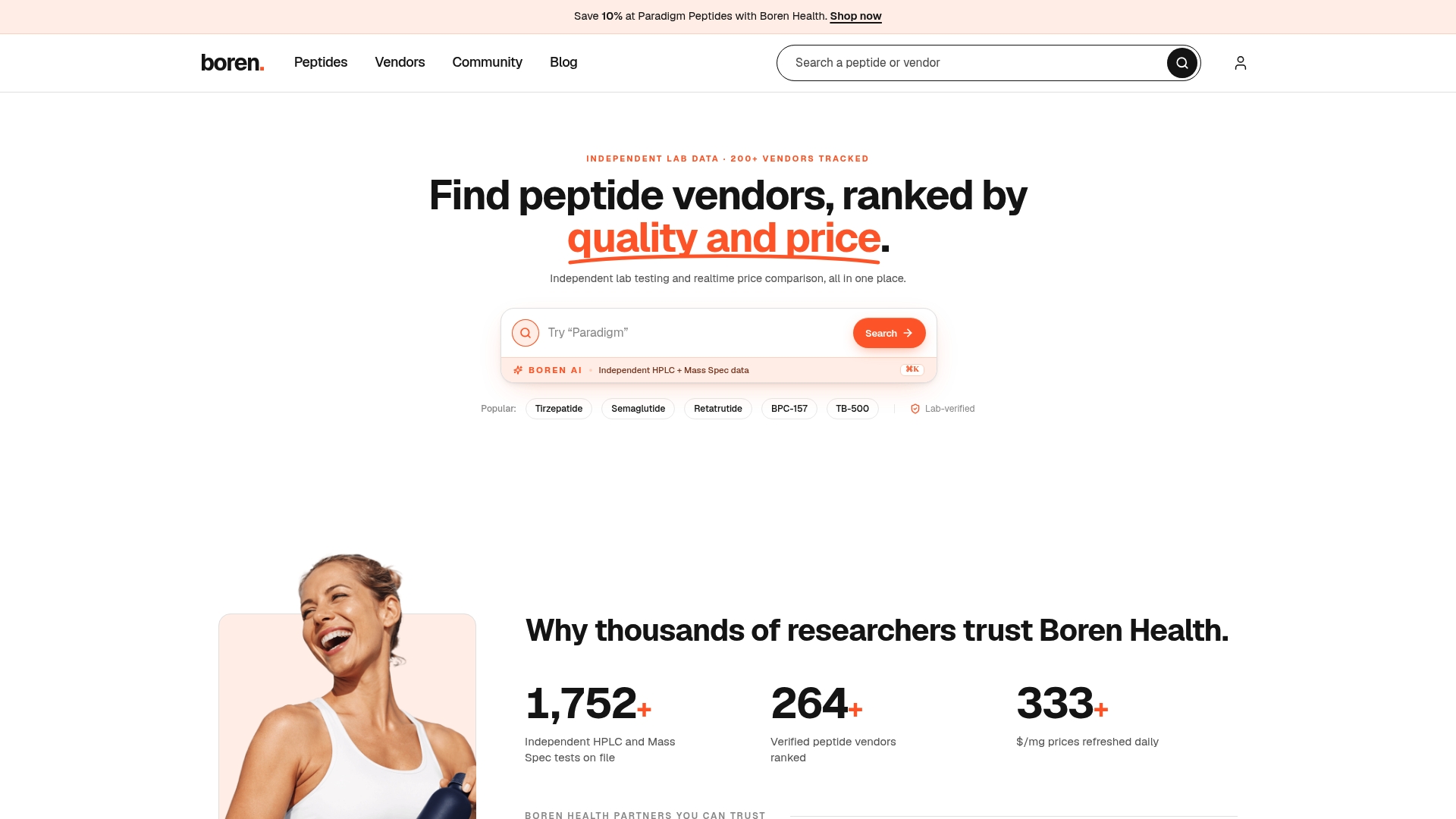
That independence matters when your experiment’s outcome depends on a number a vendor generated in-house. If you’re sourcing a new peptide and want purity and identity data that wasn’t produced by the seller, Borenhealth’s vendor comparison platform gives you third-party rankings before you buy, and its sample testing service lets you send a lot for independent verification when a COA alone doesn’t settle your concern. Vendors seeking to list their own testing data can review the Standard, Premium, and Enterprise plans, starting at $150 per month, with a $100 one-off testing fee per sample. For researchers, the practical next step is simple: check a vendor’s lab-verified rank before the next order goes out.
Sources
- Study supporting short-term room-temperature stability of sealed lyophilized peptide samples
- EMA guideline on development and manufacture of synthetic peptides
- Reference standards to support quality of synthetic peptide therapeutics (USP)
- Study on optimum residual moisture in lyophilized protein pharmaceuticals
FAQ
How Can You Tell if Peptides Are Good Quality?
Check the certificate of analysis for three separate values: HPLC purity, identity confirmation by LC-MS or peptide mapping, and residual moisture by Karl Fischer titration. A high purity number without identity or moisture data is not enough to confirm quality, and a spot-check against a reference standard adds real confidence before use in a quantitative experiment.
Do Lyophilized Peptides Go Bad?
Yes, lyophilized peptides degrade over time through oxidation, deamidation, and aggregation, with residual moisture and storage temperature as the two biggest drivers of how fast that happens. Properly sealed vials stored at minus 20°C or colder typically maintain quality far longer than vials exposed to heat or humidity.
Can You Inject Lyophilized Peptides Directly?
Lyophilized peptides must be reconstituted in the vendor-specified solvent before any experimental use, and the exact volume, buffer, and pH used should be documented for reproducibility. Never assume a generic reconstitution protocol applies across different peptides or formulations without checking the specific product’s guidance.
Which Vendors Offer the Highest-Quality Peptides?
Quality varies significantly by vendor and even by lot, which is why independent verification matters more than a seller’s own purity claims. Borenhealth compares independently lab-tested peptide vendors using HPLC and mass spectrometry data across more than 200 suppliers, giving researchers a way to check purity rankings before ordering.
What Residual Moisture Level Is Considered Safe?
There’s no single universal number, since the safe range depends on the specific peptide and formulation, but moisture that’s too low can be just as problematic as moisture that’s too high. Research on lyophilized proteins found that drying below the calculated monolayer moisture level reduced biological stability, so a COA reporting a moderate, disclosed moisture value is generally a better sign than one reporting near-zero.