Buy or Outsource? LC-MS vs HPLC for Peptide Labs, 100× Sensitivity
HPLC separates and quantifies compounds by optical detection, making it the workhorse for routine purity and quantitation. LC-MS pairs that same separation with mass spectrometry, adding molecular identity and detection limits that can be a hundred times lower. Choose HPLC when you need reliable, validated quantitation; choose LC-MS when you need to confirm what a molecule actually is or find it at trace levels.
TL;DR:
- HPLC provides reliable, validated quantitation but cannot definitively identify molecules at trace levels, unlike LC-MS.
- LC-MS offers detection limits up to a thousand times lower than HPLC and distinguishes compounds by mass-to-charge ratio, even if they co-elute.
- LC-MS requires strict sample preparation practices and high-quality consumables to prevent noise and contamination that can compromise data integrity.
- Operating costs for LC-MS are significantly higher due to consumables, maintenance, and specialized staff, making outsourcing preferable for low-volume or less complex samples.
- Combining HPLC and LC-MS results ensures accurate quantitation and confirmation of molecular identity, especially critical for peptide purity validation.
Table of Contents
- LC-MS vs HPLC: A Quick Comparison
- How Do HPLC and LC-MS Actually Work?
- How Much More Sensitive Is LC-MS Than HPLC?
- What Consumables Does LC-MS Actually Require?
- Is LC-MS Worth the Extra Operating Cost?
- When Should You Use HPLC vs LC-MS?
- How Boren Health Applies Both Techniques to Peptide Testing
- Buy the Instrument, or Send Out the Sample?
- Get Both HPLC and LC-MS Results Without Buying Either Instrument
- Sources
LC-MS vs HPLC: A Quick Comparison
Every lab manager eventually has to pick between three real options, not just two. Here’s the fast version:
- HPLC (UV/PDA detection): Reliable, cheap to run, and excellent for validated quantitation. It tells you how much of something is present, not always exactly what it is.
- LC-MS (single quadrupole): Adds mass confirmation on top of separation. Good middle ground for identity checks without full fragmentation data.
- LC-MS/MS (triple quadrupole): The most selective and sensitive option, capable of picking a single compound out of a dirty biological or environmental matrix.
Sensitivity tiers, roughly speaking: HPLC-UV methods typically detect in the parts-per-million range, single-quad LC-MS pushes into parts-per-billion, and triple-quad LC-MS/MS can reach parts-per-trillion for targeted assays.
Ask yourself four questions before booking instrument time: Do you need to prove identity, or just quantity? Is your matrix clean or complex? Does a regulatory method mandate one technique? And what’s your actual budget and turnaround window?
How Do HPLC and LC-MS Actually Work?
HPLC’s mechanics are straightforward. A pump pushes solvent through a column packed with stationary-phase particles, an autosampler injects your sample, and compounds separate based on how strongly they interact with that packing material. A detector, usually UV-Vis, a photodiode array (PDA), or fluorescence, reads the eluting bands as they pass through a flow cell. The output is a chromatogram: peaks, retention times, peak areas.
LC-MS starts the same way, then adds a chain of extra hardware after separation:
- LC column separates compounds by retention time, exactly as in HPLC.
- Ionization interface (ESI, APCI, or APPI) converts the liquid eluate into charged gas-phase ions. Electrospray ionization and its counterparts do this at atmospheric pressure, which is why they dominate modern LC-MS setups.
- Mass analyzer (single quad, triple quad, or high-resolution MS) sorts those ions by mass-to-charge ratio.
- Data system converts the resulting spectra into identifiable compound signatures, not just peak shapes.
That interface exists because a mass analyzer runs under vacuum, while your LC column runs in liquid at atmospheric pressure. Something has to bridge those two physical worlds, and that bridging step is also why LC-MS methods often demand narrower columns and lower flow rates (nano or micro scale) than a standard HPLC setup.
How Much More Sensitive Is LC-MS Than HPLC?
The numbers back up what most chromatographers already suspect. One comparative study measured absolute detection limits for several antiepileptic and beta-blocking drugs and found LC-MS detecting at roughly 0.2 to 0.5 nanograms, versus 10 to 25 nanograms for HPLC on the same compounds. That’s not a marginal edge. It’s a difference measured in orders of magnitude.
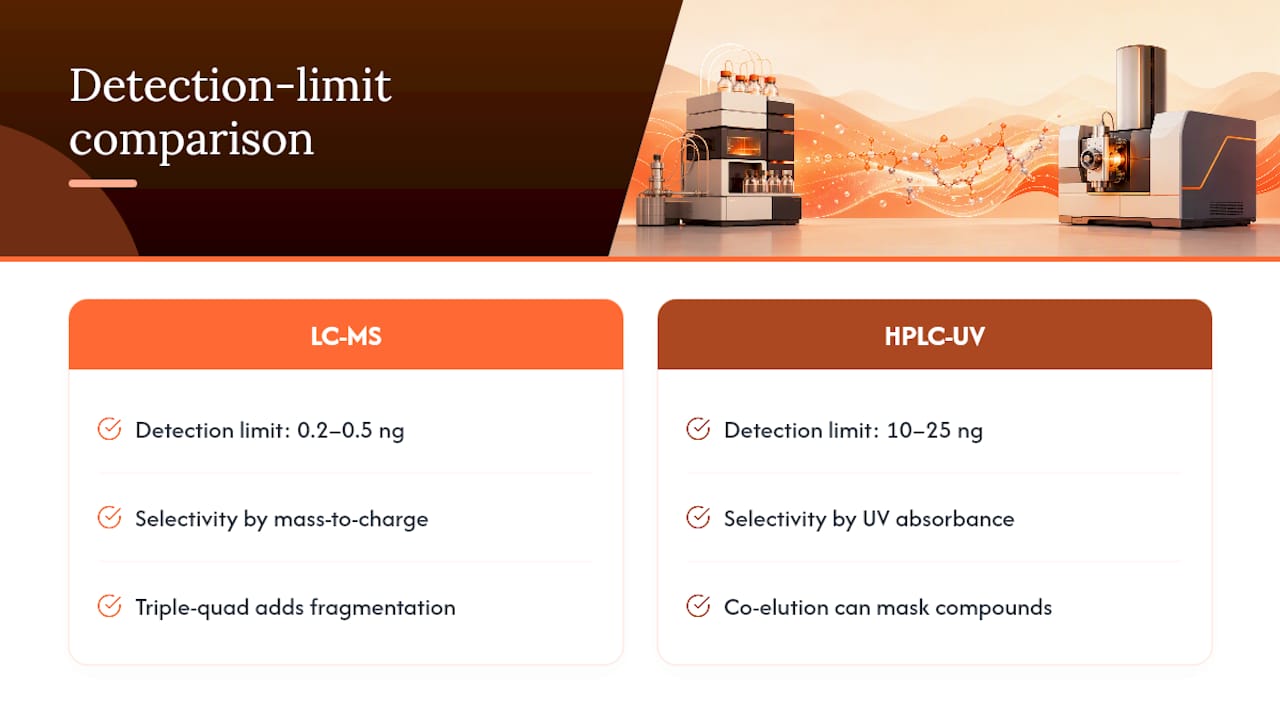
Selectivity works differently, too. HPLC-UV distinguishes compounds by how they absorb light, which fails when two substances share similar absorbance and co-elute. LC-MS distinguishes by mass-to-charge ratio, and triple-quad instruments add fragmentation patterns on top, so two co-eluting compounds with identical UV spectra can still look completely different to an MS detector.
None of this is free of pitfalls. Ion suppression, where matrix components interfere with ionization efficiency, can make a compound appear less concentrated than it is. Adduct formation can split a single compound’s signal across multiple masses. Both distort apparent sensitivity if you’re not correcting for them with matrix-matched calibration and isotope-labeled internal standards.
What Consumables Does LC-MS Actually Require?
This is where labs get burned. LC-MS is far less forgiving of sloppy sample prep than HPLC, and the consumables you’d tolerate on an HPLC run can wreck an MS baseline.
- Filter samples through 0.22 µm membranes, not the 0.45 µm filters that pass fine on HPLC.
- Use certified low-background (Type 5.0) vials. Cheap vials leach plasticizers that show up as ghost peaks.
- Skip nonvolatile buffers like phosphate. Stick to volatile modifiers, ammonium acetate, ammonium formate, or formic acid, that won’t contaminate the ion source.
- Run blanks between batches and use matrix-matched calibration so ionization differences between your standard and your real sample don’t skew results.
- Choose low-bleed columns to avoid stationary-phase material shedding into the mass spectrometer.
Low-grade consumables are one of the most common root causes of unexplained LC-MS noise, and most of it traces back to filters, vials, or buffers someone grabbed because they were already in the cabinet.
Pro Tip: Keep a separate consumables shelf labeled “MS-safe only.” The five minutes it takes to walk to the right cabinet is cheaper than re-running a batch because a phosphate buffer fouled your source.
Is LC-MS Worth the Extra Operating Cost?
Instrument price is the obvious gap. A capable HPLC system with UV/PDA detection runs a fraction of what a triple-quad LC-MS/MS system costs, and that gap widens further with high-resolution mass spectrometry (HRMS). But sticker price is only part of the real comparison.
- Solvents and consumables: LC-MS demands LC-MS-grade solvents and certified vials, both pricier than standard HPLC-grade equivalents.
- Maintenance cycles: Vacuum pumps need regular servicing, and ion sources require periodic cleaning to prevent signal drift. HPLC maintenance is comparatively simple, mostly column care and pump seals.
- Downtime risk: A fouled MS source can take a system offline for a day or more, where an HPLC clog is usually a same-day fix.
- Staffing: HPLC data interpretation is largely automated peak integration. LC-MS data interpretation is genuinely harder, requiring specialized expertise to read spectra, resolve adducts, and validate identifications rather than just accept software output.
HPLC’s simplicity is precisely why it remains easier to validate for routine QA/QC work, while LC-MS earns its cost premium when identity, not just quantity, is the question.
When Should You Use HPLC vs LC-MS?
The decision usually comes down to what question you’re actually asking the instrument.
- Routine QA/QC and batch release: HPLC handles this well. If your method is validated and you just need a purity percentage against a specification, optical detection is fast, reproducible, and cheaper per sample.
- Stability studies: HPLC again, unless you specifically need to identify degradation products rather than just track their appearance.
- Identity confirmation and impurity profiling: LC-MS/MS is the right call. Labs that need to confirm what an unknown peak actually is lean on mass spectrometry because optical spectra alone can’t settle that question.
- Metabolomics, forensic, and toxicology work: LC-MS/MS, full stop. Complex matrices and trace-level targets make MS detection close to mandatory.
- Peptide analysis specifically: Run HPLC to get your purity percentage, then run LC-MS to confirm sequence identity and screen for unwanted modifications or truncations that a purity number alone would never reveal.
Before committing to either, run through this checklist: What LOD does your application actually require? Do you need structural information, or just a number? How complex is your matrix? Does a regulatory method (USP or EP) dictate the technique? And does your throughput and budget realistically support LC-MS’s added complexity?
How Boren Health Applies Both Techniques to Peptide Testing
Peptide purity claims mean little without both halves of this comparison, which is exactly why Borenhealth runs HPLC and LC-MS in tandem rather than picking one. HPLC establishes the quantitative purity percentage; LC-MS confirms molecular identity and flags fragmentation or unwanted modifications that a purity number alone would miss.
Borenhealth enforces the consumable and matrix-control standards that keep LC-MS data trustworthy, including low-background vials and matrix-matched calibration, rather than letting variable prep quietly erode sensitivity. Researchers and buyers then use those combined lab results and vendor comparisons to make procurement decisions grounded in actual data instead of a vendor’s marketing claim.
Buy the Instrument, or Send Out the Sample?
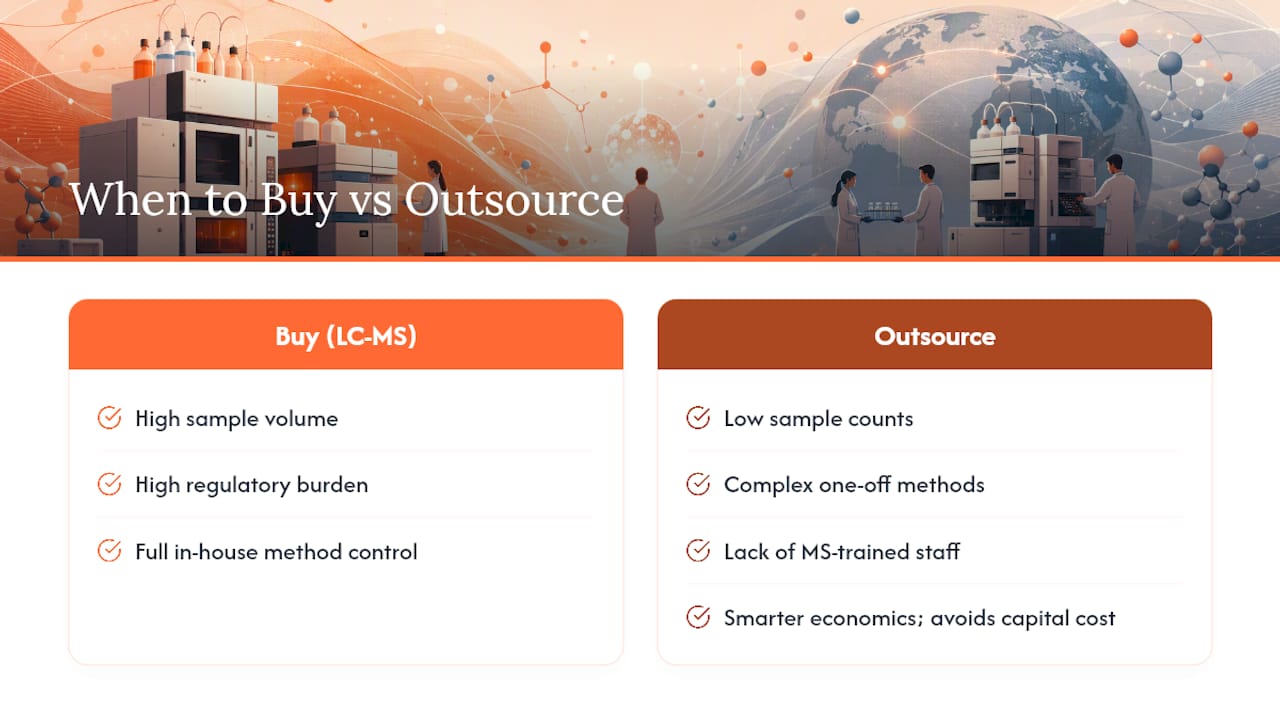
Buying an LC-MS system only makes sense if your sample volume is high and your regulatory burden demands in-house control over every method parameter. Outside of that, outsourcing is usually the smarter economics: low sample counts, complex one-off methods, or a lack of staff trained in MS data interpretation all argue for sending samples to a specialized lab rather than carrying that capital cost yourself.
One caution worth repeating: a mass spectrum is not automatically the truth. Without proper validation, isotope-labeled standards, and matrix-matched calibration, an MS signal can mislead just as easily as it clarifies.
— Ross
Get Both HPLC and LC-MS Results Without Buying Either Instrument
Running this comparison in-house means budgeting for two instrument platforms, certified consumables, and staff who can actually read a mass spectrum. Borenhealth skips that capital outlay entirely: submit a sample and get back lab-verified HPLC purity data alongside LC-MS identity confirmation, generated under the same consumable and matrix-control standards described above.
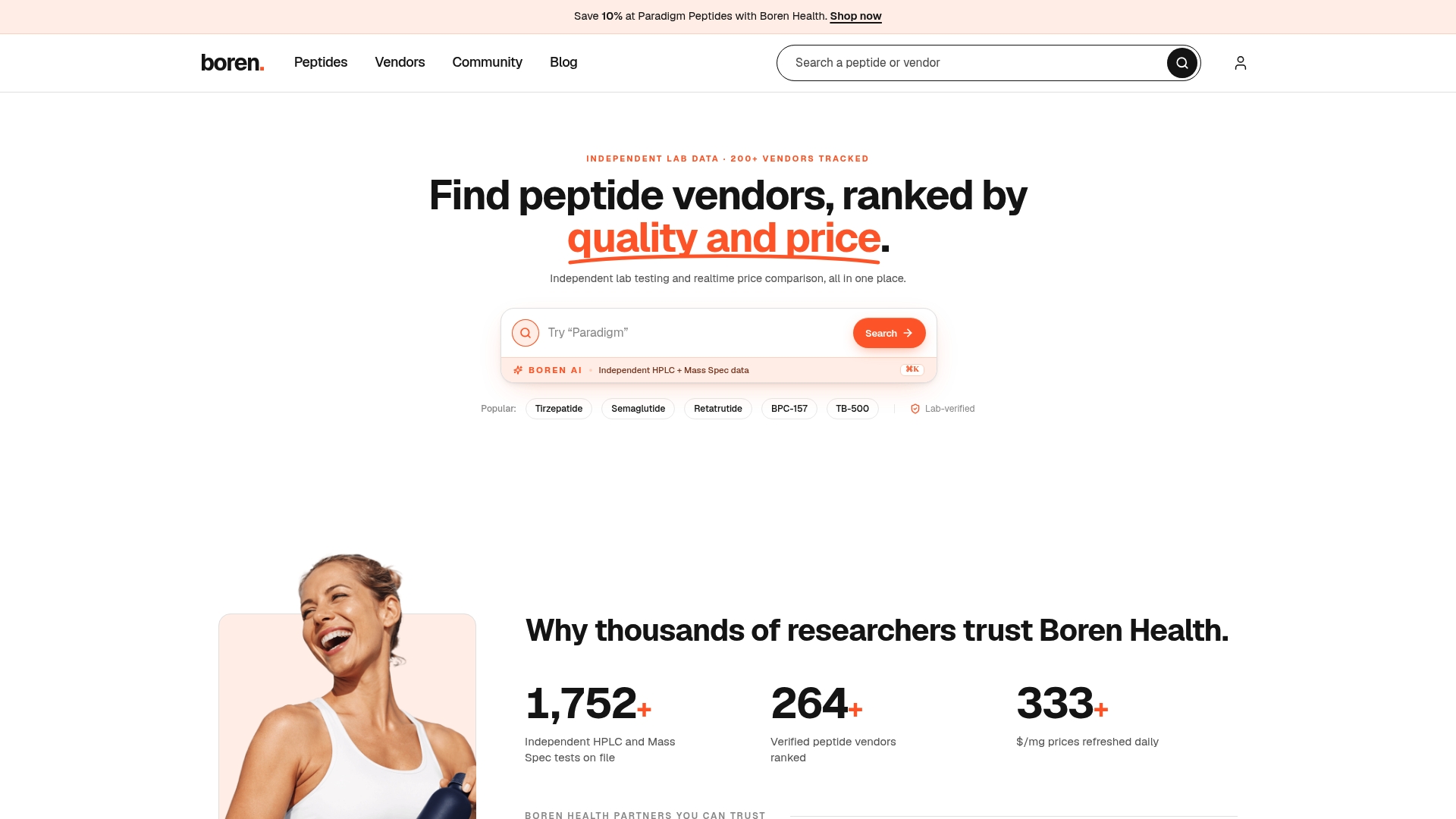
Beyond direct testing, Borenhealth’s marketplace tracks daily pricing and lab-verified purity scores across more than 200 peptide vendors, so you’re not relying on a supplier’s own certificate of analysis. If you’re sourcing peptides for research and want purity and identity data before you buy, browse lab-tested vendor comparisons or submit your own sample for independent testing to see exactly what you’re working with.
Sources
- Comparative LC-MS and HPLC analyses of selected antiepileptics and beta-blocking drugs - PubMed
- Liquid chromatography 6mass spectrometry - Wikipedia
- HPLC vs. LC-MS/MS: Cost, Sensitivity and Certified Consumable Requirements - HPLCVials
- HPLC vs LC-MS: Choosing the Right Analytical Method for Your Product | ILS Laboratories