27% Match: Researchers, Use Independent Peptide Testing to Verify COAs
Verifying a peptide independently comes down to two tests: HPLC purity analysis and LC‑MS identity confirmation. Anything short of that leaves you guessing. A credible lab backs its numbers with an accredited Certificate of Analysis, chromatograms, and mass spectra you can inspect yourself. If a supplier’s COA is the only data you have, the next move is simple: submit a sample to an independent lab or order verified results through a testing service before you use the material in any protocol.
TL;DR:
- Only tests like HPLC and LC‑MS can reliably verify peptide purity and identity, making independent testing essential before use.
- Standard testing costs range from $200 to $400 per sample, with full panels including endotoxin and metals costing more and taking longer.
- Proper sample labeling, temperature control, and chain-of-custody documentation are critical for accurate testing and regulatory compliance.
- Prioritizing labs that provide raw chromatograms and spectra ensures verifiable results, reducing the risk of incorporating contaminated or mislabeled peptides.
Table of Contents
- What Independent Lab Testing Peptides Actually Involves
- How Do You Read a Peptide Certificate of Analysis?
- How Do You Choose an Independent Peptide Testing Lab?
- What Does Peptide Testing Cost and How Long Does It Take?
- How Do You Submit a Peptide Sample for Testing?
- How Boren Health Supports Independent Verification and Vendor Transparency
- What Are the Regulatory Compliance Implications of Peptide Testing Results?
- How Should You Interpret Test Results for Risk and Decision-Making?
- The Real Gap Isn’t Access to Testing, It’s Access to Raw Data
- Order Testing or Compare Vendors Through Borenhealth
- Where to Learn More About Peptide Testing Methods
- Sources
What Independent Lab Testing Peptides Actually Involves
Independent lab testing peptides means sending a sample to a third party with no financial stake in the vendor’s sales, so the result reflects the material, not the marketing. The two core methods are High Performance Liquid Chromatography (HPLC) and Liquid Chromatography Mass Spectrometry (LC‑MS), and each answers a different question.
HPLC separates the peptide from everything else in the vial. It measures purity as a percentage and flags degradation products, truncated sequences, and residual solvents left over from synthesis. A researcher relying on a compound for dose‑response work needs to know whether that
purity claim on the label is real or aspirational.
LC‑MS confirms identity. It matches the observed molecular mass against the expected mass for the peptide’s sequence, which catches substitution errors and mislabeled vials. When sequence confirmation matters, such as verifying a novel analog or catching amino acid swaps, labs add MS/MS fragmentation on top of the base LC‑MS run.
Two additional tests apply in specific cases. Endotoxin and sterility testing become mandatory for injectable-route research or anything feeding into GLP-aligned work, since bacterial contamination doesn’t show up on a purity chromatogram. Heavy metals and elemental screening matter when the synthesis process or raw materials carry contamination risk, which is more common with lower-cost overseas synthesis runs.
- HPLC purity: catches degradation, truncated chains, solvent residue
- LC‑MS identity: confirms molecular mass matches the labeled sequence
- MS/MS: sequence-level confirmation for novel or modified peptides
- Endotoxin/sterility: required for injectable or GLP-track research
- Heavy metals panel: relevant when synthesis origin is uncertain
Independent verification research puts a number on the trust gap: across more than 1,400 samples tested by a third-party verification lab, supplier-issued COAs matched independent results exactly only 27% of the time. That means roughly three out of four supplier certificates diverge from what an outside lab finds, whether the gap is purity rounding or an outright mismatch.
Sample mass requirements vary by scope. A basic HPLC plus LC‑MS run typically needs a small fraction of a vial, while a full QC panel covering purity, identity, endotoxin, heavy metals, and sterility can require closer to 10 milligrams of material.
How Do You Read a Peptide Certificate of Analysis?
A legitimate COA is a document, not a marketing sheet, and it should read like one. The core fields to check are the sample identification number, the analytical methods used, the purity percentage, the observed molecular mass compared against theoretical mass, endotoxin results if tested, heavy metals data if tested, and a signed analyst review at the bottom.
Raw instrument data matters more than the summary numbers. A standard peptide testing panel should hand you the actual HPLC chromatogram and the LC‑MS spectra, not just a typed conclusion. Anyone can write “99% purity” on a PDF. Far fewer labs will show you the peak that produced that number.
Run through this quickly before trusting any COA:
- Is there an actual chromatogram image, or just a stated percentage?
- Are the analytical methods named specifically (column type, mobile phase, ionization mode) rather than described vaguely as “HPLC analysis performed”?
- Is there a named or credentialed analyst signature, not a generic company stamp?
- Does the sample ID on the COA match the lot you actually received?
Pro Tip: Favor labs that issue QR‑verified digital certificates tied to a secure database. Once a COA is issued this way, nobody can edit it after the fact, and you can check the certificate against the original instrument file in seconds.
How Do You Choose an Independent Peptide Testing Lab?
Start with accreditation scope, not just the accreditation itself. A lab can hold ISO 17025 certification for general chemistry work without that scope actually covering peptide assays. Ask directly whether the accreditation applies to the specific methods being run on your sample.
From there, the selection criteria split into evidence quality and operational fit:
- Confirm the lab provides raw chromatograms and spectra, not a summary-only report
- Check whether COAs are QR-verified or logged in a searchable database for later lookup
- Ask for chain-of-custody documentation if the results need to hold up for an IRB or audit trail
- Match analytical scope to your actual need: routine HPLC plus LC‑MS versus a full QC panel with endotoxin and heavy metals
- Compare turnaround times, pricing transparency, and whether a client portal exists for tracking submissions
- Ask about rush processing if a study timeline is tight
Before sending a sample, ask the lab pointed questions: What is the limit of quantification and limit of detection for this assay? What reference standards are used, and are they traceable? Can testing be run blind, without the lab knowing the supplier, to avoid bias? Some third-party verification services offer blind testing specifically for this reason, and it’s worth requesting if vendor bias is a concern. For work that goes beyond routine QC, such as higher-order structure analysis or peptide mapping, specialized characterization services exist for exactly that gap.
What Does Peptide Testing Cost and How Long Does It Take?
Budget and timeline questions come up fast once you’re comparing labs, and the ranges are wider than most first-time submitters expect.
Standard HPLC plus LC‑MS testing typically runs in the neighborhood documented by independent verification pricing data: roughly $200 to $400 per sample for a basic panel. Expanded panels that add endotoxin, heavy metals, and sterility testing cost more and take longer, since sterility testing alone often requires several days of incubation.
- Standard purity and identity panel: days to about a week, standard processing
- Full QC panel with endotoxin and metals: longer turnaround due to incubation and additional runs
- Rush processing: available at most labs for an added fee
- Batch submissions: often reduce per-sample cost if you’re testing multiple lots at once
Sample mass constraints affect cost too. A lab needing more material for a broader panel isn’t padding the invoice. It’s running more assays, each of which consumes part of your submission.
How Do You Submit a Peptide Sample for Testing?
Getting a valid result starts before the sample ever leaves your hands. Submission errors are one of the most common reasons a test comes back inconclusive or gets flagged for retesting.
- Label the vial with the peptide sequence or name, lot number, and sample weight, and attach any supplier COA you already have for comparison.
- Package the sample with temperature control appropriate to its stability profile. Some peptides degrade quickly at room temperature during transit.
- Choose a courier with reliable cold-chain handling if the peptide requires it, and avoid weekend transit windows that leave a package sitting in a warm depot.
- Request chain-of-custody documentation from the lab covering receipt, storage, and testing dates.
- Confirm in writing what raw data you’ll receive back, so there’s no surprise when the report arrives as a summary only.
Pro Tip: Chain-of-custody records aren’t paperwork theater. If a result ever needs to hold up under an IRB review or an internal audit, that documented handoff is what makes the test defensible months later.
How Boren Health Supports Independent Verification and Vendor Transparency
Vendor trustworthiness is the recurring problem in the peptide market, and Borenhealth built its platform around closing that gap. The service tracks over 200 peptide vendors and runs comparisons against HPLC and mass spectrometry results, giving researchers a single reference point instead of a scattered set of supplier claims.
The workflow is straightforward: a sample gets submitted, tested, and the resulting COA becomes accessible alongside pricing and vendor history. That doesn’t replace the lab work itself. It organizes the output so researchers aren’t hunting across a dozen vendor sites for data that may or may not be current.
Practical benefits researchers get from this setup:
- One place to compare purity results across vendors selling the same peptide
- Daily pricing updates instead of stale listings
- Lab-verified data alongside buyer feedback, rather than marketing copy alone
What Are the Regulatory Compliance Implications of Peptide Testing Results?
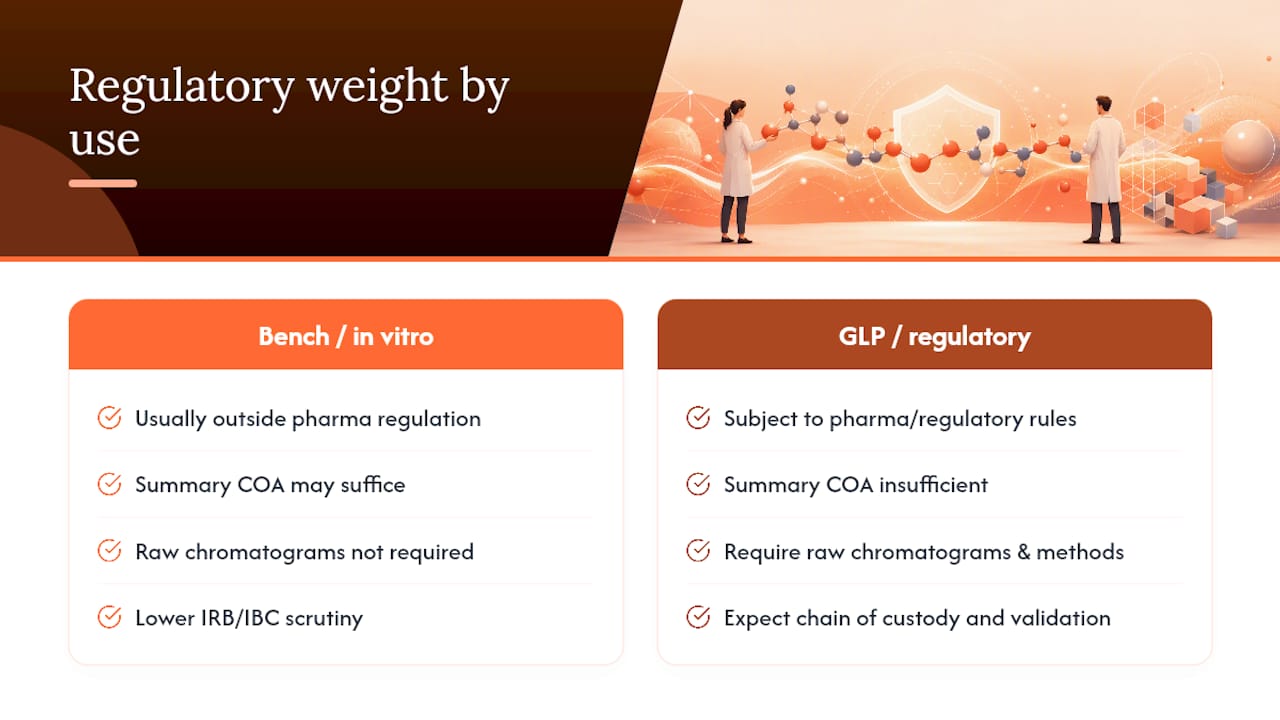
Peptide testing results carry different regulatory weight depending on how the material gets used, and researchers who blur that distinction create paperwork problems later. Material used strictly for in vitro or bench research generally falls outside pharmaceutical regulation in most jurisdictions, but that status changes fast once a peptide moves toward in vivo work, clinical application, or anything resembling a GLP‑track study.
For GLP-aligned or regulatory-facing research, documentation standards tighten considerably. A summary COA without raw chromatograms won’t satisfy an auditor, and neither will a supplier’s self-issued purity claim. Regulatory reviewers expect a documented chain of custody, method validation details, and traceable reference standards, which is exactly what an accredited independent lab is built to provide.
Institutional Review Boards and institutional biosafety committees increasingly ask for this kind of documentation before approving protocols involving research peptides, particularly ones administered to animal models. A lab report that only states “99% pure” without supporting data is a weak foundation for that kind of review.
Compliance risk also shows up at the procurement level. Sourcing from a vendor with no independent verification history creates a documentation gap that’s hard to fill retroactively if a study gets flagged for review months after the fact. Building testing into the procurement step, rather than treating it as an afterthought, is the difference between a defensible research record and a scramble to reconstruct one under scrutiny.
How Should You Interpret Test Results for Risk and Decision-Making?
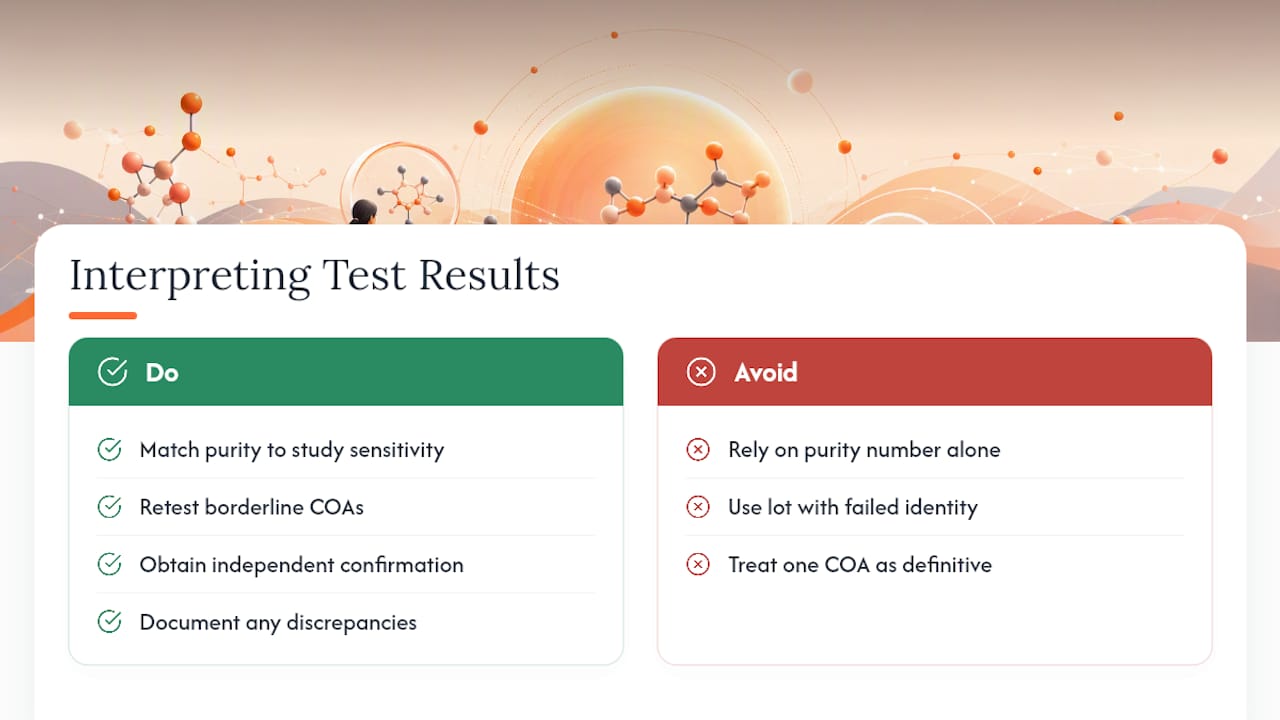
A purity number by itself doesn’t tell you whether a peptide is fit for your specific use. Interpretation depends on what the research actually requires and how much tolerance the protocol has for variance.
A 95% purity result might be entirely adequate for exploratory bench work but insufficient for a dose‑sensitive in vivo study where impurities could confound results. The gap between “acceptable” and “unacceptable” purity isn’t fixed. It shifts based on what you’re measuring and how sensitive the endpoint is to contamination.
Identity confirmation carries a different kind of risk. A mass mismatch on LC‑MS isn’t a matter of degree. Either the molecule matches the expected sequence or it doesn’t, and a failed identity check should halt use of that lot regardless of how clean the purity chromatogram looks.
When a COA shows borderline results, the reasonable move is retesting rather than assuming the worst or best case. A single data point from one lab, especially without raw data to review, is thinner evidence than researchers sometimes treat it as. Cross-referencing an independent result against a supplier’s own COA, and flagging any mismatch above a small margin, gives you a documented basis for accepting or rejecting a lot rather than a gut call. That documentation also becomes useful later if a study’s results ever get questioned.
The Real Gap Isn’t Access to Testing, It’s Access to Raw Data
Most guidance on this topic treats “get it tested” as the finish line, and that’s where the advice falls short. The harder problem is that a lot of testing that already happens produces reports nobody can actually verify. A summary percentage on a PDF is not evidence. It’s a claim, dressed up to look like evidence.
What actually matters is whether you can trace that number back to a chromatogram, a spectrum, and a named analyst who signed off on it. Researchers who treat raw data access as optional are making the same mistake as researchers who trust a supplier’s COA without question. Both are accepting a conclusion without checking the work behind it.
If there’s one thing worth prioritizing above accreditation logos and turnaround speed, it’s this: does the lab let you see the actual instrument output? Everything else, cost, speed, portal design, is secondary to that single question.
— Ross
Order Testing or Compare Vendors Through Borenhealth
An ideal peptide procurement process shouldn’t require a leap of faith on every vendor’s word. If you already have material in hand and want independent numbers before you use it, the Test My Peptide Sample page walks through ordering directly. Before submitting, have the peptide sequence or name, the sample mass, and any existing supplier COA ready so the lab can cross-reference results.
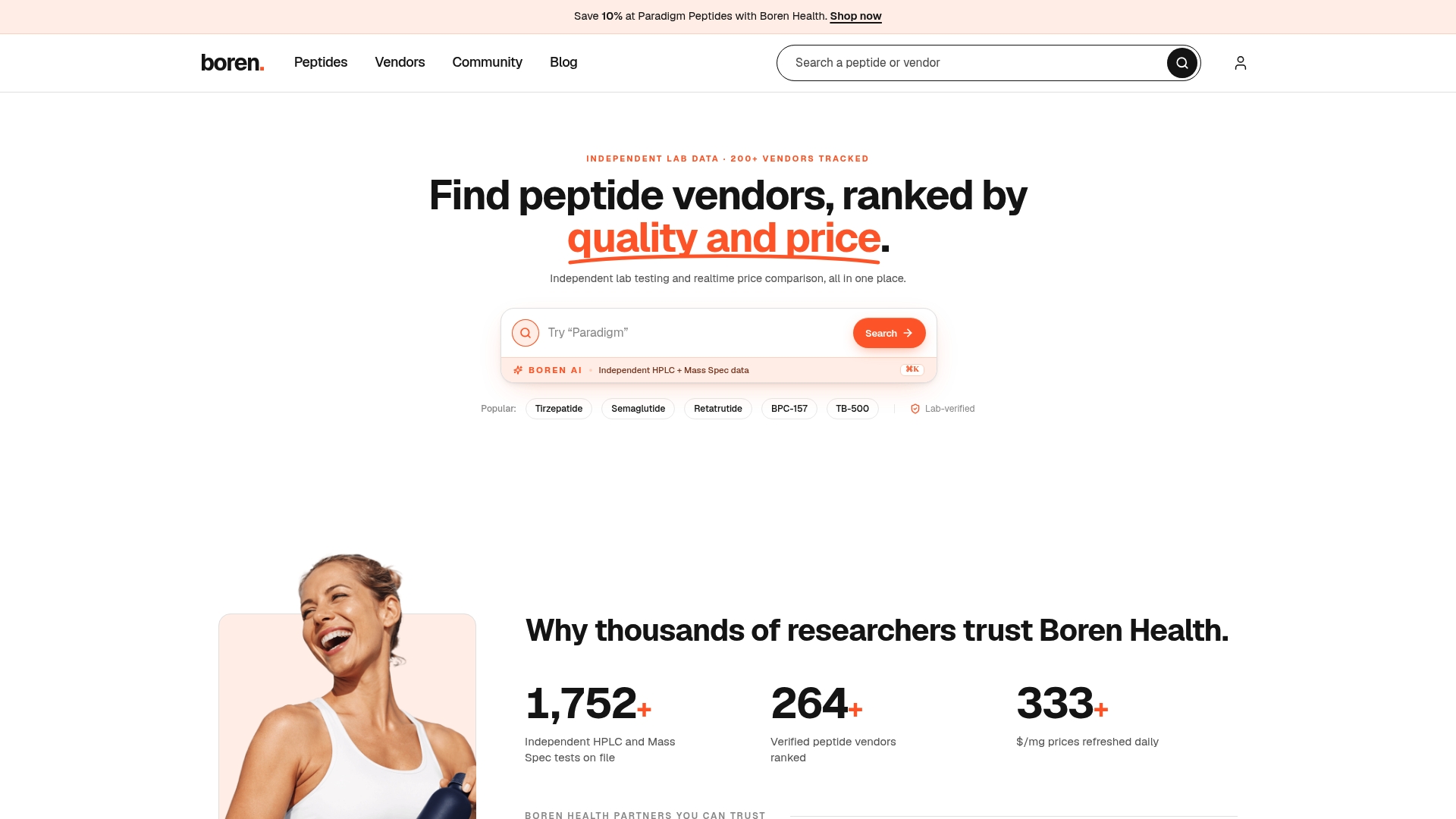
If you’re still deciding where to buy, the vendor comparison platform shows lab-verified purity data and daily pricing across more than 200 suppliers, so you’re not choosing blind. Look for a signed COA with chromatograms and spectra attached, along with a verification method to check against the raw data. Turnaround typically follows standard lab timelines, with rush options sometimes available for urgent studies.
Where to Learn More About Peptide Testing Methods
For deeper method-level detail, Prodigy Labs documents standard HPLC and LC‑MS reporting practices, ILS Laboratories outlines full QC panel scope, and BioPharmaSpec covers advanced characterization for regulatory-facing work.
Sources
- Third-party verification — ACS Lab Test
- Peptide Testing Lab | HPLC Purity & Identity COA | Prodigy Labs San Diego
- Peptide Testing Services | ILS Laboratories
- Peptide Testing & Characterization Services | BioPharmaSpec