Clinicians: Bacteriostatic vs Sterile Water, Label, Peptide Use
Bacteriostatic water contains a benzyl alcohol preservative, typically 0.9%, and is built for multiple withdrawals from the same vial. Sterile water contains no preservative at all and is meant for one use, then the vial gets discarded. The rule of thumb: reach for bacteriostatic water when you need repeated draws over days or weeks, and reach for sterile water when the drug label demands a preservative-free diluent or the patient is a neonate, where benzyl alcohol is contraindicated.
TL;DR:
- Bacteriostatic water contains a small amount of benzyl alcohol to inhibit bacterial growth, making it suitable for multiple withdrawals over weeks, unlike sterile water.
- Sterile water has no preservative, is only FDA-approved as single-dose, and must be discarded after one use to prevent contamination.
- The key difference between the two is the presence of benzyl alcohol, which makes bacteriostatic water contraindicated for neonates and unsafe for IV injections without proper isotonic adjustment.
- Proper reconstitution involves aseptic technique, and diluents should be chosen based on the drug label’s preservation and safety instructions.
- Relying on vendor and lab data, such as purity verifications, is essential to ensure the peptide’s quality and to determine the appropriate diluent.
Table of Contents
- Bacteriostatic Water vs Sterile Water: What Bacteriostatic Water Actually Is
- Bacteriostatic Water vs Sterile Water: What Sterile Water Really Means
- Side-by-Side: The Practical Differences That Matter
- How to Reconstitute Peptides Without Guessing
- Safety Rules You Cannot Skip
- Storage, Shelf Life, and Where to Actually Buy This Stuff
- Why Vendor and Lab Data Matter for Diluent Decisions
- The Regulatory Language Behind These Two Products
- Contamination and Endotoxin Risk: Where Each Product Is Vulnerable
- Beyond Peptides: Other Medications That Use These Diluents
- Author Perspective: The Mistake Almost Everyone Makes
- A Practical Next Step for Sourcing Peptides You Can Trust
- Sources
Bacteriostatic Water vs Sterile Water: What Bacteriostatic Water Actually Is
Bacteriostatic Water for Injection, USP, is sterile water with a small amount of benzyl alcohol added, usually 0.9% (9 mg/mL), though some formulations list 1.1% (11 mg/mL), according to its FDA label on DailyMed. That benzyl alcohol doesn’t sterilize the water. It suppresses bacterial growth long enough for you to draw from the same vial multiple times without the contents turning into a science experiment.
That’s the entire point of the “multiple-dose” label you’ll see on the vial. Manufacturers package it that way on purpose, and the label language reflects it.
A few things define how this product gets used in practice:
- It’s supplied in multiple-dose containers, not single-use vials.
- The preservative inhibits bacterial growth but does not replace sterile handling.
- It’s the standard diluent for peptide reconstitution when a vial needs repeated daily or weekly draws.
- It carries an explicit warning against use in neonates, which we’ll cover in more detail later.
Researchers reconstituting peptides like semaglutide or BPC-157 analogs for ongoing use typically default to bacteriostatic water for exactly this reason: one vial, many draws, over a defined window.
Bacteriostatic Water vs Sterile Water: What Sterile Water Really Means
Sterile Water for Injection, USP, is the plain version. No bacteriostat, no antimicrobial agent, no added buffer of any kind, according to its DailyMed label. It’s water, purified and sterilized, and that’s it.
Because it has nothing to slow bacterial growth once a needle punctures the seal, it comes in single-dose containers only. Draw what you need, then discard the rest. There’s no “save it for tomorrow” with sterile water, and treating it that way defeats the reason it exists.
Key facts worth locking in:
- Single-dose only; any unused portion gets discarded immediately after use.
- No preservative means no protection against contamination after the vial is opened.
- Like bacteriostatic water, it’s hypotonic as supplied and must be made approximately isotonic before intravenous use to avoid hemolysis.
- It’s the preferred, and sometimes mandatory, diluent when a drug’s instructions call for preservative-free water, including most neonatal applications.
If a compound’s manufacturer instructions explicitly say “preservative-free diluent only,” sterile water is the answer, full stop.
Side-by-Side: The Practical Differences That Matter
The distinction between these two diluents comes down to six practical factors, and they all trace back to one chemical difference: the presence or absence of benzyl alcohol.
| Factor | Bacteriostatic Water | Sterile Water |
|---|---|---|
| Preservative | Benzyl alcohol, 0.9% (9 mg/mL) or 1.1% (11 mg/mL) | None |
| Container type | Multiple-dose | Single-dose |
| Typical in-use window | The vial remains usable for several weeks once opened if stored and handled aseptically | Discard immediately after single use |
| Neonate safety | Contraindicated; labeled “not for use in neonates” | Preferred preservative-free option |
| Tonicity / IV warning | Hypotonic as supplied; must be made isotonic before IV use | Hypotonic as supplied; must be made isotonic before IV use |
| Common peptide use | Multi-draw reconstitution for ongoing dosing | Single-use reconstitution or preservative-restricted compounds |
Statistic Callout: Bacteriostatic Water for Injection typically contains benzyl alcohol at about 9 mg/mL, and is supplied in vials designed for multiple uses over a defined period if stored and handled aseptically. Sterile water carries no preservative and is intended for single use only.
One thing doesn’t change no matter which diluent you pick: the concentration math. Milligrams of peptide divided by milliliters of diluent gives you the same mg/mL whether you used bacteriostatic or sterile water. The diluent affects shelf life and draw count, not dose.
How to Reconstitute Peptides Without Guessing
Reconstitution math is simple, but the aseptic steps around it are where people get sloppy. Here’s the process from start to finish.
The concentration formula is: milligrams of peptide powder ÷ milliliters of diluent added = mg/mL. Add 2 mL of bacteriostatic water to a 5 mg vial and you get 2.5 mg/mL. Swap in sterile water instead, add the same 2 mL, and you still get 2.5 mg/mL. The diluent choice changes nothing about the number on a syringe; it changes how many times you can safely go back into that vial.
- Wash your hands and disinfect your work surface before opening anything.
- Wipe the vial’s rubber stopper with an alcohol swab and let it dry.
- Draw the diluent into a syringe, using bacteriostatic water for multi-draw plans or sterile water for single-use or preservative-restricted compounds.
- Inject the diluent slowly down the inside wall of the vial, not directly onto the powder.
- Swirl gently, never shake, until the powder fully dissolves.
- Label the vial with the date, time, and your initials so you can track the in-use window.
- Refrigerate if the peptide’s instructions call for it, and keep the vial away from light if directed.
Choose bacteriostatic water when you’re drawing from the same vial repeatedly over days or weeks. Choose sterile water when the compound’s instructions specifically call for a preservative-free diluent or you’re preparing a single dose that won’t be reused.
Pro Tip: A typical 0.5 mL injection drawn from bacteriostatic water containing benzyl alcohol delivers a small amount of preservative per draw. While generally negligible for most adults, cumulative exposure from multiple injections warrants awareness and careful tracking.
Safety Rules You Cannot Skip
Benzyl alcohol has a well-documented toxicity risk in neonates and premature infants, sometimes referred to as gasping syndrome, which is why bacteriostatic water carries an explicit label warning: “not for use in neonates,” according to the product’s NDC label listing. This isn’t a soft caution. It’s a hard contraindication, and it applies regardless of how small the dose seems.
Tonicity is the other trap people miss. Both bacteriostatic and sterile water are hypotonic straight out of the vial. Injecting either one directly into a vein without first making it approximately isotonic risks hemolysis, meaning red blood cells rupture, according to guidance from Scotland’s NHS on IV administration. A preservative doesn’t fix that. Bacteriostatic water is no safer for IV push than sterile water unless the solution has been properly adjusted first.
A short list of situations where substitution is a mistake, not a shortcut:
- Don’t use bacteriostatic water when a drug’s instructions call for preservative-free diluent, even if you’re out of sterile water.
- Don’t reuse a vial that was reconstituted with sterile water; discard leftovers immediately.
- Don’t assume a benzyl alcohol preservative makes a solution isotonic; the two properties are unrelated.
- Don’t skip the manufacturer’s label or a pharmacist consult when a compound’s compatibility is unclear.
Statistic Callout: Both diluents carry explicit warnings that they are hypotonic as supplied. Consequently, intravenous injection without appropriate adjustment poses a risk of red blood cell rupture, regardless of preservative content.
Storage, Shelf Life, and Where to Actually Buy This Stuff
Once a bacteriostatic vial is opened, manufacturer guidance commonly permits use for around 28 days if it’s stored properly and handled aseptically each time, per InjectBuddy’s reconstitution guidance, though the label on your specific product is the final word. Sterile water doesn’t get that grace period. It’s single-use; whatever’s left after your draw goes in the trash, not the fridge.
Both products are prescription-grade medical supplies, and that shapes where you find them. They’re typically procured through clinical suppliers or specialty pharmacies rather than picked up off a retail shelf, since general OTC availability is limited. Whatever vial you’re working from, label it with the date opened and your initials, use fresh alcohol swabs each time, discard on expiry without exception, and if you’re using it for research purposes, track the lot number alongside your peptide’s own lot for full traceability.
Why Vendor and Lab Data Matter for Diluent Decisions
Choosing the right diluent only works if you trust what’s actually in the peptide vial you’re reconstituting. Boren Health’s platform compares over 200 verified peptide vendors using independent HPLC and mass spectrometry testing, which matters here because a compound’s actual purity and formulation can affect whether preservative-free water is required.
A few ways that data helps when diluent choice is on the line:
- Lab-verified purity scores flag whether a peptide’s actual composition matches its labeled claims.
- Vendor comparisons surface which suppliers provide clear reconstitution and storage instructions on their certificates of analysis.
- Checking a lot-level certificate of analysis before reconstituting can reveal compatibility notes that generic guides won’t mention.
When a product’s documentation is thin or contradictory, running an independent check through a testing service closes that gap instead of guessing.
The Regulatory Language Behind These Two Products
Both bacteriostatic water and sterile water for injection are governed under United States Pharmacopeia (USP) monographs, which set the standards for purity, sterility, and labeling that manufacturers must meet before a product reaches a clinical shelf. The “USP” designation on a label isn’t decoration. It means the product has been formulated and tested against a specific compendial standard for identity, strength, and quality.
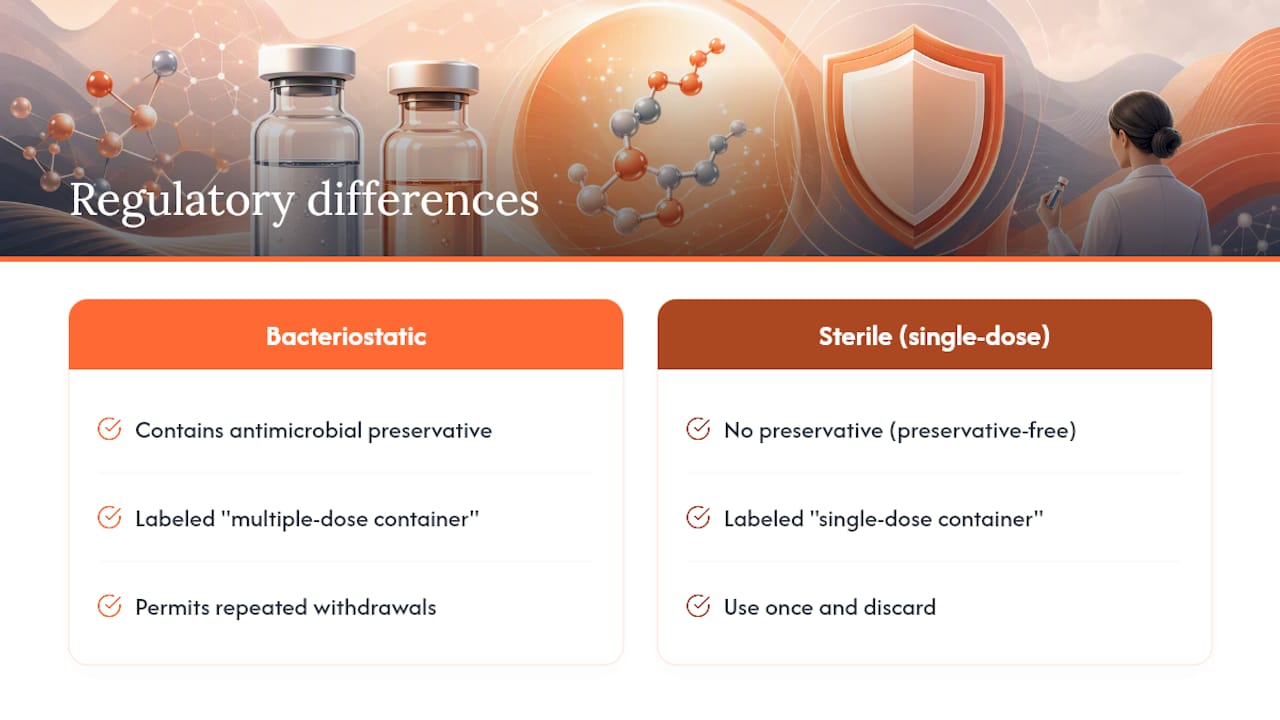
The FDA requires these standards to be reflected in the product labeling submitted to DailyMed, the government’s public repository for prescription drug information. That’s why DailyMed listings carry the authoritative wording on concentration, container type, and warnings; they’re pulling directly from FDA-approved labels, not marketing copy. When a bacteriostatic water label states 0.9% benzyl alcohol and “multiple-dose container,” that phrasing is regulatory language, not a suggestion.
The distinction between “multiple-dose” and “single-dose” containers is itself a defined regulatory category, not an informal description. A multiple-dose container is formulated and labeled specifically because it contains an antimicrobial preservative capable of inhibiting bacterial growth across repeated punctures. A single-dose container carries no such preservative and is, by definition, intended to be used once and discarded, which is exactly why sterile water only ships in that format.
Regulatory bodies outside the United States generally follow comparable pharmacopeial standards, such as the European Pharmacopoeia, though specific label wording and permitted benzyl alcohol concentrations can vary by jurisdiction. If you’re sourcing product internationally, check the label governing your specific market rather than assuming US labeling applies.
Contamination and Endotoxin Risk: Where Each Product Is Vulnerable
Sterile water carries zero built-in defense against contamination once the seal is broken. That’s precisely why it’s restricted to single use. Bacteria introduced at the moment of puncture, from a poorly disinfected stopper or reused needle, have nothing stopping them from multiplying if the vial sits around for a second draw.
Bacteriostatic water’s benzyl alcohol buys you a margin, not immunity. It inhibits bacterial growth across repeated withdrawals, which is the entire justification for the multiple-dose label, but “bacteriostatic” means it slows growth, not that it sterilizes the solution on contact. Aseptic technique, a clean stopper wipe before every single draw, remains non-negotiable regardless of which diluent is in the vial.
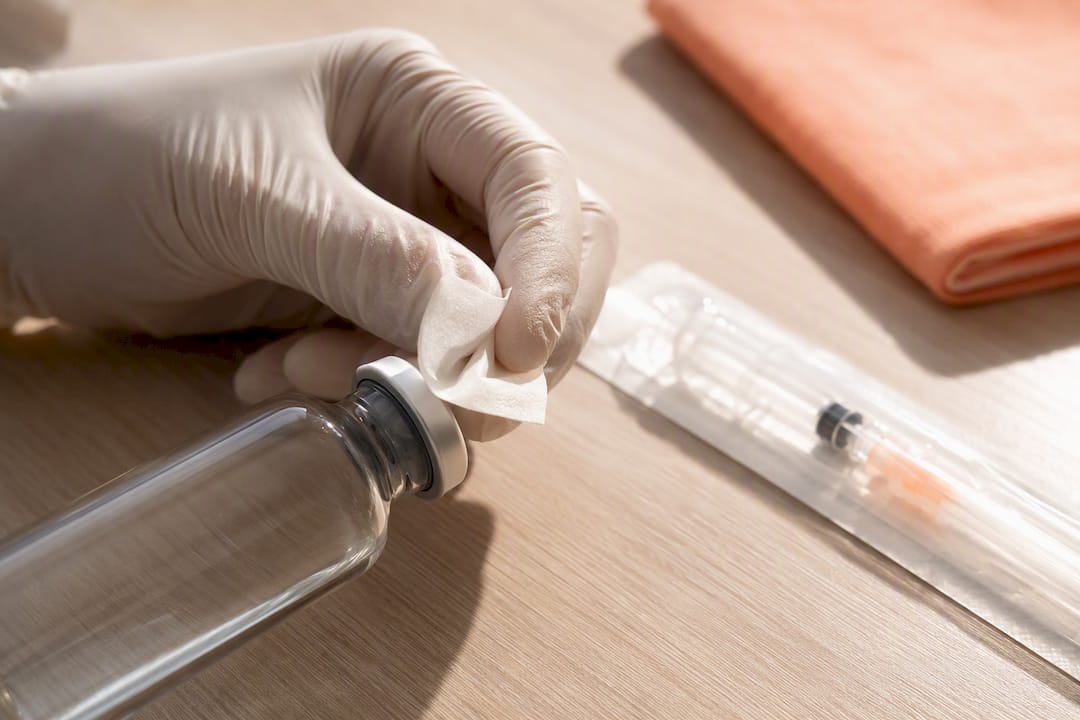
Endotoxins are a separate concern from live bacterial contamination, and neither preservative addresses them. Endotoxins are remnants of bacterial cell walls that can trigger a pyrogenic (fever-inducing) reaction even after the bacteria themselves are dead. USP-grade water for injection is manufactured and tested to strict endotoxin limits at the point of production, but that control applies to the sealed, unopened vial. Once you puncture the stopper, you’re managing risk with technique, not chemistry. A dirty needle or an unswabbed rubber top can introduce endotoxin-bearing contaminants regardless of whether the water inside is bacteriostatic or sterile.
The practical takeaway: benzyl alcohol reduces the odds of live bacterial growth across multiple draws, but it does nothing for endotoxin risk and nothing that excuses skipping a fresh alcohol swab before every single withdrawal.
Beyond Peptides: Other Medications That Use These Diluents
Peptide reconstitution gets most of the attention online, but both diluents have a long history in mainstream clinical use well outside that context. Bacteriostatic water is a common diluent for reconstituting certain injectable antibiotics and hormone preparations that ship as lyophilized powder and require repeated dosing from the same vial over a treatment course.
Sterile water shows up constantly in hospital settings for single-dose reconstitution of injectable medications where a preservative would interfere with the drug itself, or where the patient population, neonates and infants especially, rules out benzyl alcohol entirely. It’s also used for irrigation purposes in some surgical and wound care contexts, again because a preservative-free solution is required against tissue exposure.
Compatibility isn’t universal, though. Some drug formulations specify only sterile water because the manufacturer has tested stability data solely against that diluent. Introducing benzyl alcohol into a formulation never tested with it, even though it “should” work chemically, is a real risk profile, not a technicality. This is where manufacturer package inserts and pharmacist consultation matter more than general reconstitution guides. If a medication’s insert doesn’t explicitly list bacteriostatic water as an acceptable diluent, don’t assume it’s interchangeable with sterile water just because both are, chemically, mostly H2O.
Author Perspective: The Mistake Almost Everyone Makes
The most common error I see isn’t picking the wrong diluent. It’s assuming a preservative solves problems it was never designed to solve. Benzyl alcohol stops bacterial growth; it does nothing for tonicity, and it’s not a substitute for clean hands and a fresh alcohol swab every single time.
Before you reconstitute anything, run this checklist: read the actual drug label, confirm whether a preservative is permitted or restricted, label every opened vial with date and initials, and pull the certificate of analysis if one’s available. That last step catches more mistakes than people expect.
— Ross
A Practical Next Step for Sourcing Peptides You Can Trust
Getting the diluent right only matters if the peptide itself is what the label claims. Boren Health exists for exactly that gap: independent HPLC and mass spectrometry testing across more than 200 verified vendors, with purity scores and pricing updated daily, so you’re not relying on a seller’s own claims about what’s in the vial.
If a vendor’s documentation is vague about reconstitution or storage requirements, that’s usually a sign worth investigating further before you draw a single milliliter. Boren Health’s vendor comparison tool lets you check purity data and buyer feedback before you commit to a supplier, and if you already have a sample and want an independent read on what’s actually in it, Test My Peptide Sample runs third-party lab verification instead of taking a label at face value. Start with the vendor comparison if you’re still sourcing, or send in a sample if you want to confirm what’s already in your fridge.
Sources
- BACTERIOSTATIC WATER for Injection, USP — DailyMed
- Bacteriostatic Water for Injection, USP — label (NDC list)
- Administration of medicines by intravenous route — Right Decisions (Scotland NHS)